
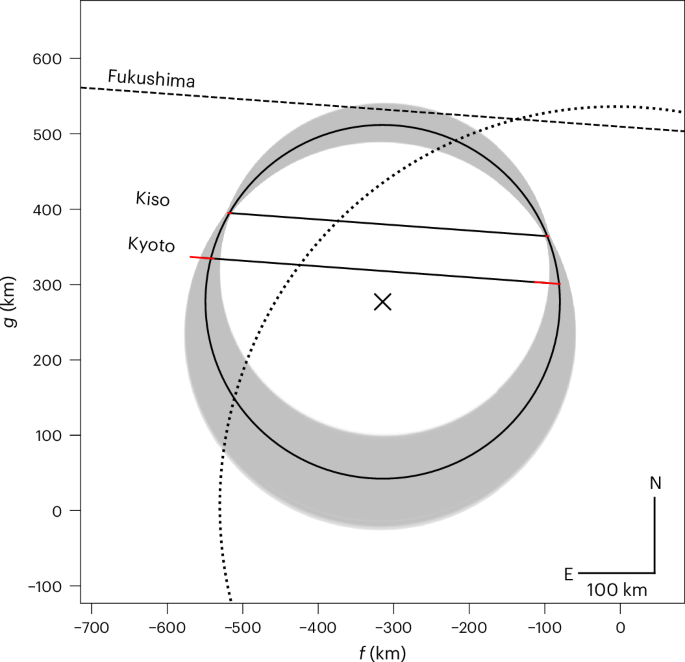
Mommert, M. et al. TNOs are cool: a survey of the trans-Neptunian region. V. Physical characterization of 18 plutinos using Herschel-PACS observations. Astron. Astrophys. 541, A93 (2012).
Gaia Collaboration (Vallenari, A. et al.) Gaia Data Release 3 Summary of the content and survey properties. Astron. Astrophys. 674, A1 (2023).
Arimatsu, K. et al. New constraint on the atmosphere of (50000) Quaoar from a stellar occultation. Astron. J. 158, 236 (2019).
Santos-Sanz, P. et al. Physical properties of the trans-Neptunian object (38628) Huya from a multi-chord stellar occultation. Astron. Astrophys. 664, A130 (2022).
Yuan, Y. et al. Reconciling results of 2019 and 2020 stellar occultations on Pluto’s atmosphere. Astron. Astrophys. 689, A9 (2023).
Arimatsu, K. et al. Detection of an extremely large impact flash on Jupiter by high-cadence multiwavelength observations. Astrophys. J. Lett. 933, L5 (2022).
Sako, S. et al. in Ground-Based and Airborne Instrumentation for Astronomy VII (eds Takami, H. et al.) Vol. 10702, 140–156 (SPIE, 2018).
Braga-Ribas, F. et al. A ring system detected around the Centaur (10199) Chariklo. Nature 508, 72–75 (2014).
Ortiz, J. L. et al. The size, shape, density and ring of the dwarf planet Haumea from a stellar occultation. Nature 550, 219–223 (2017).
Proudfoot, B. et al. Constraints on Quaoar’s rings and atmosphere from JWST/NIRCam observations of a stellar occultation. Planet. Sci. J. 6, 146 (2025).
Pereira, C. L. et al. The rings of (2060) Chiron: evidence of an evolving system. Astrophys. J. Lett. 992, L19 (2025).
Sicardy, B., El Moutamid, M., Renner, S., Sfair, R. & Souami, D. Origins of rings in the Solar System. Philos. Trans. R. Soc. Lond. Ser. A 383, 20240193 (2025).
Giuliatti Winter, S. M. et al. The stability around Chariklo and the confinement of its rings. Astron. Astrophys. 679, A62 (2023).
Yelle, R. V. & Lunine, J. I. Evidence for a molecule heavier than methane in the atmosphere of Pluto. Nature 339, 288–290 (1989).
Yelle, R. V. & Elliot, J. L. in Pluto and Charon (eds Stern, S. A. & Tholen, D. J.) 347–390 (Univ. Arizona, 1997).
Sicardy, B. et al. Large changes in Pluto’s atmosphere as revealed by recent stellar occultations. Nature 424, 168–170 (2003).
Meza, E. et al. Lower atmosphere and pressure evolution on Pluto from ground-based stellar occultations, 1988–2016. Astron. Astrophys. 625, A42 (2019).
Sicardy, B. et al. A Pluto-like radius and a high albedo for the dwarf planet Eris from an occultation. Nature 478, 493–496 (2011).
Ortiz, J. L. et al. Albedo and atmospheric constraints of dwarf planet Makemake from a stellar occultation. Nature 491, 566–569 (2012).
Levine, S. E. et al. Occultation of a large star by the large plutino (28978) Ixion on 2020 October 13 UTC. Astron. J. 161, 210 (2021).
Benedetti-Rossi, G. et al. The trans-Neptunian object (84922) 2003 VS2 through stellar occultations. Astron. J. 158, 159 (2019).
Ortiz, J. L. et al. The large trans-Neptunian object 2002 TC302 from combined stellar occultation, photometry, and astrometry data. Astron. Astrophys. 639, A134 (2020).
Schaller, E. L. & Brown, M. E. Volatile loss and retention on Kuiper belt objects. Astrophys. J. Lett. 659, L61–L64 (2007).
Stern, S. A. & Trafton, L. M. in The Solar System Beyond Neptune (eds Barucci, M. A. et al.) 365–380 (Univ. Arizona Press, 2008).
Young, L. A., Braga-Ribas, F. & Johnson, R. E. in The Trans-Neptunian Solar System (eds. Prialnik, D. et al.) 127–151 (Elsevier, 2020).
Hubbard, W. B., Hunten, D. M., Dieters, S. W. B., Hill, K. M. & Watson, R. D. Occultation evidence for an atmosphere on Pluto. Nature 336, 453–454 (1988).
Elliot, J. L. et al. Pluto’s atmosphere. Icarus 77, 148–170 (1989).
Lellouch, E., de Bergh, C., Sicardy, B., Käufl, H. U. & Smette, A. High resolution spectroscopy of Pluto’s atmosphere: detection of the 2.3 μm CH4 bands and evidence for carbon monoxide. Astron. Astrophys. 530, L4 (2011).
Agnor, C. B. & Hamilton, D. P. Neptune’s capture of its moon Triton in a binary–planet gravitational encounter. Nature 441, 192–194 (2006).
Broadfoot, A. L. et al. Ultraviolet spectrometer observations of Neptune and Triton. Science 246, 1459–1466 (1989).
Protopapa, S. et al. JWST detection of hydrocarbon ices and methane gas on Makemake. Astrophys. J. Lett. 991, L34 (2025).
Volkov, A. N. et al. Kinetic simulations of thermal escape from a single component atmosphere. Phys. Fluids 23, 066601 (2011).
De Prá, M. N. et al. Widespread CO2 and CO ices in the trans-Neptunian population revealed by JWST/DiSCo-TNOs. Nat. Astron. 9, 252–261 (2025).
Emery, J. P. et al. A tale of 3 dwarf planets: Ices and organics on Sedna, Gonggong, and Quaoar from JWST spectroscopy. Icarus 414, 116017 (2024).
Grundy, W. M. et al. Measurement of D/H and C13/C12 ratios in methane ice on Eris and Makemake: evidence for internal activity. Icarus 411, 115923 (2024).
Glein, C. R. et al. Moderate D/H ratios in methane ice on Eris and Makemake as evidence of hydrothermal or metamorphic processes in their interiors: geochemical analysis. Icarus 412, 115999 (2024).
Desch, S. J., Cook, J. C., Doggett, T. C. & Porter, S. B. Thermal evolution of Kuiper belt objects, with implications for cryovolcanism. Icarus 202, 694–714 (2009).
McKinnon, W. B., Prialnik, D., Stern, S. A. & Coradini, A. in The Solar System Beyond Neptune (eds Barucci, M. A. et al.) 213–241 (Univ. Arizona Press, 2008).
Stern, S. A. et al. Transient atmospheres on Charon and water–ice covered KBOs resulting from comet impacts. Icarus 246, 298–302 (2015).
Greenstreet, S., Gladman, B. & McKinnon, W. B. Impact and cratering rates onto Pluto. Icarus 258, 267–288 (2015).
Morbidelli, A., Nesvorný, D., Bottke, W. F. & Marchi, S. A re-assessment of the Kuiper belt size distribution for sub-kilometer objects, revealing collisional equilibrium at small sizes. Icarus 356, 114256 (2021).
Schlichting, H. E. et al. Measuring the abundance of sub-kilometer-sized Kuiper belt objects using stellar occultations. Astrophys. J. 761, 150 (2012).
Arimatsu, K. et al. A kilometre-sized Kuiper belt object discovered by stellar occultation using amateur telescopes. Nat. Astron. 3, 301–306 (2019).
Sicardy, B., Braga-Ribas, F., Buie, M. W., Ortiz, J. L. & Roques, F. Stellar occultations by trans-Neptunian objects. Astron. Astrophys. Rev. 32, 6 (2024).
Lellouch, E. et al. Pluto’s atmosphere gas and haze composition from JWST/MIRI spectroscopy. Astron. Astrophys. 696, A147 (2025).
Gomes-Júnior, A. R. et al. SORA: Stellar occultation reduction and analysis. Mon. Not. R. Astron. Soc. 511, 1167–1181 (2022).
Lucky Star project. Occultation by 2002XV93 (2024-01-10) (LESIA, Observatoire de Paris-PSL, 2023); https://lesia.obspm.fr/lucky-star/occ.php?p=126908
Arimatsu, K. et al. Organized Autotelescopes for Serendipitous Event Survey (OASES): design and performance. Publ. Astron. Soc. Jpn 69, 68A (2017).
Arimatsu, K. et al. Diffraction modelling of a 2023 March 5 stellar occultation by subkilometer-sized asteroid (98943) 2001 CC21. Publ. Astron. Soc. Jpn 76, 940–949 (2024).
Harris, A. W. A thermal model for near-Earth asteroids. Icarus 131, 291–301 (1998).
Sicardy, B. et al. The structure of Titan’s stratosphere from the 28 Sgr occultation. Icarus 142, 357–390 (1999).
Rommel, F. L. et al. Stellar occultation observations of (38628) Huya and its satellite: a detailed look into the system. Planet. Sci. J. 6, 48 (2025).
Arimatsu K. et al. Raw movie data, reduced light curves, and model profiles for the 2024-01-10 occultation by (612533) 2002 XV93. Zenodo https://doi.org/10.5281/zenodo.18976431 (2026).