
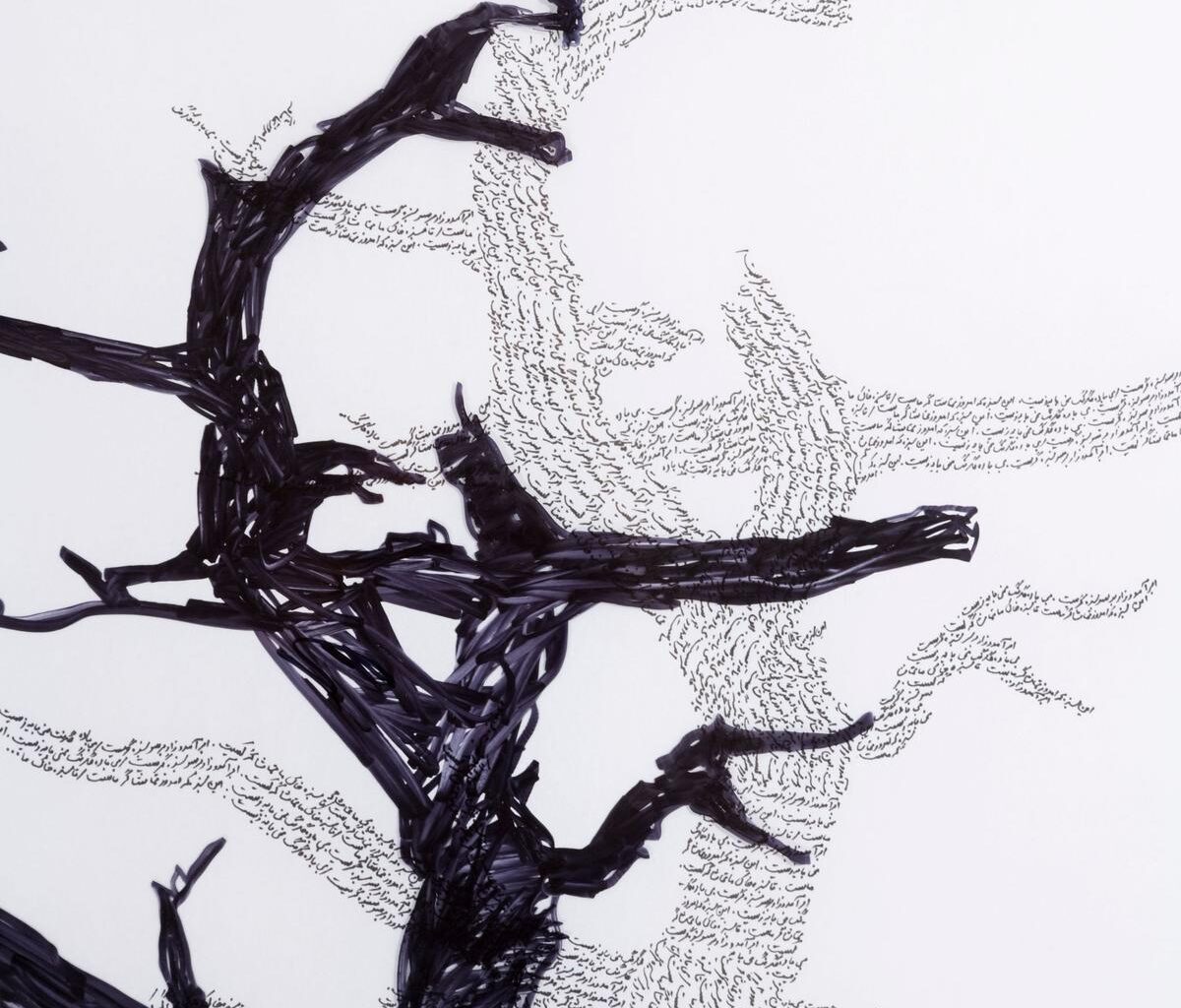
Reflecting on the failures of multiple languages amid regimes of repression and war. Did you know LARB is a reader-supported nonprofit?
LARB publishes daily without a paywall as part of our mission to make rigorous, incisive, and engaging writing on every aspect of literature, culture, and the arts freely accessible to the public. Help us continue this work with your tax-deductible donation today!
AFTER THE MASSACRE of Iranians by the Islamic Republic regime in January, I could not speak English for several weeks. Two months later, when the United States and Israel began bombing Iran, I became alienated from my mother tongue, Persian. This essay is, thus, an essay of contradictions: I am using language to write about how I am alienated from my languages. But what other tool do I have?
If we take for granted that people are made subjects through language, that language both reflects the world we live in and shapes that world, these fissures in my languages make sense. They are exactly what should be happening. Today, we Iranians are cornered, on the one hand, by the violence of the Iranian regime against the right to life and dignity, and, on the other, by the US-Israeli invasion that is demolishing the infrastructures of daily life—energy facilities, schools and universities, bridges, and more. The world that we have known is crumbling, and we do not yet have language capable of capturing and containing the horrifying truths of AI-driven wars and malicious governments. This is our moment of collapse, both of language and in language. What can we do now but mourn our losses? Hoping we can find our way back into a world where the capacity of language is restored—where it can bring life and liberation.
¤
When the news of the January massacre reached me, I was in Marseille, France, where I had just arrived for a one-month visiting position at a university. I suddenly found it difficult to position myself in English, my second language. As a translator between English and Persian and a writer who primarily writes and publishes in English, this was terrifying. In my books, I use English to examine the horrors inflicted upon Iranians by the regime as well as the historical and political contexts beyond Iran within which these horrors have been embedded. I wrote one of my books from the perspective of the victims of violence and the other through the lens of the perpetrators. Persian was, of course, the immediate language of the place and events I was looking into, and English offered a degree of distance, which helped me balance the intellectual and the emotional, the personal and the public, the local and the global. The distance also allowed for some room to reflect on history and the relationship between evil and art, theory and practice. It helped me locate bodies—both living and dead—at the center of it all.
When the estimates of 12,000 killed started to circulate online (though exact numbers are still under examination by human rights organizations), I first found myself unable to speak English. Instead, I found solace online, speaking with Iranian friends in diaspora (none in Iran because of the internet blackout), trying to make sense of what was happening.
In the aftermath of the massacre, English felt like a burden. I did not feel like translating the news, the rumors, the speculations for English readers—neither friends nor strangers. I did not feel like explaining. I did not feel like sharing. The language just couldn’t convey the suffering, the fear, the uncertainty, the grief, the rage, the devastation.
Even now, these words seem trite—not able to meet the moment and not commensurate to the disaster, even though I was experiencing it from a distance in France. At the time, my location exposed me to more documentation than people actually in Iran, due to the internet blackout there. But even if translation were possible, what would be its impact? Could anything stop the killing? Bring back the lives lost?
A few days later, at a public reading in a Marseille bookstore, I asked the audience to read the monologue by the protagonist of my second book—a female torturer. She was fictional but she was also real, based on research I had done into the global history of torture. As the audience read, I interrupted them by counting corpses: “One, two, three, four …” I could hardly breathe. I remember I did not want the audience to keep reading. I remember I counted and counted, stumbling over the numbers, my voice trembling. By the time the reading was over, I had counted only as high as a few hundred. Thousands of others remained uncounted. And after all, these were merely numbers: no acknowledgment of their names, let alone their lives.
Afterward, I suggested to my friends that we eat at an Iranian restaurant. During the dinner, a young woman who worked there sat with the owner, an older Iranian man. I could hear them talking about the massacre. Seeing my tears, the young woman walked over to me. She, a university student, and I, a visitor in town—two strangers—held each other and cried.
But there were already rifts forming. The next weekend, a gathering for Iran convened at the Port of Marseille. It was a small crowd, but a divide was present among us: those who believed in a multirepresentational people’s fight for democracy and freedom, and those who sought leadership under the son of the shah.
At the port that day, there was also a gathering for Palestine. That group was more organized, much bigger, and much louder. When they reached us, a few walked over in curiosity or solidarity, but most stayed away. Rather than unity, it felt like a clash.
I spent much of the next several weeks in a silence so deep and troubled that it could barely be contained in any of the languages at my disposal. When the internet became (somewhat) available in Iran, I met online with my Iranians Writing in English students, now really a group of friends (some based in Iran, some elsewhere). Between the five of us, the majority did not feel like they could, or would even want to, write in English. For me, English and French felt like they did not belong to my world or my body, like they could not give the tools I needed to represent the reality of the violence.
What brought me partly back into English—I say “partly” because the distance in the spoken language still feels huge—was translation. I encountered a personal essay in Persian in an online journal, a diary recounting ordinary life on the ground during the massacre, and I wanted to make sure that story existed in English, for the sake of documentation, for history. Translating the piece felt like the writer was taking me by the hand, guiding me around Tehran and, somehow, back to English.
¤
I first saw the news of the US-Israeli attack on Iran on my phone in Paris. My body froze. There was a moment of relief and joy, after the initial disbelief that the supreme leader was killed, but those feelings dissipated quickly. The images of the bombings in Iran recalled the horrors of Gaza, Iraq, and Afghanistan. In the face of the destruction, I once again tumbled into a quiet shock, lacking words, struggling to communicate.
English is now the language of the aggressors, as well as the false messages of liberation they leave for Iranians. It is the language of the man who said he might bomb the island of Kharg, one of the most important oil resources of the country, “just for fun.” It is the language other Western governments use to demand Iran stop retaliating, governments that have otherwise remained generally silent about the war on Iran, the genocide in Palestine, and the invasion of Lebanon. It is the language of many self-appointed “human rights advocates” peddling empty gestures of empathy, care, and solidarity.
And yet, Persian, too, has begun to feel unsafe. It is the language used to promote this war over loudspeakers and in the news media throughout a severely polarized diaspora. The language in which some in Iran speak of the war as salvation, arguing that the regime forces are worse. The language in which the son of the shah invites the Iranian public to protest, calling their dead “war casualties,” only to remain silent now about the civilian casualties. It is the language in which the regime threatens the Iranian people—the language in which I have been attacked, even by friends and family, for standing firmly against war.
I, once again, find grounding only through collaboration. A few days into the war, a tech-savvy friend in Tehran got through to me and suggested that every day we each write a few paragraphs to document our days and send them to each other. I have also begun translating narratives of the war. Texts by Iranian civilians navigating everyday life amid the uncertainty of each moment, as attacks spread across Tehran and through Iran, with targets including electricity and water facilities as well as universities. I am not interested in grand narratives or analytical texts, but in witness accounts that allow me to get close to realities on the ground. This working on language with others is the only thing keeping me from losing my mind.
¤
Featured image: Sara Dolatabadi, from the series Reflection. Courtesy of Sara Dolatabadi. Image has been cropped.
LARB Contributor
poupeh missaghi’s books include Sound Museum (2024) and trans(re)lating house one (2020), both with Coffee House Press, and her translations include Boys of Love by Ghazi Rabihavi (University of Wisconsin Press, 2024), In the Streets of Tehran by Nila (Ithaka Press, 2023), and I’ll Be Strong for You by Nasim Marashi (Astra House, 2021). She is currently an assistant professor of English and literary arts at the University of Denver, and a faculty mentor at the Low Residency MFA in Creative Writing at the Pacific Northwest College of Art, Portland, Oregon.
Share
Copy link to articleLARB Staff Recommendations
The uprising in Iran isn’t only against armed oppression; it’s also over narrative.
With the American-Israeli assault on Iran, the die is cast.