
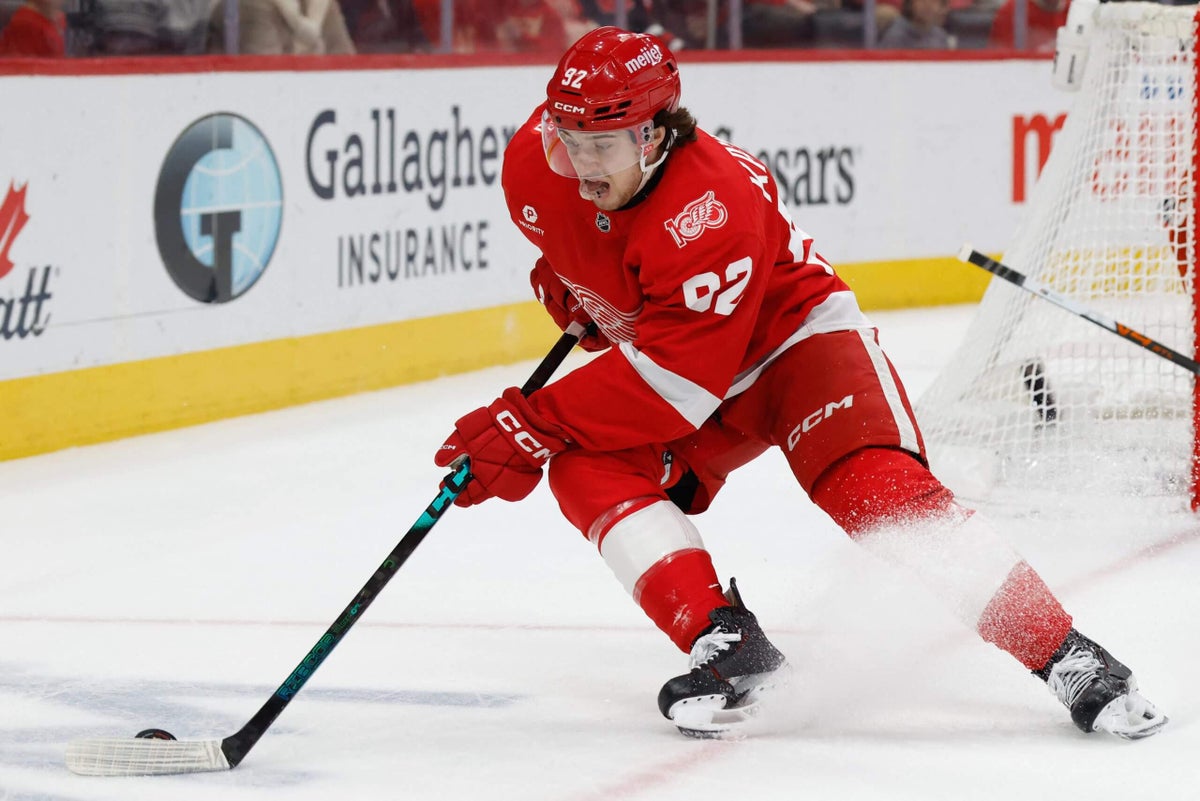
Of all the roster questions the Detroit Red Wings have entering the 2026 offseason, one of the most fascinating is the one they’ve been working to answer for (at least) half a decade: What’s the plan, both now and going forward, at second-line center?
A year ago, it looked like the question might finally have an answer, with a breakout second half by rookie Marco Kasper that made him an apparent solution. But after a sophomore slump saw Kasper’s role change, time after time, throughout the season, that position is now back in the spotlight as the Red Wings look to snap the NHL’s longest playoff drought.
In reality, Detroit needs more from all of its centers: at the No. 1 spot, where Dylan Larkin’s five-on-five production dipped this season, and in the bottom six as well, with Kasper, J.T. Compher and Michael Rasmussen all not scoring as much as hoped in 2025-26. But the No. 2 spot — which for most of the season belonged to Andrew Copp — has been the most common focus in public discussion.
Copp didn’t spend the whole season on the second line, but when he got there, he fit quite well with Alex DeBrincat and Patrick Kane on what became Detroit’s most consistent line. General manager Steve Yzerman spoke highly of his performance after the season.
“I think he adjusted very well and did a good job there,” Yzerman said. “On the defensive end of things, pretty darn good. Assist totals were up. A lot of chances didn’t go in the net, but apart from that, I think he had a very good season.”
To Yzerman’s point about chances not going in the net, Copp’s 7.8 percent shooting percentage was the second lowest of his career, and well below his 10.8 percent career average. So he probably deserved a few more goals. And even then, Copp finished with a respectable 43 points, a career-high 34 assists and solid-as-ever defense.
But on a team that missed the playoffs for a 10th straight season, everything is up for examination. And one way to begin that examination is to see what the No. 2 centers look like on the eight teams still playing today, with the second round of the Stanley Cup playoffs now underway.
2Cs for remaining playoff teams
PlayerTeamAge5v5 Points / 605v5 On-ice GF/605v5 On-ice xGF%
Anaheim
33
1.76
2.56
55.30%
Buffalo
26
2.01
3.65
51.25%
Carolina
22
1.71
2.98
58.62%
Colorado
34
2.1
3.3
59.53%
Montreal
22
1.99
3.29
43.08%
Minnesota
31
1.74
2.43
53.49%
Philadelphia
29
1.81
2.99
48.94%
Vegas
32
1.29
2.32
54.99%
Note: Ages are for 2025-26 season
The first thing that jumps out: This list of names doesn’t necessarily look too imposing on paper.
That’s partly because some of the best second-line centers in the world saw their teams eliminated in Round 1 — or missed the playoffs altogether. The Florida Panthers, a gold standard of NHL center depth with Aleksander Barkov, Sam Bennett and Anton Lundell, fell into the latter camp, partly because Barkov missed the season due to injury.
Meanwhile, the Edmonton Oilers went out in Round 1 — as did Dallas, Tampa Bay, Ottawa, Utah and Los Angeles — taking names such as Leon Draisaitl, Roope Hintz, Anthony Cirelli, Dylan Cozens, Logan Cooley and Quinton Byfield out of the picture as well.
So perhaps this year’s group is a bit of an anomaly. And yet they’re the second-line centers for the eight teams good enough to still be playing, meaning they outlasted the teams with those loftier names in the 2C hole.
Or, in some cases, knocked them out directly. That was true of Montreal against Tampa Bay, despite it being tough to pin down exactly who the Canadiens’ 2C really is. I listed Oliver Kapanen for the Canadiens here because he held down the role for most of the season, but in the playoffs, it has more often been Alex Newhook or Kirby Dach, who played only 37 games this regular season. In those games, Dach certainly had a better expected goals share (49.65 percent) than Kapanen, but his on-ice goals per 60 (3) was slightly lower than Kapanen’s at five-on-five, as were his five-on-five points per 60 (1.77). Meanwhile, Newhook had a similarly low xG share to Kapanen, but very strong five-on-five production (2.43 points per 60) and on-ice goals numbers (3.54).
Vegas was similarly tricky, as Tomas Hertl is playing as the Golden Knights’ 3C in the playoffs right now. Mitch Marner is playing out of position as the 2C, with Brett Howden next to him and also taking plenty of face-offs. I considered listing either Marner or Howden here instead, but Marner’s track record of actually playing down the middle is minimal, and Hertl still played more than two full minutes per game more than Howden this regular season.
With all of that said, there are two key takeaways about what the No. 2 centers on round-winning teams do in the regular season.
First, generating offense is a big part of it. All eight saw their teams score at least 2.3 goals per 60 minutes with them on the ice at five-on-five. For five of them, that number was at least 2.9. And while the team scoring goals is more important than the individual center picking up a point on the play, those individual contributions were still there: all but one of these second-line centers had at least 1.7 five-on-five points per 60 this regular season. That’s more than any Detroit center had this season.
Just as importantly, in nearly every case, the No. 2 centers helped tilt the ice dramatically in their team’s favor. Six of the eight earned above 51 percent of expected goals at five-on-five in the regular season, and five of them were above 53 percent. While plenty of that comes from being able to drive offensive chances, it also requires playing stout enough defense to not give those chances right back.
So if that’s the bar, how do the Red Wings’ current options measure up going into next season?
Internal 2C candidates
PlayerAge5v5 Points / 605v5 On-ice GF/605v5 On-ice xGF%
32
1.52
2.5
51.58%
22
0.93
1.64
51.71%
31
1.49
2.33
46.49%
21
1.13
2.13
49.51%
N/A
1.6
2.11
51.75%
Note: Ages are as of Nov. 1, 2026
At first glance, Detroit’s other internal options would all be on the lower end of the remaining playoff centers. And that’s probably the best way to view this.
But what’s notable — and not captured by this chart — is how Copp’s stats change when isolating the minutes he actually played on the second line with DeBrincat and Kane. His expected goals share goes up to 54.1 percent, and his on-ice five-on-five goals per 60 goes up to 3.68. Suddenly, that is right in line with the 2Cs still playing today.
That’s the case for running back that trio for another year (assuming Detroit is able to keep Kane) and focusing the major offseason efforts toward getting Larkin more firepower at top-line left wing and remaking the bottom six.
But with Copp soon to be 32 and entering the final year of his deal, it’s also not a long-term solution. That brings the focus back toward Kasper, Nate Danielson and Emmitt Finnie, the three young centers Detroit drafted in 2022 (Kasper) and 2023 (Danielson and Finnie), all of whom have now made their NHL debuts and figure into the franchise’s future.
Kasper has played the most of the three thus far, and the only one to have actually been a second-line center for any prolonged time. And while his sophomore slump was a major focus throughout the 2025-26 season, recent news that he may have been playing through a knee injury for parts of the season does color the narrative.
He will reportedly miss the World Championship for Austria, and is quoted in European outlet Hockey-News.info as saying he had been on crutches and in a knee brace. The report said Kasper had been struggling with the knee before an MRI finally revealed the damage. That adds context to his productivity dip this season, as well as uncharacteristically low shooting percentages both individually (6.9 percent) and with him on the ice (6.8 percent), both of which are likely to rebound to some extent next season.
Kasper’s 2024-25 stats were much closer to the viable range for a playoff 2C, so even just getting back to where he was as a rookie would help his cause and the Red Wings. Of the remaining playoff centers, he’d be most similar to Hartman, a gritty pivot who can score around the net and is effective defensively, but probably needs a skilled play-driving linemate to really amass strong point totals. I think his ceiling is higher than Hartman’s, but of the names on that list, he’s likely the closest.
On that note, though, both Yzerman and head coach Todd McLellan noted the need to find Kasper a more consistent spot in the lineup next year. He was all over the place this past season: center, wing, top six, bottom six, you name it.
“Ironically, that’s because we believe in him,” McLellan said. “We move him around to different spots because we think he can do the job. But maybe we have to find him a consistent home.”
Yzerman also mentioned Kasper needing to figure out “what he is as a player, how he can be an effective NHLer,” and that’s certainly part of his remaining development, as it is with most young players.
In that spirit, perhaps in a year or two — or maybe sooner — he’s back to looking like the long-term answer at 2C. It certainly wouldn’t be a shock after how he played a year ago. Or maybe Danielson, who is currently out with an injury, steps forward next season. Maybe Finnie gets more run down the middle.
But for a team burning to make the playoffs right now, that’s still leaving a lot up to chance and timing, especially with Larkin set to turn 30 this summer. The Red Wings can only afford to wait so long. And if they decide they want a player with a little more certainty next season, they may need to explore outside options.
Potential 2C targets
PlayerAge5v5 Points / 605v5 On-ice GF/605v5 On-ice xGF%
33
1.69
2.66
45.44%
34
2.29
2.96
55%
27
1.27
1.8
44.64%
27
2.74
3.62
55.14%
Note: Ages are as of Nov. 1, 2026
Robert Thomas is the name who jumps off this list, and for good reason: He’s not a 2C at all. He’s a No. 1. That makes him highly appealing — but also highly unlikely.
I’m including him because of all the talk about him this past trade deadline, but no one was willing to pay the price for Thomas then, and I can’t see the cost going down after a strong finish to the season. So I’m betting he stays put in St. Louis. Still, Thomas’ track record speaks for itself, and if he does end up being available this summer, he’s absolutely worth a serious run and a big offer to acquire. He’s that good.
Meanwhile, Vincent Trocheck and Elias Pettersson’s numbers are colored by being on abysmal teams. The Vancouver Canucks and New York Rangers were the worst teams in their respective conferences, and inevitably, everyone’s play suffers in that kind of situation. Both are better than their numbers here indicate, but would also cost serious assets to acquire.
One of Detroit’s young centers would figure to be the starting point in any trade, and while that’s entirely reasonable (and manageable), it’s something Detroit will have to weigh nonetheless. Is Trocheck, who turns 33 in July, enough of a long-term answer to merit that price? Is Pettersson, who counts $11.6 million against the cap, a slam dunk to rebound in new surroundings? And is that more valuable than directing those resources toward other needs?
If not, then perhaps signing Coyle, who grades out quite well by every metric, is the smarter play — albeit as more of a bridge to Kasper or Danielson. Or maybe it’s enough to go with Copp or Kasper for another year, and devote all of those resources to fixing the top-line left wing and bottom six. Certainly, after spending two top-10 picks on young centers, the Red Wings have to be hoping their long-term 2C is already in the organization.
But after another year outside the playoffs, hope only counts for so much. And while there are many other needs for the Red Wings to worry about, the second-line center questions aren’t going away until a bona fide answer emerges.