
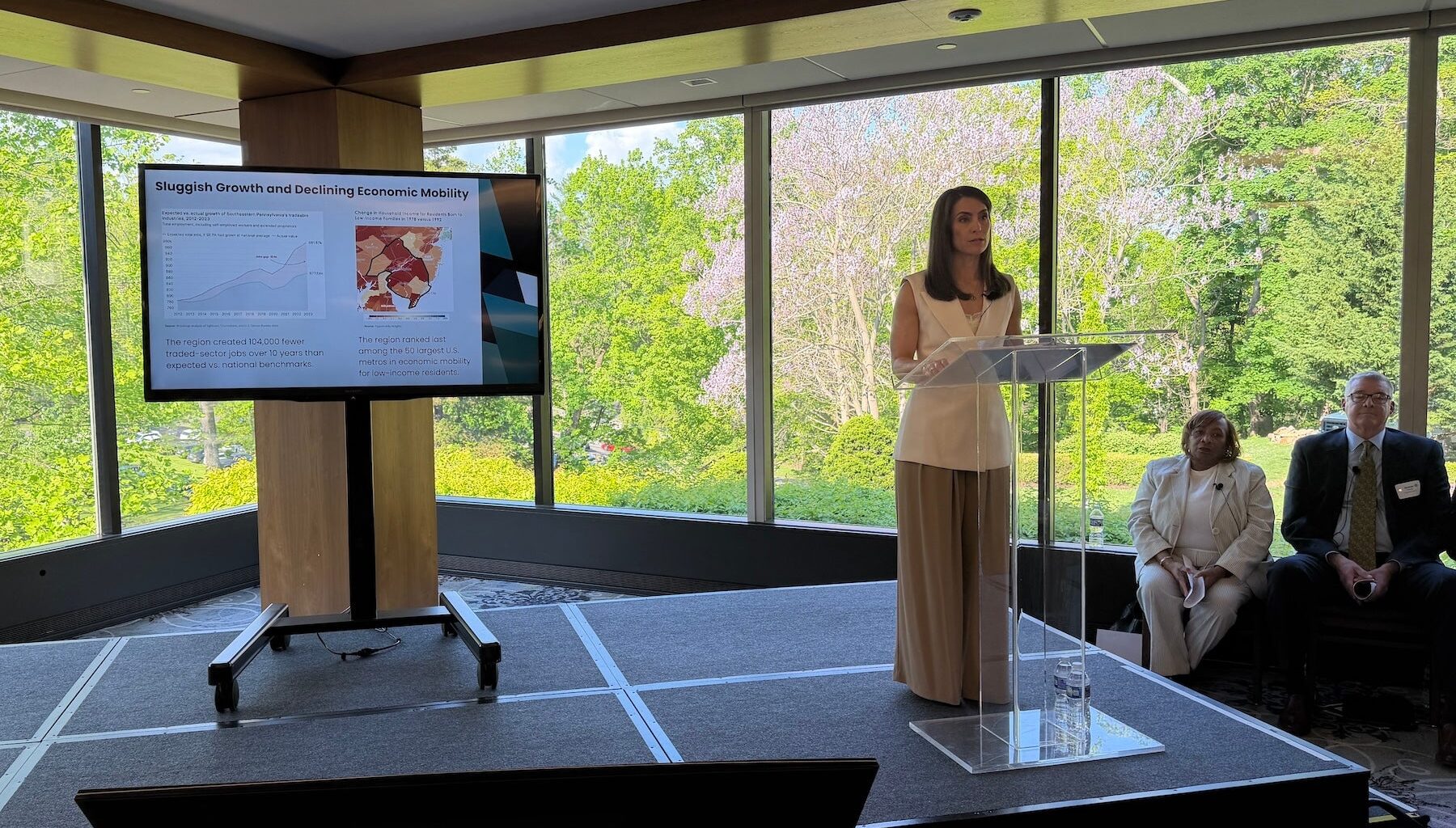
How the Philly area got here
Project leaders say the problem stems from years of underinvestment in economic development and poor coordination among employers, educational institutions and local governments. They say the disconnect has left job seekers unable to fill open positions while employers struggle to find qualified candidates, despite the region’s well-educated workforce.
Those kinds of challenges are what the GPGP is expected to take on, Greenwood said.
“The regions growing faster than us are better organized,” she told an audience during the launch announcement at Villanova University. “They are more focused. They are more invested. They made a decision to act together and they built the tools to do it. So that’s what we’re doing.”
Wawa CEO Chris Gheysens likened it to geese when they fly in formation with those in front providing draft for those behind them.
The partnership “asks all of us to move together, forward together, aligned as a region, not as individual entities. At Wawa, we call it flying in V formation,” he said. “It makes us stronger. And actually when geese fly in V formation, they fly further and more efficiently.”
From potential to prosperity
The launch of the new initiative coincided with the release of a detailed strategy report, “From Potential to Prosperity,” which outlines how leaders plan to translate the region’s strong assets into sustained economic gains.
The strategy focuses on three “opportunity industries,” including biomedical engineering and production, enterprise digital solutions and precision manufacturing in industrial technologies, chosen for their ability to generate jobs accessible to non-college-educated workers while strengthening the region’s position in national and global markets.
“Growth alone isn’t enough,” said Philadelphia Works CEO Patrick Clancy. “But when we pair growth with investments connecting people to opportunity, our region can finally realize its potential.”
Donna Frisby-Greenwood, senior vice president at The Pew Charitable Trusts, added that the partnership’s work would help local families “flourish,” especially if done alongside support like housing, childcare and access to public benefits and other efforts to improve other systems.
“Joining forces to accelerate growth is critical to making progress on economic advancement,” she said at the launch. “When we are working together to do all of these things, our region can realize its potential to create a thriving economy that benefits everyone.”
The report’s comprehensive list of goals includes:
Building regional growth capacity
Focus on opportunity industries
Connect talent to opportunity
The strategy also involves better coordination across Philadelphia and its suburban counties, Bucks, Chester, Delaware and Montgomery, an area that encompasses 4.2 million residents and a $355 million economy.
“The partnership will enhance our work in each individual county by providing the regional coordination and shared structure that will be a force multiplier for maximum impact,” Montgomery County Commerce Director Stephen Forster, who was involved in the strategy report’s development, said at the launch. “I’ve seen new levels of engagement and collaboration across our economic and workforce development colleagues.”
Disclosure: Pew Center for Arts & Heritage is among WHYY’s financial supporters. WHYY News produces independent, fact-based news content for audiences in Greater Philadelphia, Delaware and South Jersey.