
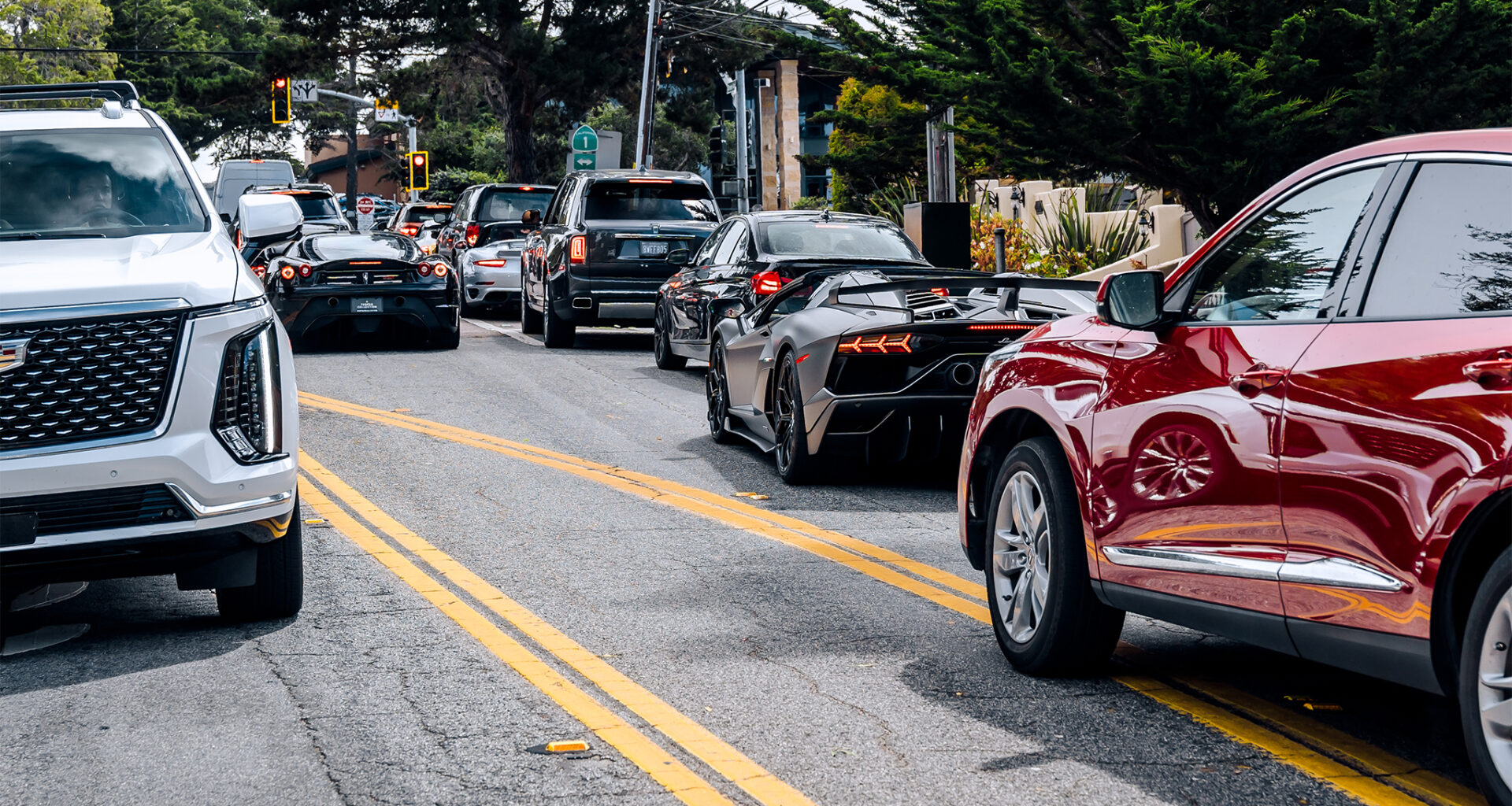
Visitors to the Monterey Peninsula this summer may be unwittingly participating in an AI experiment to determine how fast or slow they arrive at their destination.

It is a big bet that county transportation officials, in conjunction with Caltrans, are making: an AI signal system pilot program that could eliminate the need for roundabouts along the same corridor.
This week, Caltrans launched the AI signal program along the storied Highway 68 corridor, which connects the farmlands of Salinas to the ocean shores of Monterey and acts as the main feeder into the area from Highway 101. Adaptive traffic signals are now live between the heavily trafficked 9-mile stretch from San Benancio Road to Josselyn Canyon Road.
Article continues below this ad
The change isn’t visible to the human eye, but whether traffic flows better during the height of the oncoming busy season should be very apparent to all who attempt to navigate their way to their destination, local transit officials said.
“We put it in this week, so it’s in play now,” Doug Bilse, the principal engineer for the Transportation Agency for Monterey County, told SFGATE on Wednesday. “It went live on Tuesday, yesterday. We were analyzing it yesterday, and there’s still some bugs to work out, but it was working. It’s a work in progress. It’s a pilot project we’ll be evaluating for five years.”
Traffic in Monterey, Calif., on Aug. 20, 2025.
Brandon Woyshnis/Getty Images
The program deploys adaptive traffic signals, traffic lights that use a combination of AI and sensors that determine and automatically adjust to the current flows of traffic.
Article continues below this ad
Make SFGATE a preferred source so your search results prioritize writing by actual people, not AI.
Add Preferred Source
Bilse said that the timing for the program’s start — on the cusp of the busy summer travel season — is by design. “In a couple weeks when school lets out, when Laguna Seca has an event or anything unexpected happens, that’s where adaptive shines,” he said.
The Federal Highway Administration pitches the technology as a solution to an age-old traffic signal problem: “Wait, go, stop, wait, wait some more; most drivers have spent time fuming at red lights,” the agency’s site reads. “ … Why don’t traffic lights adjust to actual conditions?”
“Implementation of the ATSC system comes after months of field testing and calibration which helped build the model for the new system,” Caltrans stated in an announcement on the program’s launch.
Article continues below this ad
In March 2025, the Transportation Agency for Monterey County’s board of directors approved the Adaptive Traffic Signal Control Pilot Project with the five-year pilot program.
The GTP Start at the WeatherTech Raceway Laguna Seca during the IMSA WeatherTech SportsCar Championship in Salinas, Calif., on May 3, 2026.
Brandon Badraoui/Lumen/Getty Images
Many were eager to see this plan in motion as both a cost- and time-saving alternative to the potential installation of roundabouts.
“If we can save 200 million ultimately by not doing roundabouts, by spending a million dollars or whatever for nine AI [signals], I would like to find out as soon as possible if AI works,” Bruce Delgado, a board member and mayor of the city of Marina, told Caltrans officials at the time of the decision to approve the program.
Article continues below this ad
“[It] seems like a really good way to spend money,” he continued.
But even as the AI-powered signals are being tested, local transit officials and Caltrans are still vetting the Scenic Route 68 Corridor Improvements Project, which offers two different alternatives for a long-term traffic solution in the region.
The first “would convert nine intersections into roundabouts; five would be converted into single-lane roundabouts, three would be hybrid roundabouts (a combination of one and two traffic lanes around the circle) and one would be converted into a two-lane roundabout,” according to the project’s website.
The other alternative would be the permanent installation of the AI-based system, which “would include expanded signalized intersections with adaptive signal control technology and enhanced lane channelization to provide auxiliary through lanes and additional right and left turn lanes.”
Article continues below this ad
Cannery Row in Monterey, Calif., on Sept. 10, 2016.
Andrius Kaziliunas/Getty Images
For his part, traffic engineer Bilse, while acknowledging the cost effectiveness and potentially positive impact of the AI signals, noted that roundabouts are still a better overall solution.
“It adapts better than adaptive signals, handles more capacity and is safer, no T-bones coming through intersections,” he explained.
However, roundabouts are also much more expensive: “We don’t have enough money to do all nine roundabouts, but we can easily put adaptive signals in for $1.5 million,” he said, noting the roundabout project could potentially cost around $64 million.
Article continues below this ad
“Is that our best use of public funds? Or is there another project that makes more sense,” he said.
Are there any drawbacks to the program? Bilse said that there is the possibility of some kind of equipment failure — for example, a camera at an intersection not talking to another — that could lead to traffic “confusion.” However, Caltrans is monitoring the system and this program closely to avoid such incidents, he said.
“We’re learning the process,” he added. “We’re looking at it and saying, ‘Wow, what if this happened?’ But Caltrans has done a really good job — a really good team effort.”
Article continues below this ad