
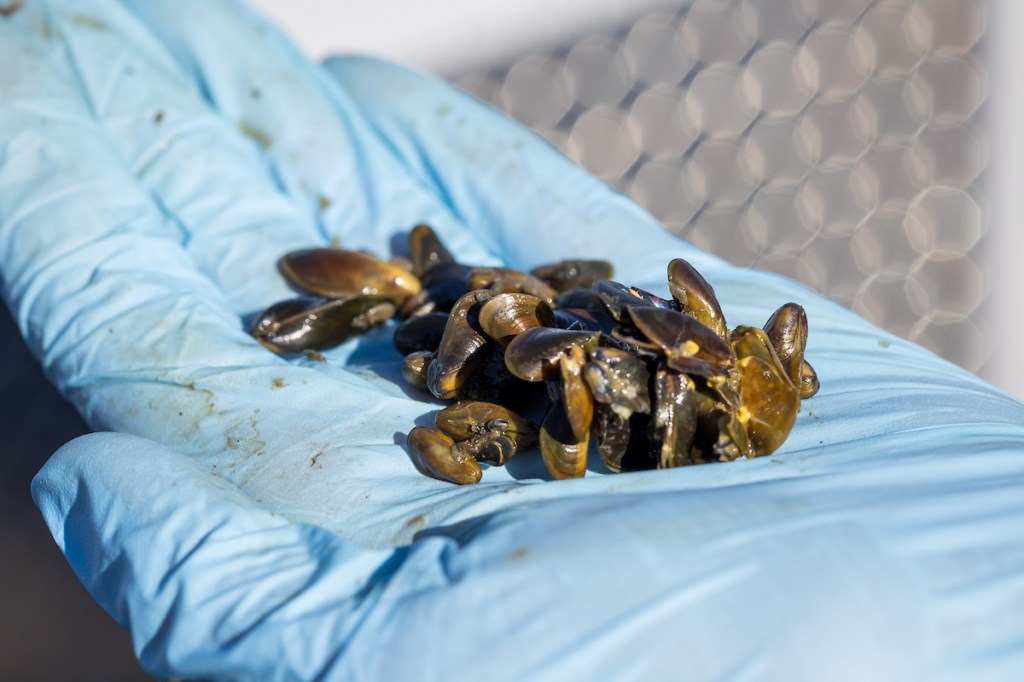
For the first time, golden mussels, an invasive species of tiny mollusks that can rapidly reproduce and cause millions of dollars in damage to pipes, drinking water plants, irrigation systems and dams — sparking growing concerns across California — have been found in Santa Clara County.
Last month, a juvenile golden mussel was discovered in the raw water intake area at the Penitencia Water Treatment plant near Alum Rock Park in San Jose. A few weeks later, in late April, an adult was found in a raw water strainer at the Santa Teresa Water Treatment Plant in San Jose’s Almaden area.
The water remains safe to drink, say officials at the Santa Clara Valley Water District, which owns the plants and provides water to 2 million residents of Silicon Valley.
But the discovery of the diminutive invaders has alarmed local officials, who say they must now install equipment costing hundreds of thousands of dollars at some district facilities to remove them, step up inspection rules for boaters on local reservoirs and limit the way more than dozen groundwater recharge ponds are used this year.
“We’re concerned,” said Jason Araujo, a utility maintenance manager with the Santa Clara Valley Water District. “At the moment, we’ve only detected two. But that means more are probably coming. It’s not out of control yet, but as the season goes on, they could be multiplying a lot more.”
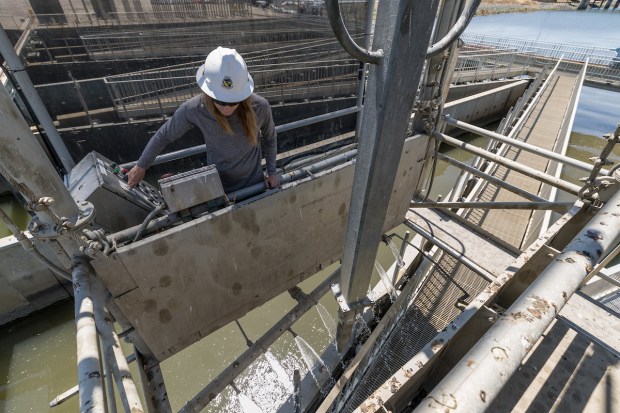 California Department of Water Resources Utility craftsworker Paul Bronson cleans golden mussels of from Skinner Fish Facility louvers that divert fish away from the pumps at Banks Pumping Plant in Contra Costa County, Calif., on July 1, 2025. (Photo: Nick Shockey / California Department of Water Resources)
Araujo said officials believe the mollusks arrived from the South Bay Aqueduct, which takes water from the Sacramento-San Joaquin River Delta to Santa Clara County, and from San Luis Reservoir, a vast reservoir east of Gilroy where the mussels have been discovered and which connects to Santa Clara County with pipes.
The mussel, a 1-inch-long creature with a golden brown shell, is native to China. They live for two years, and can survive in water as cold as 41 degrees and as warm as 95. They can even live for up to 10 days with no water. In some places, left unchecked, they grow in shockingly dense concentrations on hard surfaces, river banks and reservoir bottoms.
“They are kind of like super invaders. They can reproduce multiple times a year,” said Andrea Schreier, an associate adjunct professor of animal sciences at UC Davis. “A single mussel can release thousands of larvae at a time. The numbers can add up pretty fast.”
Some studies have shown the mussels may be eating plankton that native fish and other species eat, and they have been linked to harmful algae blooms.
Two weeks ago, the San Joaquin County Board of Supervisors declared a local emergency after the mussels began increasingly turning up in water equipment there. Hilary Crowley, a county spokeswoman, said a $100 million floodgate completed in 2024 has been infested with the relentless mollusks, requiring an expensive removal.
On Tuesday, the Kern County Board of Supervisors is expected to declare a similar local emergency. The measures will allow both counties to apply for state and federal assistance.
“This is not a speculative or emerging threat,” said Kern County Supervisor Phillip Peters in a letter to Gov. Gavin Newsom. “It is an active infestation within critical infrastructure that supports municipal water delivery, agricultural irrigation, groundwater recharge, and industrial operations across the Central Valley and beyond.”
Between 1965 and 1990, golden mussels from China spread to Hong Kong, Japan, Korea and Taiwan, usually on boats. Around 1990, they appeared in Argentina. By 2006, they were infesting Uruguay, Paraguay, Bolivia and Brazil.
In South America and Asia, they have clogged water pipes, grates, tanks, filters and cooling equipment at power plants, dams, wastewater treatment plants, refineries, steel mills, canals, agricultural irrigation systems and boats. In 2025, one study estimated in South America they cost the hydropower industry $7 million to $8 million a year in maintenance and $45 million to $120 million in lost hydropower when facilities were shut off.
The species first turned up, probably from the ballast water or hull of a foreign ship, state officials say, in October 2024 in the Port of Stockton.
Since then, it has spread quickly through the Delta. The mussels have clogged siphons used to move delta water to farmers, covered intake screens at the Contra Costa Water District, and caused the East Bay Municipal Utility District to close all of its reservoirs last year to boaters as a precautionary measure. The mussels’ tiny larvae have drifted down canals and aqueducts of the State Water Project and have been detected as far south as Bakersfield, Los Angeles and San Diego counties.
“They are hardy,” said Steve Gonzalez, a spokesman for the California Department of Fish and Wildlife. “Their survivability is high than other invasive mussels. Once they got into the Delta we knew it was going to be tough.”
The main state strategy at this point is to boost inspections of boats around the state. Boaters are urged to “clean, drain and dry” their boats before coming onto lakes. In February, two boaters were fined $5,000 by the Tahoe Regional Planning Agency for altering an inspection tag to try to bring an uninspected boat onto Lake Tahoe.
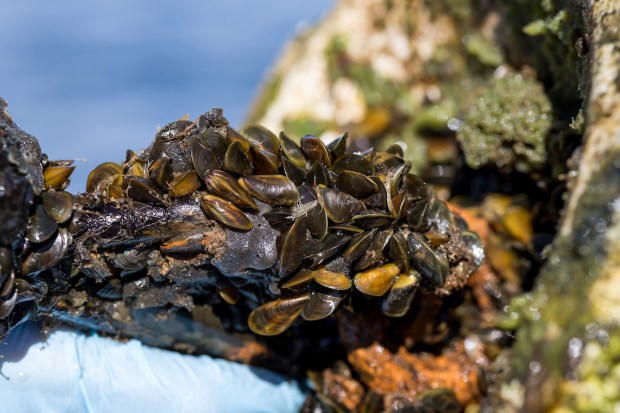 Golden mussels during surveys at O’Neill Forebay at San Luis Reservoir in Merced County, Calif., on Nov.13, 2024. (Photo: Xavier Mascareñas / California Department of Water Resources)
The mussels can be removed with scraping, pressure washing and underwater cleaning by divers. But because the mussels breed so quickly, the operations must be done regularly — sometimes by shutting down part or all of a water plant, dam or other facility — and the large numbers of dead mussels must be disposed of.
Chemicals like copper sulfate and ammonia also kill them, but are toxic to people, fish and wildlife.
At the Contra Costa Water District, workers regularly clean them off four intake screens that bring the agency Delta water, said Jennifer Allen, a district spokeswoman. The mussels are in the Contra Costa Canal, but not in drinking water plants yet, she said. The agency is studying ways to use chemicals that kill algae as one defense.
“This is a big issue for water agencies around the state,” she said. “Eradication would be great. But it may not be possible.”
The Santa Clara Valley Water District has purchased a $130,000 ultraviolet light system for the pumping plant at San Luis Reservoir that sends water to Santa Clara County to try to kill them. Several more may be needed for the Coyote Pumping Plant near Anderson Reservoir and the Vasona Pumping Plant in Los Gatos, Araujo said.
Two other species of invasive mollusks, the zebra mussel and quagga mussel, have entered California over the past 20 years. Through boating inspections and other methods, they have been largely contained. Even though golden mussels are more hardy, officials hope rising awareness, more research, and treatment will stop them from causing as much damage as they have in South America and Asia.
“You get rid of them once, but the problem is they’ll come back because there are so many places in the State Water Project where they are found now,” Schreier said. “In the coming years, there is going to be more and more research into ways to control them.”
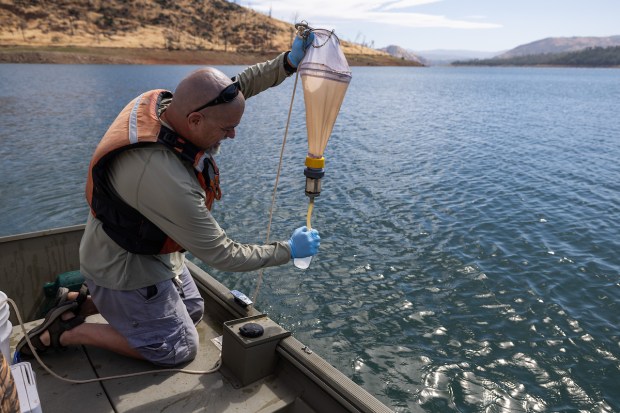 California Department of Water Resources Environmental Scientist Kevin Moncrief collects water samples at Lake Oroville in Butte County, looking for golden mussels and other invasive species on July 21, 2025. (Photo: Andrew Nixon / California Department of Water Resources)