
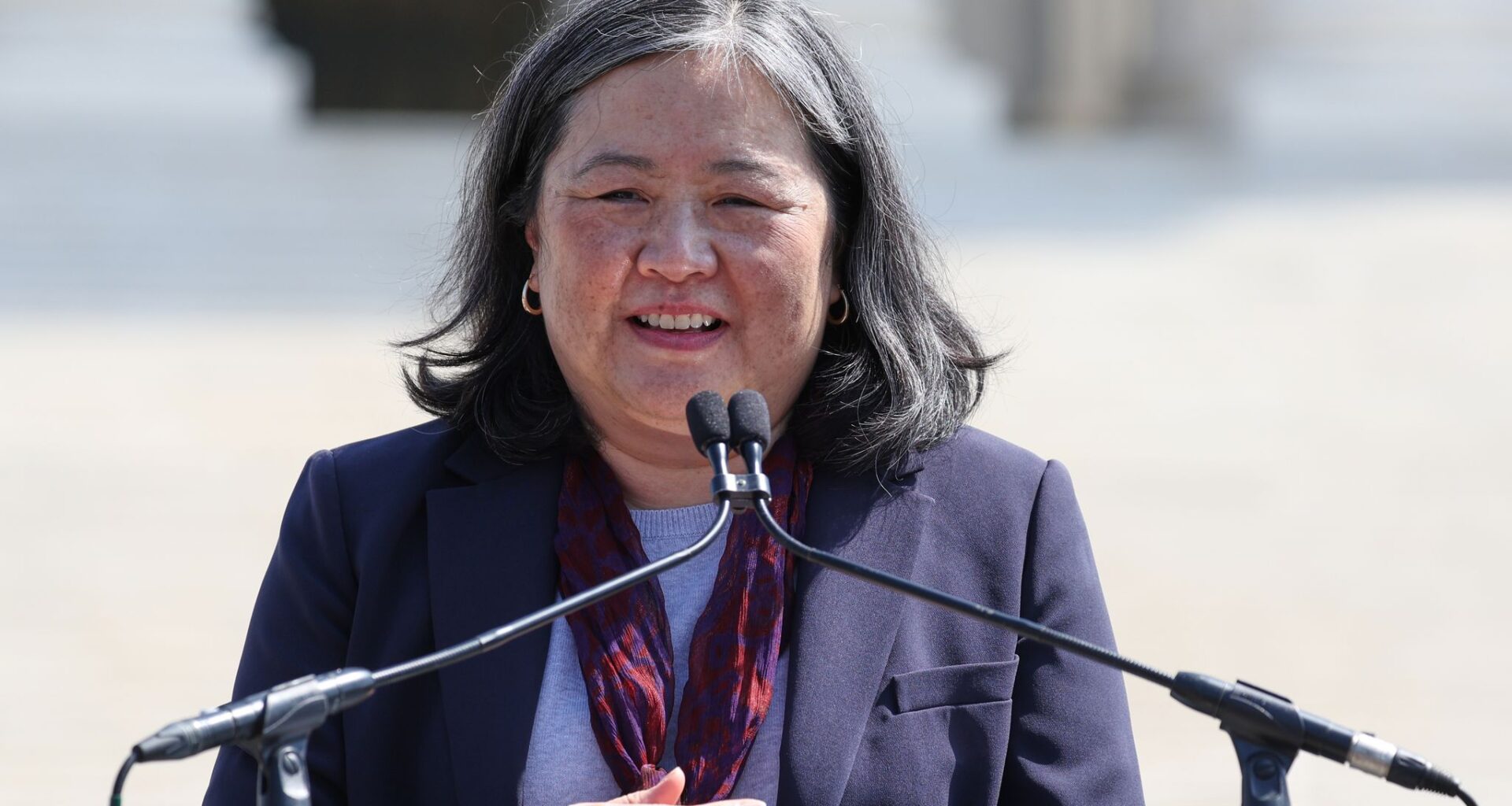
ACLU legal director Cecillia Wang speaks outside the U.S. Supreme Court after justices heard oral arguments on whether President Donald Trump can deny citizenship to children born to parents who are in the United States illegally or temporarily, on Capitol Hill in Washington, Wednesday, April 1, 2026.
Tom Brenner/Associated Press
Neal Katyal, the attorney who argued against the Trump administration in the case Trump v. Hawaii, speaks to members of the media outside the Supreme Court, Wednesday, April 25, 2018, in Washington.
Andrew Harnik/Associated Press
This courtroom sketch depicts Cecillia Wang, the American Civil Liberties Union legal director, standing center, making arguments before the U.S. Supreme Court, Wednesday, April 1, 2026, in Washington, as President Donald Trump departs shortly after Wang began her presentation in defense of broad birthright citizenship.
Dana Verkouteren/AP
Nearly 4 in 10 Houston-area Asian residents reported that they, a friend or a family member had experienced discrimination in the past 12 months, according to a recent survey completed by Rice University’s Kinder Institute for Urban Research. Nearly half of those who described their experiences cited insults and derogatory comments. Nearly one-quarter reported being treated differently or excluded.
This is Houston — one of the most diverse cities in America — and still, our Asian American neighbors are being told to “go back to your country.” Nearly five years after the pandemic-era wave of anti-Asian hate, the tide has not fully receded.
That is why we cannot stay silent about what happened recently on the national stage.
Article continues below this ad
The month of May is Asian American, Native Hawaiian and Pacific Islander (AANHPI) Heritage Month — a time when our communities across this nation, including here in Houston, celebrate our contributions to American life. As Houstonians who lead two national bar organizations representing the interests of the more than 80,000 AANHPI lawyers, judges, law professors, and law students throughout the country, we write to share why this Heritage Month is particularly critical in combating discrimination.
Last month, an episode of the “Savage Nation” podcast was virulently anti-Asian. A transcript of this podcast was shared by many, including a repost by the president of the United States. While much of the attention focused on the podcaster’s anti-Indian and anti-Chinese rhetoric — including tired tropes of immigrants in the high-tech sector taking American jobs,and the description of India and China as “hellholes” and their people as “not like European Americans” in terms of loyalty and assimilation — the podcast also took aim at the legal profession, the pending Supreme Court birthright citizenship case, Asian American attorneys and the rule of law.
The transcript described Cecilia Wang, the legal director of the ACLU — an American born in the United States to parents from Taiwan — as “a Chinese American who looks to me like the classic ACLU attorney. Very smart, very evil, very devious,” and calls her “the snake from the ACLU.” It claimed she was attempting to “turn us into a colony of China.” All this because Wang argued on behalf of plaintiffs in the birthright citizenship case before the Supreme Court, litigation in which both of our organizations have filed legal briefs supporting the plaintiffs’ claims.
Equally alarming was the invocation of a Shakespearean call for violence against lawyers. The line “the first thing we do, let’s kill all the lawyers,” from “Henry VI,” was referenced, alongside the claim that “the country has been stolen from us by these effing lawyers.” Whatever its literary origins, there is nothing literary about that statement in 2026. When directed at individuals and an entire profession, this language is dangerous. We, especially as leaders of bar organizations, condemn it unequivocally.
Article continues below this ad
Instead, this Heritage Month, consider what our communities have built through the law. Wong Kim Ark’s 1898 Supreme Court case enshrined the promise of the 14th Amendment for all born on U.S. soil. Bhagat Singh Thind fought to become a naturalized citizen — and was denied, despite serving the United States in uniform.
These cases, which are foundational to our immigration and civil rights jurisprudence, were argued in a time when most Asian Americans could not practice law. Today, AANHPI attorneys like Wang of the ACLU and Neal Katyal, who recently won a major tariff case before the Supreme Court, carry on that tradition — profoundly shaping law on behalf of fellow Americans, not at the behest of any foreign power.
AANHPI attorneys have served this nation as military officers, judges, prosecutors, public defenders and senior officials in government roles in the executive branch for both parties, including this current administration. And our communities extend well beyond the bar. We count among us the founders of NVIDIA, YouTube and Instacart. We include young athletes like skater Alysa Liu and golfer Akshay Bhatia. And we love our cuisines. But we are more than ethnic foods. We are health care workers, first responders, teachers, small business owners, artists and volunteers.
The model minority myth has often pigeonholed us into science and technology stereotypes, rendering our struggles invisible and our humanity incomplete. Our communities experience both success and poverty, like any other American community, because we are exactly that: American communities. Even the nomenclature “Asian American” contains approximately 50 distinct ethnic groups, with over 100 different dialects and languages. We are not a homogenous group, but rather a vibrant diverse community.
Article continues below this ad
AANHPI Heritage Month should be more than a celebration. It should be a call for all elected leaders to actively defend, invest in and uplift our communities by expanding representation, confronting hate and discrimination, and ensuring that our stories and contributions are recognized as an essential part of the American experience
Joseph Yao is the president of the National Asian Pacific American Bar Association. Nishi Kothari is the president of the South Asian Bar Association of North America. Both are Houston-based attorneys.