
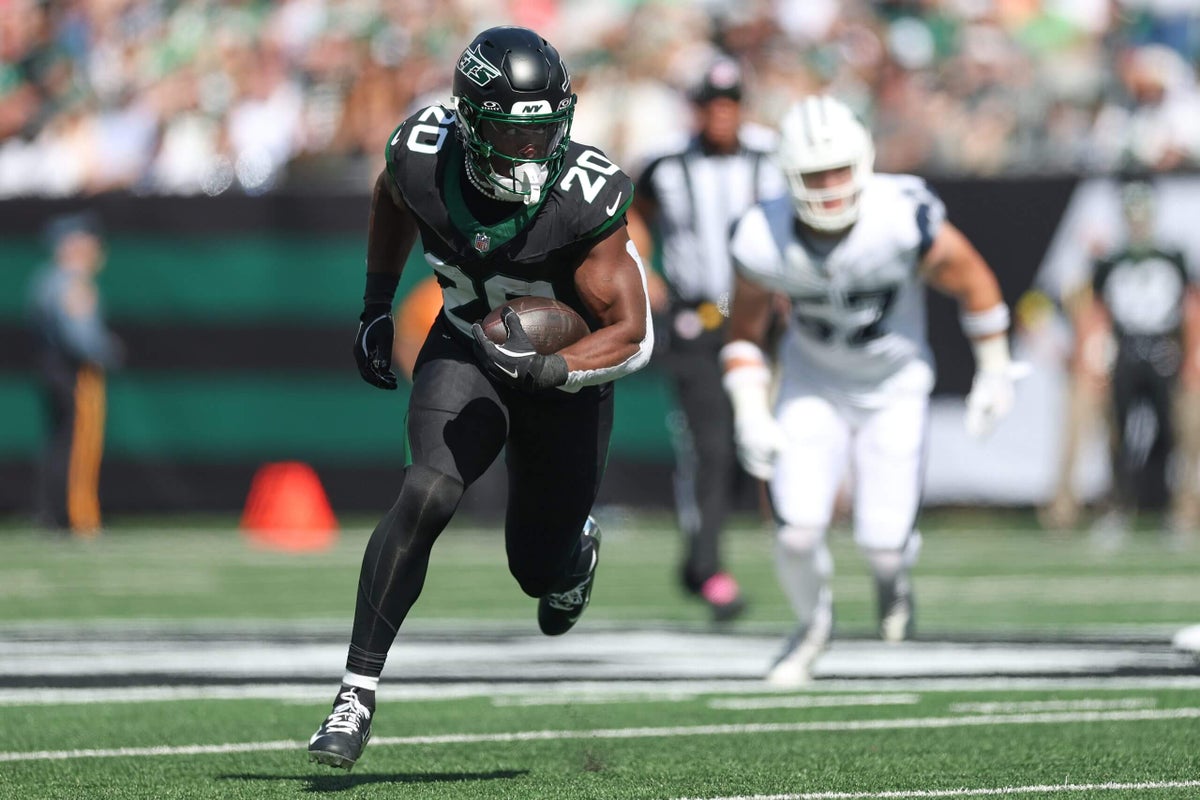
Breece Hall’s time between tears tells quite the story.
According to Hall, the last time he cried, he was on the path to a historic rookie season, when it felt like anytime he touched the ball there was a chance he was going to score. On an October day in Denver, he did just that. Hall surged through the middle of the defense before the Broncos even realized what hit them. A few seconds and 72 yards later, he was in the end zone.
One quarter later, Hall’s knee bent awkwardly on a tackle. He was helped off the field and into the locker room and was soon told he had torn his ACL. He cried. A year later, in that same locker room, he pointed to the trainer’s table after a Jets win, the memory still fresh.
That injury was on Hall’s mind again — he cited it as the last time he’d cried, until Friday.
This time, it was happy tears. Hall just signed a three-year, $45.75 million contract with the Jets, a team source told The Athletic, making him the third-highest-paid running back in the NFL. Hall landed a lucrative new contract with the team he felt like he was ready to leave in November. The deal can be viewed as a win for both sides. Hall gets a life-changing contract, financial and job security at a position (running back) that often doesn’t carry a long shelf life. The Jets lock in Hall on a front-loaded contract ($29 million guaranteed in the first two years) with zero guaranteed money after the second season. Both sides get to avoid the awkwardness that could’ve come from Hall skipping the offseason program — and from possibly entering the season playing on the franchise tag.
For a long time, players the Jets drafted rarely became worthy of a second contract. It was part of the franchise’s reputation — cheap and/or unable to properly identify talent in the NFL Draft. But since GM Darren Mougey was hired last year, he’s signed five players to second contracts before they could hit free agency; Hall joins Garrett Wilson, Jamien Sherwood, Jeremy Ruckert and Sauce Gardner, who has since been traded. The narrative that the Jets don’t take care of their own can die.
So can the one about Hall not wanting to be here.
Maybe Hall didn’t want to be a Jet at some point (or points) in time. At the height of his rookie year, it felt like the Jets had found someone special, a true game-changing running back — the sort the Jets hadn’t really found since Curtis Martin wore green and white. The knee injury changed things, though not drastically. Hall has been one of the most productive, multi-dimensional running backs in the NFL since coming into the league, even as the Jets have shuffled through quarterbacks and play callers, often unable to figure out the proper way to use him.
Hall took a run 83 yards in his first game back from the ACL injury in 2023, but it took then-offensive coordinator Nathaniel Hackett until midseason (something Hackett admitted publicly) to realize that Hall was a useful weapon in the passing game, too. Hall expressed his frustration privately and, sometimes, publicly.
He was healthy in 2024, but his quarterback (Aaron Rodgers) was determined to operate the offense his way, which didn’t leave much room for running the ball. The Jets finished last in rushing attempts in a wholly miserable campaign.
Last year, Aaron Glenn spent all offseason promising that the Jets would find creative ways to use Hall in the passing game. Instead, he went mostly ignored — in 11 of 16 games, he was targeted three or fewer times.
And yet, since 2022, Hall ranks 10th in scrimmage yards, sixth in yards per touch, sixth in receptions and fourth in receiving yards among running backs — despite missing 10 games his rookie year with that ACL injury, and with how long it took to get his explosiveness back after the fact. Last year, Hall became the first Jets player to rush for 1,000 yards in a decade.
Through it all, Hall hasn’t been one to hide his frustration. His Twitter page has often told the story. Sometimes subtly, sometimes not.
The most famous one: One day after an ugly October loss to the Broncos in London, he posted to Instagram and finished his caption with “#Free20,” a reference to his number — and an intimation that he wanted out. He did nothing to dispel those assertions, and his explanation for the post a few days later didn’t make a whole lot of sense either: “It’s referencing, like, being in the moment, being in the game. I’m ready for whatever.” There were rumblings at the trade deadline that Hall wanted a “fresh start,” especially as he watched Mougey trade away Gardner, defensive tackle Quinnen Williams, and cornerback Michael Carter II in a full-blown firesale. The Jets received offers, including a reported third-round pick from the Kansas City Chiefs. But despite all the noise, the Jets never really came close to trading him.
The Jets were motivated to lock in Hall before free agency. Conversations between Mougey and Hall’s representation — his primary agent is Nicole Lynn of Klutch Sports — were productive in March, but the two sides couldn’t quite get over the finish line. So Mougey placed the franchise tag on Hall — worth more than $14 million — and tabled the conversations until after the NFL Draft.
They picked up again over the last week. Hall saw what the Chiefs paid Kenneth Walker in free agency — $43.05 million over three years, $28.7 million guaranteed — and wanted to top him. The Jets were motivated to get a deal done now, with the understanding that the Falcons (with Bijan Robinson) and the Lions (Jahmyr Gibbs) will be resetting the running back market very soon. Hall’s price was only going to go up.
So Mougey struck now. Hall got slightly more than Walker ($45.75 million to $43.05 million overall, $29 million to $28.7 million guaranteed), and that works to the Jets’ benefit in ways other than saving them money if they had let Robinson or Gibbs go first.
This is not unlike the way the Jets were able to structure Gardner’s contract last offseason. Gardner wanted to be labeled the NFL’s “highest-paid cornerback,” which led to concessions on his end that made the contract easier to get out of if the Jets decided to trade him. It made the offer the Colts gave the Jets at the deadline — two first-round picks and wide receiver Adonai Mitchell — an easier one to swallow since there wouldn’t be long-lasting financial implications.
That’s the same situation with Hall. This isn’t a contract that hurts the Jets’ cap flexibility now or in the future since there is no money guaranteed beyond the second year. It essentially amounts to a two-year, $29 million contract, which is about the amount of money per year Hall would have earned on the franchise tag anyway.
None of that is to say the Jets intend to move on from Hall anytime soon.
Mougey and Glenn went into this offseason with the understanding that they couldn’t really afford to let a player of Hall’s caliber walk away. That’s why they didn’t trade him at the deadline either.
For a team that had so many roster holes, Hall’s departure would have created a new one — an unnecessary one considering how much cap flexibility the Jets had this offseason and in the future. They were able to franchise tag him and have that cap figure hanging on the books, and still went out and reloaded the roster.
Maybe Hall isn’t the same caliber of player as Robinson, Gibbs, Christian McCaffery or others of that ilk. But he is only 24 and is a dynamic weapon who should be surrounded by the best offensive supporting cast he’s had since joining the Jets. There’s a solid offensive line in front of him, a competent quarterback in Geno Smith and dynamic weapons at wide receiver (Garrett Wilson, Adonai Mitchell, rookie Omar Cooper) and tight end (Mason Taylor and rookie Kenyon Sadiq). Even better: All of those skill-position players, plus left tackle Olu Fashanu and right tackle Armand Membou, are under contract beyond the 2026 season.
This offseason, more than anything, has been about building toward 2027, when the Jets have three first-round picks in a draft supposedly rich with quarterback talent. Think about what the Jets offense looked like when they tried dropping Sam Darnold into it in 2018, or Zach Wilson in 2021. For once, they aren’t rushing things — they’re building toward the future.
Hall is part of that. Even if it sometimes felt like he wouldn’t be.