
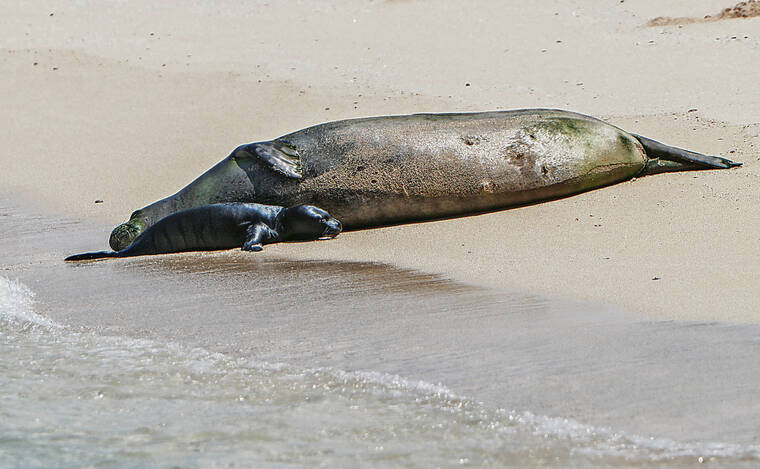
A sleek, black Hawaiian monk seal pup sidles up to its mom, sometimes resting its chin on her back or playfully reaching out to her with one flipper.
Kaiwi has once again given birth to a pup at Kaimana Beach Park in Waikiki, not an ideal location for the endangered species, as it is also popular among beachgoers. But it’s not the first time it has happened.
The first known birth of a pup at Kaimana Beach occurred in June 2017, causing a flurry as federal wildlife officials faced the challenge of keeping the mom-and-pup pair safe from crowds of onlookers.
Since then, a monk seal known as Rocky gave birth to pups there twice, in 2017 and 2022. Kaiwi has now given birth at Kaimana Beach four times, including in 2024, 2023 and 2021.
Each time the message from wildlife officials, including the National Oceanic and Atmospheric Administration and Hawaii Department of Land and Natural Resources, has always been the same: Please give mom and pup space as they nurse and bond for the month or so.
“For the next five to seven weeks, the pair will stay together while the pup nurses and gains the necessary strength to survive when mother Kaiwi departs,” said DLNR in a news release. “During this time, the pup is vulnerable and dependent on its mother for survival. Human disturbance during this period can have serious and lasting consequences. If repeatedly stressed, a nursing mother may abandon her pup, significantly reducing its chances of survival.”
Don’t miss out on what’s happening!
Stay in touch with breaking news, as it happens, conveniently in your email inbox. It’s FREE!
Additionally, mother monk seals can be very protective of their offspring and will bite if threatened, officials said.
Authorities have set up expansive netting across the beach, along with warning signs, to establish a perimeter of safety around the animals. NOAA recommends maintaining a distance of at least 150 feet, both on land and in the water, or better yet, choosing a different beach altogether while the pair are nursing.
‘Basic respect’
Despite advisories meant to keep both humans and monk seals safe, many beachgoers continue to swim, surf and paddle at Kaimana Beach while Kaiwi and her pup are present. And as in past years, there have been close encounters.
“The department is aware that there are people who are breaching the seal resting area, which is basically the fenced off area at the beach,” said DLNR Division of Conservation and Resources Enforcement Chief Jason Redulla during a recent press briefing. “This is the area that the seals are resting in for the time being.”
In a few weeks, he said, the pair will be going into the ocean and foraging for food as mom teaches the pup how to become an independent animal that can survive in the wild.
“And so, for these people to be breaching the area and getting close to the pup, this is not a good idea at all,” Redulla said, especially for their own safety.
Authorities cannot legally close Kaimana Beach to the public but have taken greater measures to establish a safety perimeter in more recent years, with netting extending all across the sand.
NOAA’s nonprofit partner, Hawaii Marine Animal Response, sends volunteers to help monitor the situation, but their role is to educate, not enforce any recommended distances.
In July 2022, Rocky bit a 60-year-old woman from California who was swimming at Kaimana Beach while the monk seal was in the ocean with her pup, causing lacerations to the swimmer’s face, arm and back.
The Hawai‘i Tourism Authority sent an email blast after the incident, advising visitors to temporarily avoid the beach.
DLNR determined the woman happened to be in “the wrong place at the wrong time,” even though numerous warning signs were posted at the shoreline to alert people to the presence of the mother seal and pup.
That year, DLNR provided 24/7 enforcement at Kaimana Beach, as well as the following year. DLNR is not yet doing that with the latest monk seal birth, according to Redulla, due to how labor-intensive and costly it can be.
“We could consider that,” he said. “We just would like people to show some basic respect for these animals. Stay out of the seal resting area, stay away from these animals, let them be, and, you know, hopefully it doesn’t get to a situation where we have to go 24/7. But we’re prepared to go there if it’s required.”
Most endangered seal
Hawaiian monk seals, or Neomonachus schauinslandi, are considered one of the most endangered seal species in the world.
The population of Hawaiian monk seals had been declining for about six decades but has been recovering due in part to efforts by NOAA and The Marine Mammal Center, which set up a dedicated hospital in Kailua- Kona for injured and ailing seals.
Only an estimated 1,600 Hawaiian monk seals are now left in the wild, but even this is considered a milestone. Most reside in the Northwestern Hawaiian Islands but a growing number are found in the main Hawaiian archipelago.
They are federally listed under the Endangered Species Act and protected under the Marine Mammal Protection Act as well as Hawaii law.
NOAA considers female seals critical to the recovery of the species. Although Hawaiian monk seals give birth year-round, peak pupping season starts in March and runs through August.
Rocky, also identified as RH58, is considered a matriarch after becoming the first known seal to give birth at Kaimana Beach. She has had at least 15 pups, some of which went on to have their own offspring.
Kaiwi, or RK96, is also a supermom of sorts, having given birth to seven pups. She is known to frequent East Oahu’s Kaiwi coastline, where she herself was born and where she had previously given birth.
Monk seals often return to their own birthplace to have pups, but not always, which is why Rocky surprised experts when she gave birth to a pup at Kaimana Beach in 2017.
The following year, she pupped on Kauai. Then in 2024, she surprised experts once again by being the first monk seal on record to give birth at Sand Island State Recreation Area on Oahu.
Kaiwi has been more consistent so far, giving birth to her latest pup at Kaimana Beach at sunset May 3.
Over the years, it seems public awareness and an appreciation for Hawaiian monk seals have grown. Spectators at Kaimana Beach “ooh” and “aah” at the mother and pup from behind the protective netting. The rare sight also draws a crew of dedicated monk seal photographers who use long lenses to capture and share tender and amusing moments between the pair.
Authorities say it is also important to maintain a distance because young seals are highly impressionable, and close human interaction can lead to habituation.
“Wild seals that get used to people can lose the instincts they need to survive and can become dangerous as they grow larger and stronger,” DLNR said. “Staying away keeps everyone safe and gives seals a better chance to live in the wild.”
Additionally, officials ask people to keep their dogs leashed at the beach, as pups have been killed by dog attacks in the past.
Bad behavior
Despite growing awareness, bad human behavior around the federally protected animals persists.
Just a few days after Kaiwi pupped at Kaimana Beach, video surfaced of a man appearing to lob a large rock at a monk seal’s head in the nearshore waters off Lahaina on Maui. The social media post Tuesday has since gone viral and continues to make its rounds, with swift backlash and criticism against the man, identified by authorities as a 37-year-old visitor from Seattle.
The case has been handed over to NOAA’s Office of Law Enforcement, which confirmed it is investigating the incident but did not provide more details.
NOAA Fisheries said that as a federally protected species, actions or attempts to harass, hunt, shoot, capture, trap, kill, wound, harm or pursue Hawaiian monk seals can be punishable through fines.
In past years, NOAA has fined visitors $500 to $1,500 for unlawfully touching or harassing Hawaiian monk seals and sea turtles. Many were caught after posting videos to Instagram and TikTok.
As the weeks progress, Kaiwi and her pup are expected to range farther into the ocean as she teaches it to be independent. Typically, after the pup weans and its mother leaves, NOAA officials will monitor the young seal and likely relocate it to a more remote spot on Oahu, away from humans.
Under state law, intentionally harming or harassing a Hawaiian monk seal is considered a class C felony, punishable by up to five years in prison and a maximum fine of $50,000.
—
RESPECTING HAWAIIAN MONK SEALS
>> Stay at least 150 feet away from mothers with pups.
>> Stay at least 50 feet away from all monk seals.
>> Use an alternate beach during the nursing period.
>> Remain behind any posted signs, cones or barriers.
>> Avoid swimming near a mother monk seal and pup.
>> Use a camera zoom or binoculars instead of approaching, but no flash or drones.
>> Keep dogs on a leash and well away from seals.
>> Know you will not be able to outswim a mother seal, should she see you as a threat.
>> Report monk seal sightings to the NOAA marine wildlife hotline at 888-256-9840.
>> See a monk seal being harassed? Report it to NOAA’s Office of Law Enforcement at 800-853-1964.
DID YOU KNOW?
>> Hawaiian monk seals are born with a black coat of fur, which they shed later for a silvery-gray one.
>> Monk seal moms typically nurse five to seven weeks, then wean, abruptly leaving pups to be independent.
>> While nursing, monk seal moms will not leave to forage for food and lose a lot of weight.
>> Seal pups weigh 25 to 35 pounds at birth and gain up to 200 pounds upon weaning.
>> To learn more, visit NOAA’s FAQs page on monk seal moms and pups.
Source: DLNR, NOAA