
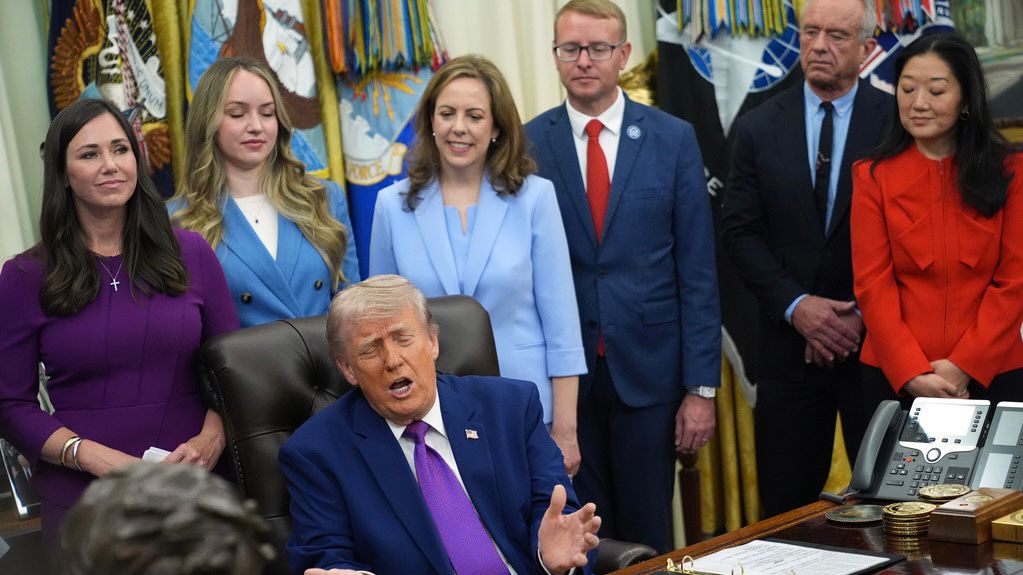
WASHINGTON — President Donald Trump announced several programs Monday designed to improve women’s healthcare and increase the American fertility rate.
One day after Mother’s Day, when the Department of Health and Human Services launched the moms.gov website for new and expecting mothers, Trump said he is enacting “groundbreaking childcare reforms.”
What You Need To Know
President Donald Trump announced several programs Monday designed to improve women’s healthcare and increase the American fertility rate
One day after Mother’s Day, when the Department of Health and Human Services launched the moms.gov website for new and expecting mothers, Trump said he is enacting “groundbreaking childcare reforms”
Among those reforms is a new Labor Department rule that formally creates a fertility benefit option for employers to offer employees outside of their health insurance plans, Trump said
Health Secretary Robert F. Kennedy Jr. praised his agency’s new moms.gov website as “a huge win for the MAHA and for the pro-life movement,” describing the site as a one-stop shop for IVF, prenatal and postnatal care, nutrition, baby formula and the federal pharmaceutical program TrumpRX
Among those reforms is a new Labor Department rule that formally creates a fertility benefit option for employers to offer employees outside of their health insurance plans, Trump said.
“This will be a supplemental option available to those who need it, much like vision or dental insurance,” he said at an event where he was joined by Health Secretary Robert F. Kennedy Jr., Centers for Medicare and Medicaid Services Administrator Dr. Mehmet Oz and several prominent women involved in implementing the new programs.
“This will hopefully reduce the number of couples who ultimately need to resort to (in-vitro fertilization) because challenges can be identified and addressed very early in the process,” Trump said, adding that it will “be a major help for millions of American moms that will result in more beautiful American babies.”
Last month, the U.S. Centers for Disease Control and Prevention said the U.S. fertility rate had fallen to a record low of 53.1 births per 1,000 women aged 15-44 in 2025 — a 1% decline from 2024 that continued a two-decade downward trend.
A fertility rate lower than the replacement rate not only falls short of sustaining the U.S. population but also supporting the federal benefit programs, Social Security and Medicaid, Kennedy said.
“We are approaching the cataclysmic rates that China and Japan are now experiencing that is threatening their economy,” he said. “It’s a threat not only to our economy, to our national security, it’s a direct threat to our Social Security trust fund and the Medicare trust fund.”
Kennedy praised his agency’s new moms.gov website as “a huge win for the MAHA (Make America Healthy Again) and for the pro-life movement,” describing the site as a one-stop shop for IVF, prenatal and postnatal care, nutrition, baby formula and the federal pharmaceutical program TrumpRX that offers lower prices for some fertility treatments following the president’s recent deals with pharmaceutical companies to lower costs.
The opening page of moms.gov says it is “addressing the needs of mothers and fathers who face difficult or unexpected pregnancies and ensuring the wellbeing of mothers and the health of American families.”
It provides search engines to find federally qualified health centers in medically underserved areas and pregnancy centers that provide support for unexpected pregnancies. Planned Parenthood says pregnancy centers are “fake” health clinics run by anti-abortion advocates.
The website also provides nutrition recommendations for pregnant women, new mothers and infants; a link to enroll children in Trump Accounts that provide children born between 2025 and 2028 with a $1,000 retirement investment; a link to TrumpRx.gov to find medications “to help couples build their families;” and other information ranging from substance use and infections to health conditions that may affect a pregnancy and sleep safety for babies.
“One in three Americans are under babied,” said Oz, seeming to coin a term he defined as meaning “you either don’t have any children or you have less children than you would normally want to have.”
Oz credited the tax and spending bill Trump signed last July with “saving Medicaid” — the federal program that works with states to provide free and low-cost health coverage to about 80 million people, according to the HHS.
The Congressional Budget Office estimates 7.8 million people will lose their health insurance by 2034 because of the bill, which includes strict new work requirements and more frequent checks on eligibility.
Oz also praised the $50 billion Rural Health Transformation Program signed into law last year for “incredibly beneficial advances to help Americans living in rural America have babies safely,” he said, citing HHS data that found maternal mortality is 30% higher in rural areas compared with cities.
Trump also announced Monday that his administration is approving reforms to the federal Child Care and Development Fund, including the HeadStart program that provides free early childhood education, health and nutrition services to low-income kids through the age of 5.
Trump said the reforms will free up childcare for stay-at-home parents and give states more flexibility, lower costs and increased options to empower parents to choose childcare that works best for them.
Childcare advocacy groups, however, say the changes will eliminate a Biden administration rule that caps childcare copayments for low-income families at 7% of household income and will worsen childcare affordability.
“We know last year alone you had about 455,000 women leave the workforce due to affordability and accessibility of childcare,” Sen. Katie Britt, R-Ala., said.
“If you have or want the opportunity to stay home, we want that for you,” she said. “But if you want or need the opportunity to re-enter the workforce, I want to be a part of building back America like President Trump is doing. We don’t want affordability or accessibility to be an impediment to that.”
According to the First Five Years Fund, families spend an average of about 20% of their incomes on childcare, or $13,000 per child per year. Low-income families, however, spend up to 80% of their income on care, preventing their ability to participate in the workforce.