
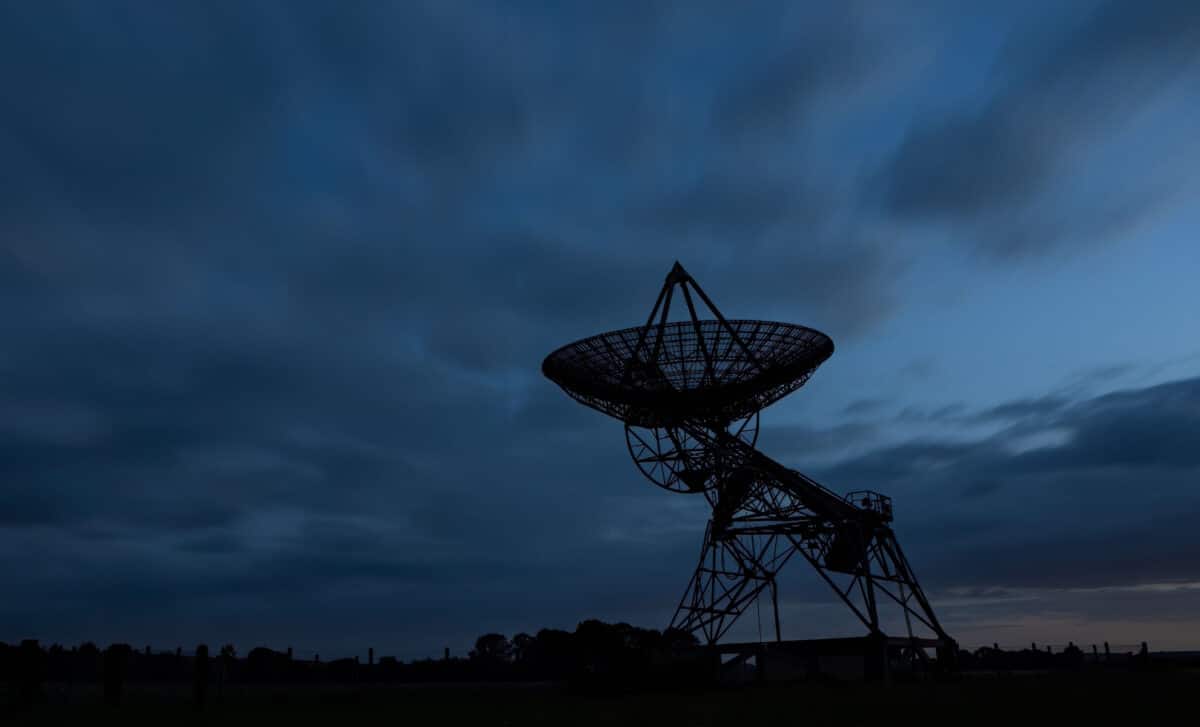
What began as a telecommunications engineering task quickly turned into one of the most influential discoveries in modern astronomy. Jansky’s work introduced a completely new way to observe the universe, expanding astronomical research beyond visible light for the first time.
At the time, astronomers relied exclusively on optical telescopes to study celestial objects. Jansky’s discovery demonstrated that stars and other cosmic bodies emit energy in the form of radio waves that can be detected from Earth. The finding changed the direction of astronomical research and opened an entirely new observational field.
Working at Bell Telephone Laboratories in New Jersey, Jansky had been assigned a relatively practical mission: determine the cause of static interfering with long-distance radio communications. To carry out the investigation, he built a large rotating antenna capable of tracking the direction of incoming interference signals as they moved across the sky.
A Repeating Hiss Pointed to an Unknown Source in Space
During his observations, Jansky detected a persistent hissing sound unlike ordinary radio interference. At first, he suspected the noise came from natural or human-made sources. The signal, though, behaved differently from anything he had previously recorded.
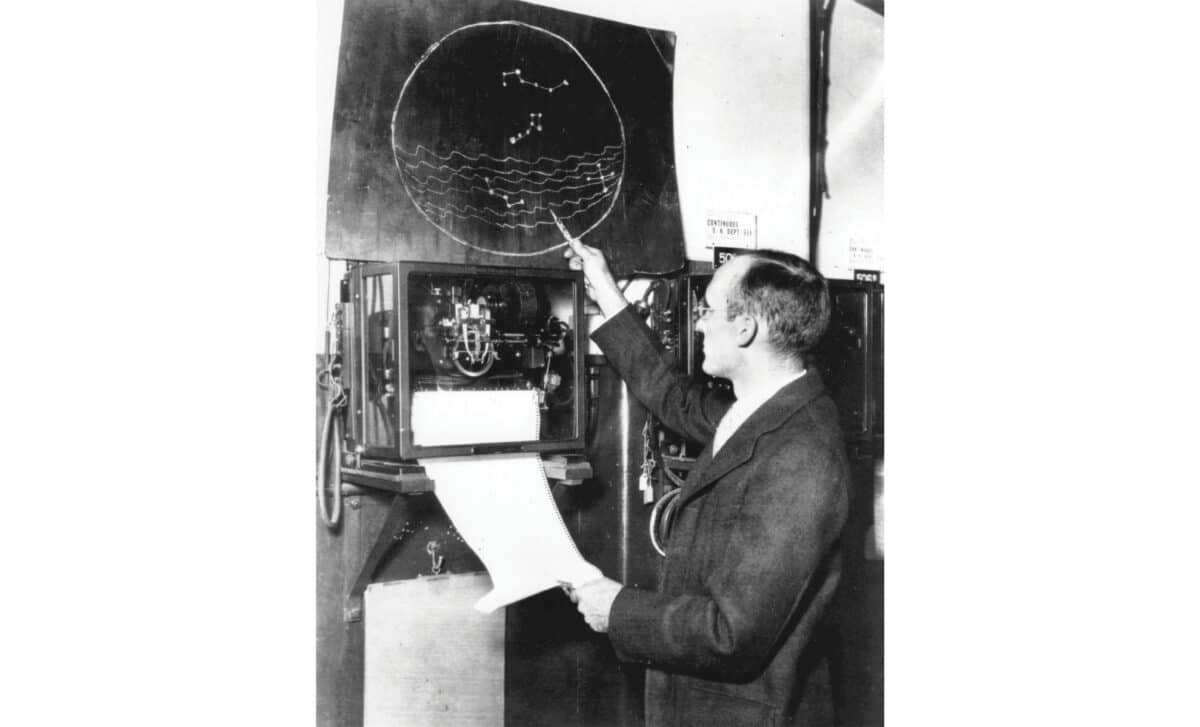 Karl Janksy circa 1930’s – © National Radio Astronomy Observatory
According to a 1933 paper published in Nature, the hiss repeated every 23 hours and 56 minutes, matching what is known as a sidereal period. That timing indicated the source was linked to the stars rather than to Earth-based activity or the Sun.
Jansky reported that the signal appeared to come from a fixed location in space. The recurring pattern ruled out many conventional explanations and pushed him to continue examining the origin of the emissions.
The Milky Way Emerged as the Source of the Radio Emissions
As his work progressed, Jansky identified the strongest concentration of radio emissions in the direction of the Sagittarius constellation. This region lies near the center of the Milky Way galaxy.
Later findings published by Nature confirmed that the radiation originated from the Milky Way itself and not from solar activity. According to the report cited by the Times of India, the Sun did not contribute to the detected emissions.
Before Jansky’s observations, the Milky Way had never been known to produce radio signals. Space was largely considered radio quiet, and astronomy remained focused entirely on visible-light observation. The discovery challenged that assumption without any initial intention to study astronomy itself.
A Discovery That Rewrote the Rules of Astronomy
Before Jansky’s research, astronomers depended exclusively on visible-light telescopes to collect information about celestial bodies. Images and observations were limited to what could be seen directly through optical instruments.
Jansky’s findings introduced a completely new observational method. According to NASA, the discovery showed that stars and other cosmic objects emit radio waves detectable from Earth, creating the basis for radio astronomy.
The impact of the discovery extended well beyond Jansky’s original telecommunications project. A technical effort aimed at reducing static in communication systems ultimately revealed an entirely new way to explore the universe, one that astronomers still rely on today.