
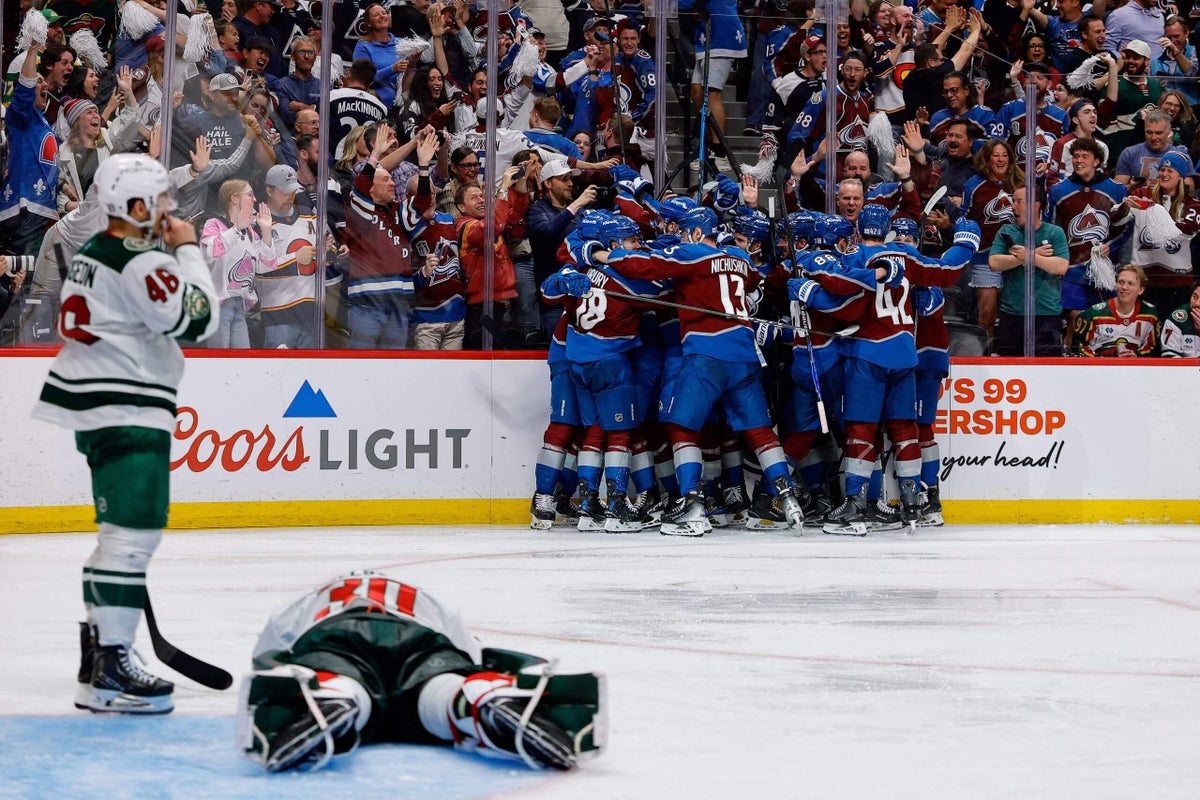
DENVER — Fifteen minutes after the most shocking loss in Minnesota Wild playoff history, general manager and president of hockey ops Bill Guerin, with three of his fellow executives following in single-file line, came down from their corner suite at Ball Arena and headed toward the back of a still closed locker room.
Guerin, not making eye contact with any of the assembled reporters, looked like he had just gone 10 rounds with Mike Tyson. The man who assembled this roster looked both furious, and, like his coach and players, shell-shocked at what he had just witnessed and how it could have happened.
How on Earth could this Wild team, after dominating the first period and taking a 3-0 lead with a chance to keep its season alive and force a Game 6, collapse in such an absolutely disgusting fashion?
Seven harmless shots in the final 43 minutes, 52 seconds of a game against the mighty Colorado Avalanche. Sitting back for 40 long, exhausting, aggravating minutes. Blowing a two-goal lead in the final 3 1/2 minutes because of poor execution and attention to detail. Looking so inept and jittery in the first few minutes of overtime until that fourth and final goal sent the Wild back to Minnesota with no more games to play after a devastating 4-3 season-ending loss.
“It’s just empty,” Mats Zuccarello said.
“Shock,” Marcus Foligno said.
“Anger and frustration,” Brock Faber said. “You work all year for one thing, and just feels like it closes like that, and it’s just done, it sucks.”
The Wild would have been underdogs to beat the league’s best team even with Joel Eriksson Ek and Jonas Brodin, who both missed the series with injuries. The trickle-down effect was too much to recover from. The Wild’s penalty kill, without them, stunk. Their power play, without Eriksson Ek at the net-front, was awful. With Ryan Hartman already miscast as the No. 1 center, young Danila Yurov wasn’t ready to be No. 2, and it’s ridiculous in a must-win game that they had no other option but to play Michael McCarron in that role.
On the blue line in Brodin’s spot, Jake Middleton, for the second postseason in a row, was beyond overmatched, on the ice for 13 goals against, including the tying and losing goals Wednesday.
Still, to see this team crumble into smithereens after playing so well in the first 20 minutes is the type of thing that can get a coach fired, even with the built-in excuse of no Eriksson Ek and Brodin.
“I think our guys competed hard,” coach John Hynes said, avoiding the opening question of the news conference on what the heck happened. “This group is a pleasure to coach. You go nine months together, basically, right? And great competitors, great character, gave everything they had. And that’s all you can ask as a coach.”
You can also ask them not to blow a three-goal lead for the first time in Wild playoff history. And maybe to try to skate the puck over the red line once or twice in the second half of the game.
As Faber said so honestly after, the Avalanche deserved to win this series.
“You can’t really hide or dance around the fact that they outplayed us, but … that’s where the frustration comes in,” Faber said. “I feel like when we are at our best, we can beat that team. We just didn’t.”
One of the Wild’s popular phrases in this series was, “Our best is good enough.” We saw that in a dominant Game 3 victory that served mostly as a tantalizing tease of what could have been.
But you can’t play four or five good periods in a series and expect to win, especially against the class of the NHL. The Avalanche looked and felt every bit like a Stanley Cup champion — a blend of resilient and relentless.
It wasn’t just Nathan MacKinnon, who scored in every game of the series, dominating. It was players like Ross Colton and Parker Kelly and Jack Drury.
The Wild know the Avalanche are the best team in the league when it comes to tips, yet they couldn’t keep them from the middle of the offensive zone and gave up two more deflected goals Wednesday.
“They get a lot of bodies in there,” goalie Jesper Wallstedt said. “That makes it a hard job for me with screens and traffic. It’s hard for goalies to save (tips). They got to the areas where they had to get to, and they got rewarded for it.”
The Wild, a presumed Cup contender for the first time, acted like pretenders. It showed in their inexplicable faceplant in Game 4 at home, when they had what Foligno called a “brain fog” and got arrogant and didn’t play their game. And it ended with this epic collapse in Game 5, snatching defeat from the jaws of victory.
They had the Avalanche right where they wanted them, then let them rip their hearts out.
“Every one of us had a strong belief that we were going to bring this back to St. Paul,” Wallstedt said. “Everyone gave it (their) all out there. Felt like we really, really had an effort that could win us a game, but today it just wasn’t enough.”
The Wild needed their best players to be better. There’s no hiding from that.
Where was the Matt Boldy who was such a clutch game-breaker in the first round against the Dallas Stars? He had just one goal in five games, an empty-netter. In the last minute of regulation, he looked panicked as he fumbled the puck left and right. In the first few seconds of overtime, he made a poor pass to McCarron on a two-on-one. Later in overtime, seconds before the game ended, he couldn’t catch Kirill Kaprizov’s pass for a one-timer.
Where the heck was Kaprizov, the guy who held the Wild hostage before the season in contract talks and in six weeks will cash an $18.1 million signing bonus check — the first in his brand new $17 million-per-year deal, the richest in NHL history? He showed some life in a dominant Game 3 in buoying that win. But in the Game 4 flop, he had one measly shot on goal. In the must-win Game 5? Zero, including not shooting and instead passing to Boldy seconds before Colorado came down and ended Minnesota’s season.
Hynes dodged a question about Kaprizov after the game. And Kaprizov got visibly and audibly angry when asked about his pass to Boldy and having no shots.
Kaprizov and Boldy could have been heroes if that pass had connected. Instead, Boldy whiffed and, seconds later, Brett Kulak — of all players — put the dagger in Minnesota’s season after Martin Nečas came through in the clutch with a tremendous setup.
This loss stings far more than the others, particularly because the Wild raised their own expectations. They finally won a first-round series for the first time in a decade, but desperately wanted more. And a path was there, especially with either the Anaheim Ducks or Vegas Golden Knights waiting in the next round.
“You get through these guys, you never know,” Quinn Hughes said.
“You get past Colorado, and you’ve got a shot,” Foligno echoed.
That’s what will probably haunt this group for a long time. This is the most talented collection of Wild players in team history, and their core isn’t getting any younger. They’ve got Hughes, one of the game’s premier defensemen, for just one more season, unless he signs an extension, which he can starting this summer.
“I think it’s a little early to be thinking that way,” Hughes said. “Obviously, just disappointed right now and proud of everyone in how we competed and battled and just leave it at that.”
At some point, the Wild have to break through. But Wednesday night, they were handed a harsh lesson from a true contender — one that smelled blood against a team that cowered and played scared to death from the 20-minute mark on.
“(We) took a step, for sure. I don’t think anyone can deny that,” Boldy said. “But I think we can start to realize what we are capable of — the type of team we are. How good we are. The core we have. We’re capable of so much.
“That’s the positive thing. So the sooner that we can realize that and act like that and play our game like that, the better off we’re going to be. Unfortunately, you’ve got to learn how to lose to learn how to win. That team over there has done that. They’ve gone through ups and downs. They’ve learned how to lose and learned how to win, and I think that’s what we have to do. We have to use this experience to benefit us and start to realize that with the group we have that this is a great chance for us to take another step in the right direction.”
But haven’t the Wild learned how to lose enough in the last decade? Especially this core? How many more heartbreaks do they need to “mature” and figure it out?
On Wednesday, they found out that the season ending in mid-May is just as painful as it feels in late April.
Especially the embarrassing and preventable way it happened this time.