
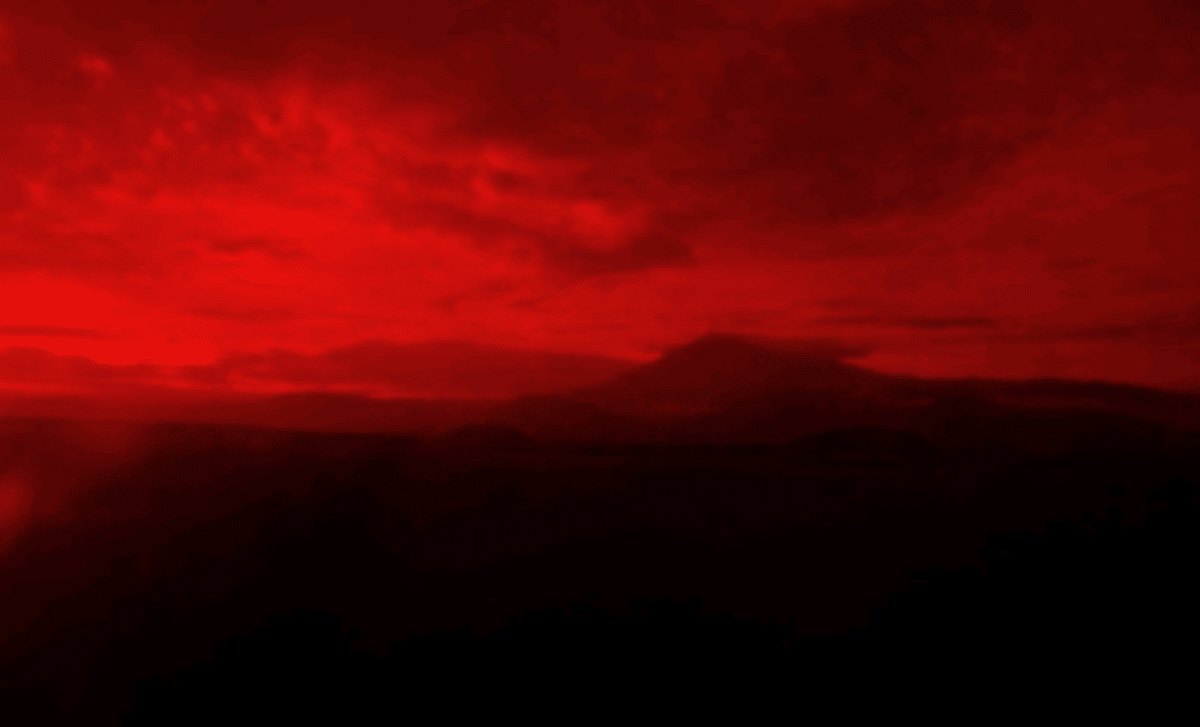
A powerful solar storm that erupted more than 800 years ago has been uncovered through an extraordinary combination of ancient tree analysis and medieval historical records. The discovery, detailed in Proceedings of the Japan Academy, Series B, points to a dangerous burst of solar activity that likely occurred between the winter of 1200 CE and the spring of 1201 CE. Scientists believe the event was strong enough to trigger vivid red auroras visible far from the poles while sending high-energy particles racing through Earth’s atmosphere.
Ancient Trees Became A Time Capsule Of Solar Violence
The breakthrough came from researchers at the Okinawa Institute of Science and Technology (OIST), who developed a highly refined method for tracking traces of ancient solar proton events hidden inside preserved wood. These events occur when violent eruptions from the Sun accelerate charged particles to enormous speeds, sometimes approaching 90% of the speed of light. When those particles strike Earth’s atmosphere, they can trigger chemical reactions that produce radioactive carbon-14. Tiny traces of that isotope become trapped inside living organisms, including trees, preserving a long-term record of solar activity.
The team analyzed buried asunaro trees recovered from northern Japan and detected subtle carbon-14 spikes invisible to older measurement methods. Their ultra-precise approach took more than a decade to refine and allowed scientists to identify “sub-extreme” solar proton events that were previously almost impossible to detect. Those storms may not match the scale of the largest solar catastrophes ever recorded, but they still carry major risks for modern technology and future crewed lunar missions.
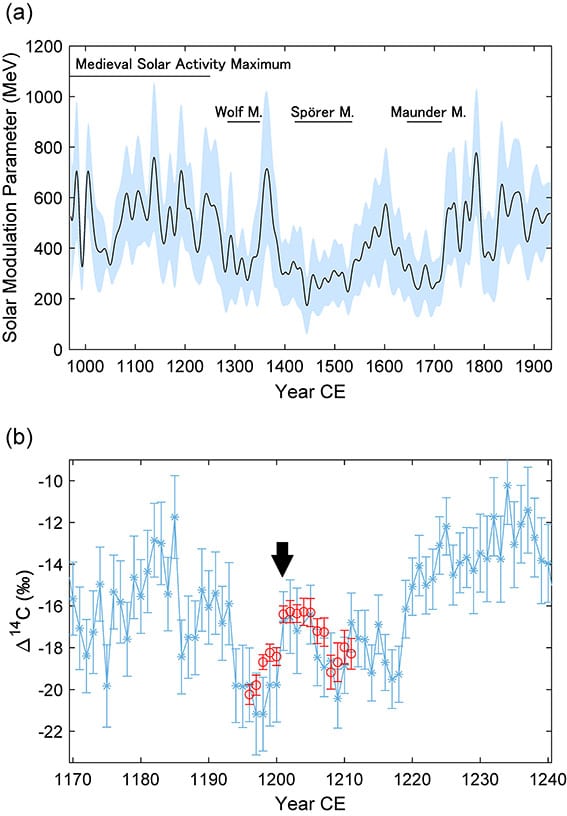 Reconstructed solar activity and carbon-14 data identifying a likely solar proton event around 1200 CE, during a period of unusually intense medieval solar activity.
Credit: Proceedings of the Japan Academy, Series B
Professor Hiroko Miyahara from the OIST Solar-Terrestrial Environment and Climate Unit explained:
“Previous studies on historical SPEs have focused on rare, extremely powerful events. Our paper provides a basis for detecting sub-extreme SPEs — events that occur more frequently and are around 10-30% of the size of the most extreme cases, but still hazardous. Sub-extreme SPEs are more challenging to detect, but our method now allows us to efficiently identify them and better understand the conditions under which they are more likely to occur.”
The study published in Proceedings of the Japan Academy, Series B gives researchers a much sharper picture of how often dangerous solar activity may have occurred throughout history. Scientists now believe the Sun may produce hazardous radiation storms more frequently than earlier estimates suggested.
A Medieval “Red Sky” Record Led Scientists To The Discovery
The investigation gained momentum after researchers examined historical Japanese documents describing unusual celestial events. One key source was Meigetsuki, the diary of poet and nobleman Fujiwara no Teika, who recorded seeing mysterious “red lights” glowing across the northern sky over Kyoto in February 1204 CE. Similar reports also appeared in historical Chinese texts describing red auroras appearing at unusually low latitudes.
Auroras themselves are not direct evidence of solar proton events, but they often emerge during periods of violent solar activity involving massive magnetic eruptions from the Sun. Those historical descriptions gave scientists a narrow timeframe to investigate using carbon-14 analysis and dendroclimatology, a technique that compares tree-ring growth patterns linked to regional climate conditions.
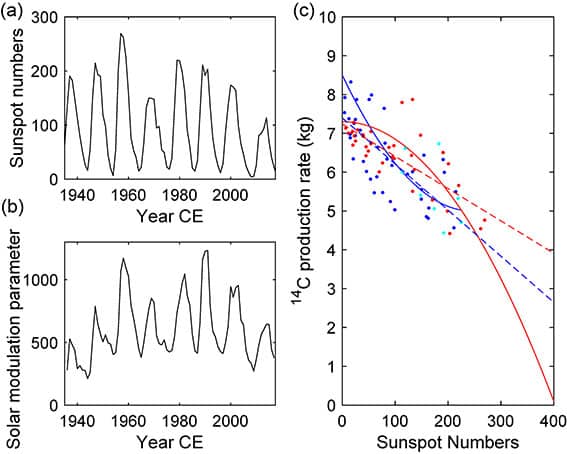 Solar activity and carbon-14 production, showing that higher sunspot activity corresponds to lower atmospheric carbon-14 formation.
Credit: Proceedings of the Japan Academy, Series B
The evidence pointed toward a major solar proton event occurring between late 1200 and early 1201 CE. Researchers believe the event unfolded during a period when the Sun itself was behaving far more aggressively than it does today. Their reconstruction of ancient solar cycles revealed something unexpected: solar cycles during that era appeared to last only seven to eight years rather than the modern average of eleven.
Miyahara said:
“The high-precision data not only allowed us to accurately date sub-extreme solar proton events, but it also lets us clearly reconstruct the solar cycles of the period. Today, the Sun’s activity fluctuates over eleven-year-long cycles, but we’ve found that the cycle was just seven to eight years long back then, indicating a very active Sun. The SPE we have dated occurred at the peak of one of these cycles.”
That shortened cycle suggests the medieval Sun may have been operating in a highly energized state capable of generating repeated bursts of dangerous activity over relatively short periods.
Why These Ancient Solar Storms Matter Today
The discovery carries major implications for modern civilization because humanity is becoming increasingly dependent on vulnerable technologies both on Earth and in space. Extreme solar storms can interfere with satellites, GPS navigation, radio communications, aviation systems, and electrical grids. For astronauts traveling beyond Earth’s magnetic shield, the risks become even more severe.
Scientists often point to the intense solar proton storms of 1972, which erupted between the Apollo 16 and Apollo 17 Moon missions. If astronauts had been exposed directly during a lunar excursion, radiation levels may have reached lethal levels in a matter of hours. As agencies like NASA prepare for long-duration missions under the Artemis program, understanding the frequency and warning signs of solar storms has become increasingly urgent.
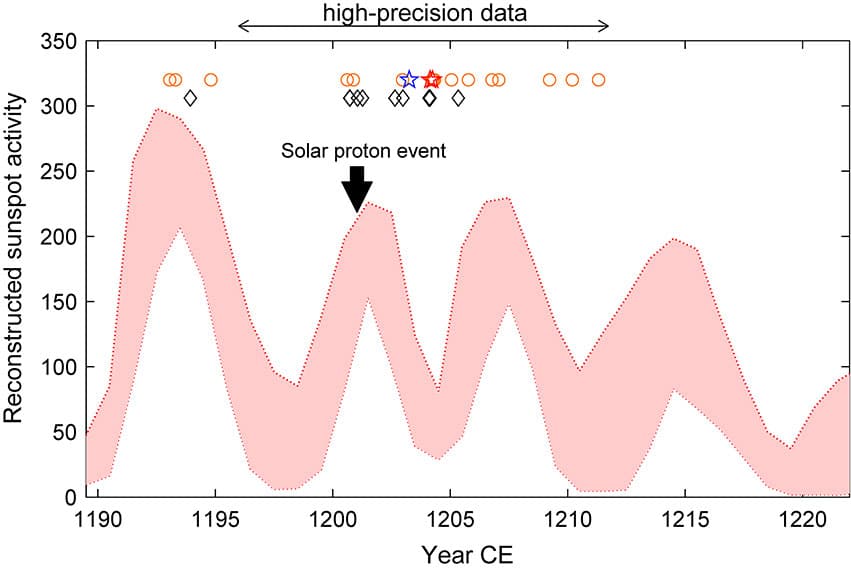 Solar activity between 1190 and 1220 CE, highlighting a probable solar proton event around 1200–1201 CE during a period of elevated medieval solar activity.
Credit: Proceedings of the Japan Academy, Series B
The newly discovered event also highlights the growing importance of combining multiple scientific disciplines to reconstruct ancient space weather. Carbon-14 analysis alone cannot provide a complete picture. Historical literature, climate studies, and astronomical records all help scientists refine timelines and identify links between auroras, sunspots, and solar eruptions.
Miyahara concluded:
“Historical literature provides a candidate time window, and dendroclimatology enables direct intercomparison between detected SPE and reports of sunspots and auroras recorded in literature. Integrated approaches like these are necessary to accurately reconstruct past solar activity, helping us better understand the characteristics of extreme space weather.”