
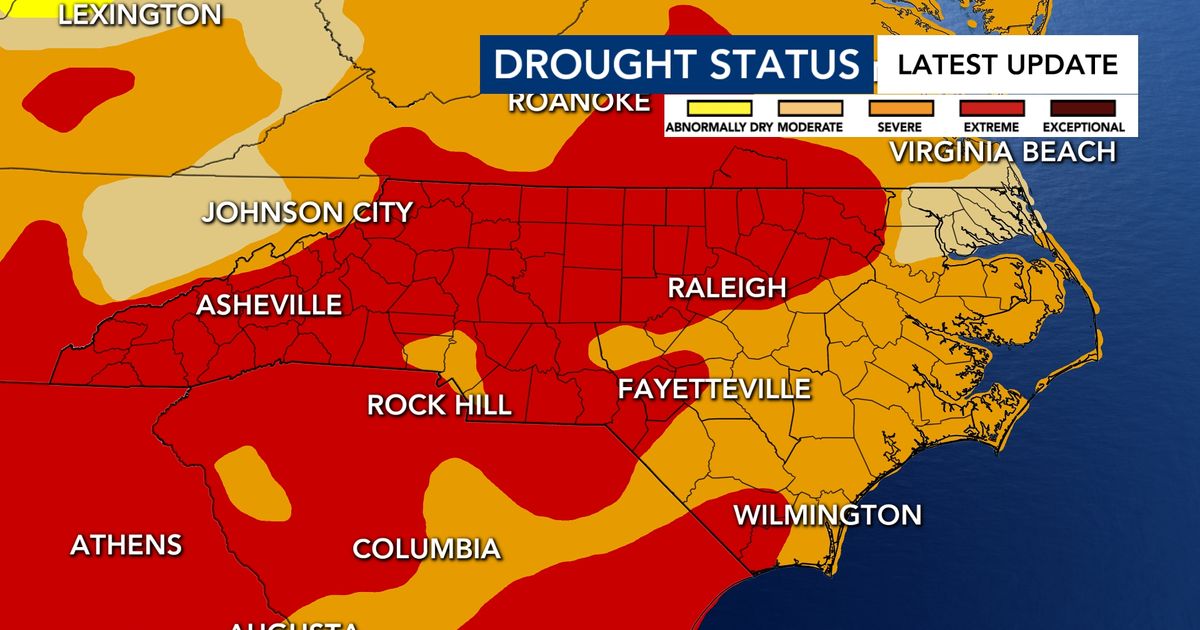
Even after recent rain, much of North Carolina remains locked in severe or extreme drought conditions as state regulators grapple with growing battles over who gets access to water during a period of rapid growth and mounting strain on river basins.
The latest U.S. Drought Monitor map released Thursday showed large portions of central and western North Carolina in extreme drought, while much of the eastern half of the state remained in severe drought.
The worsening long-term dryness was one of several major topics discussed this week during meetings of the North Carolina Environmental Management Commission’s Water Allocation Committee, where regulators also weighed controversial interbasin water transfers and updates to dam safety rules.
“One of our biggest concerns is we’re entering the growing season already below normal,” Klaus Albertin with the N.C. Division of Water Resources told commissioners. “During our last major drought in 2007, we started the summer in much better shape.”
During Wednesday’s drought update, Department of Environmental Quality staff presented maps showing long-term precipitation deficits, historically low streamflows and stressed water conditions across much of the state.
Officials said recent rainfall has varied dramatically by region, complicating drought messaging and water restrictions.
“Charlotte got two to three inches, and the rest of the state, for the most part, got a quarter to half,” Albertin said. “It varies quite a bit and it does cause confusion.”
The discussion comes as North Carolina faces growing pressure on water supplies from population growth, industrial demand and recurring drought conditions.
Water transfer battles intensify
Committee members also received updates on several high-profile interbasin transfer requests, known as IBTs, which allow communities to move water from one river basin to another.
The issue has become increasingly contentious as fast-growing communities search for long-term water supplies while downstream communities warn that permanently removing water from already stressed river basins could create future shortages.
The Town of Mooresville is seeking to increase its transfer request from 8 million gallons per day to 12.6 million gallons per day by 2055.
Charlotte Water is also pursuing a modification request that would nearly double its authorized transfer capacity from 33 million gallons per day to 63 million gallons per day.
Meanwhile, Fuquay-Varina’s controversial proposal to transfer water from the Cape Fear River Basin to the Neuse River Basin continues drawing intense opposition from downstream communities.
The proposal would allow the town to withdraw up to 6.17 million gallons of water per day from the Cape Fear River Basin while returning treated wastewater to the Neuse River Basin.
During the meeting, DEQ staff said regulators received roughly 2,000 email comments, 54 formal letters and about 1,600 petition signatures regarding the proposal, with the majority critical of the transfer.
Communities and utilities downstream have argued the proposal could reduce river flows during drought, strain drinking water supplies and worsen pollution concentration issues in the Cape Fear River.
State regulators are now preparing a hearing officer’s report on the proposal, which is expected to return to the committee in September before additional public hearings and a final EMC determination.
The debate has become part of a broader debate over how North Carolina manages water as development accelerates across the state and communities compete for increasingly strained resources.
Dam safety rules also under review
The committee also advanced proposed updates to North Carolina’s dam safety rules, which regulators say are intended to modernize standards and account for changing downstream development patterns.
According to DEQ, North Carolina has roughly 7,471 dams statewide, including about 1,551 classified as high-hazard dams, meaning failure could potentially result in loss of life.
The proposed changes would update hazard classifications using newer traffic counts, economic impacts and future downstream development.
DEQ’s regulatory analysis said more dams are being classified as high hazard each year as development expands downstream and newer modeling tools identify greater risks.