
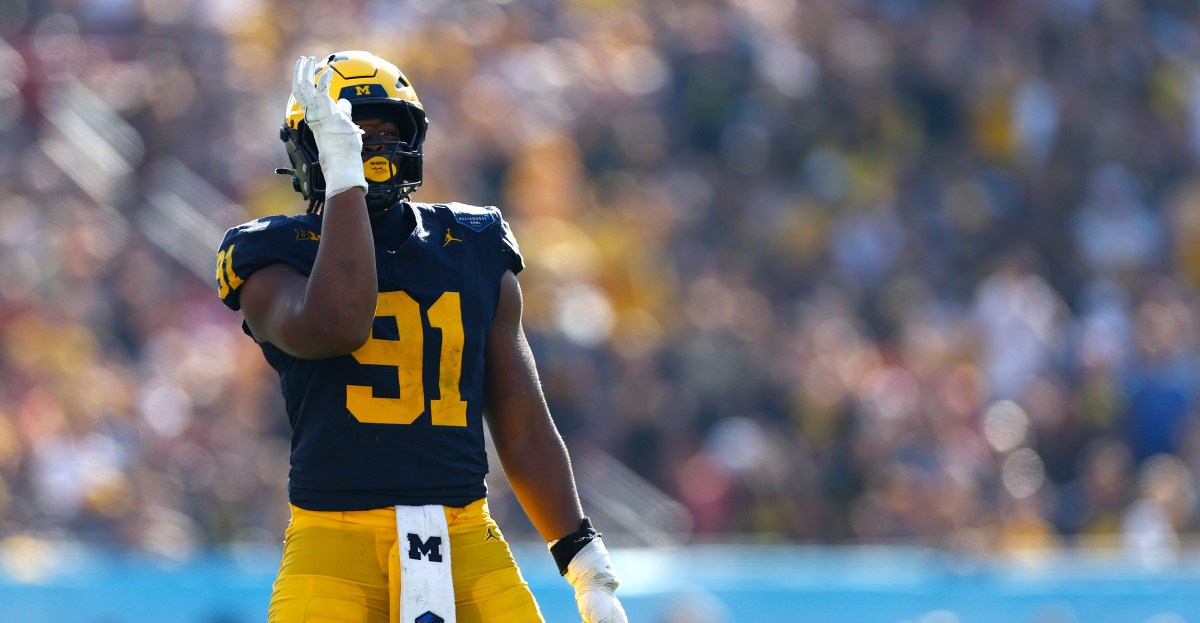
Could Michigan’s edge rotation actually be better than people think in 2026? There’s been a lot of focus this offseason on what Michigan lost along the edge and whether or not the Wolverines can replace that production. But what if I told you this defensive end group might end up a strength on the roster.
Once you start looking a little closer at the pieces Michigan still has — along with some of the things we’ve seen and heard throughout the spring — there are actually a few reasons to believe this position group could surprise people this fall.
Everyone knows the big name is John Henry Daley. The former Utah standout followed Kyle Whittingham to Ann Arbor after compiling 11.5 sacks last season and being named an All-American. National media outlets are already throwing major expectations on him heading into the new season. If he is anywhere close to the player he was prior to his Achilles injury at the end of the 2025 season, Michigan already has a legitimate and elite player along the edge.
But what makes this group intriguing isn’t just Daley — it’s the potential the pieces around him could end better than most people realize.
Take Dominic Nichols, for example. His numbers from last season won’t jump off the page immediately, but the underlying Pro Football Focus (PFF) metrics are actually pretty encouraging. Nichols finished as one of the top-graded defenders on Michigan’s roster, per PFF, despite playing just 198 snaps. He also posted a 72.2 overall grade and was one of the highest-rated tacklers on the entire defense with an 85.2 grade.
Following the spring game, Whittingham even went as far as to saying he believes Nichols has future All-Big Ten potential. The physical tools are obvious as well — he has a long frame, an explosive first step, and legitimate traits as both a pass rusher and a run defender. If there’s actual smoke to his development, Michigan may already have one player that’s able to replace some of the production from last season.
Then there’s Nate Marshall, who barely scratched the surface statistically. There’s even a world where he’s the player in this room with the highest ceiling outside of Daley. Formerly a Top 50 overall recruit, Marshall’s athletic upside has been talked about pretty much nonstop since he arrived on campus. The sophomore leap conversation has only grown louder this spring.
Cam Brandt is another interesting piece here, and if last year’s snap counts mean anything, he is the most experienced returning Wolverine at the position. He’s probably become oddly underrated among fans after an uneven 2025 season, but the staff seems genuinely encouraged by the progress he made this spring. Whittingham specifically mentioned that Brandt trimmed weight this offseason, which helped his burst and explosiveness off the edge. Sometimes that stuff actually matters more than people think for defensive ends trying to turn pressures into sacks.
Even beyond the top names, the Wolverines keep talking about having legitimate depth there. Lugard Edokpayi continues generating buzz because of his freakish length and athletic traits, while five-star freshman Carter Meadows could force his way into the conversation sooner rather than later.
Most importantly, the staff itself seems extremely confident in the room. Whittingham has repeatedly referred to the defensive line as a whole as the deepest and strongest unit on the roster, even mentioning Michigan could realistically rotate close to 10 players up front this season. That’s not coach-speak you usually hear unless a staff genuinely feels good about what it has.
Now, does that automatically mean Michigan is suddenly fielding another 2021-caliber edge group? Not at all. There are still real questions — Daley is coming off a major injury, Nichols hasn’t done it over a full season yet, and Marshall is still largely projection at this point. But there’s also a very real path where this ends up being one of the more disruptive edge rotations in the Big Ten.