
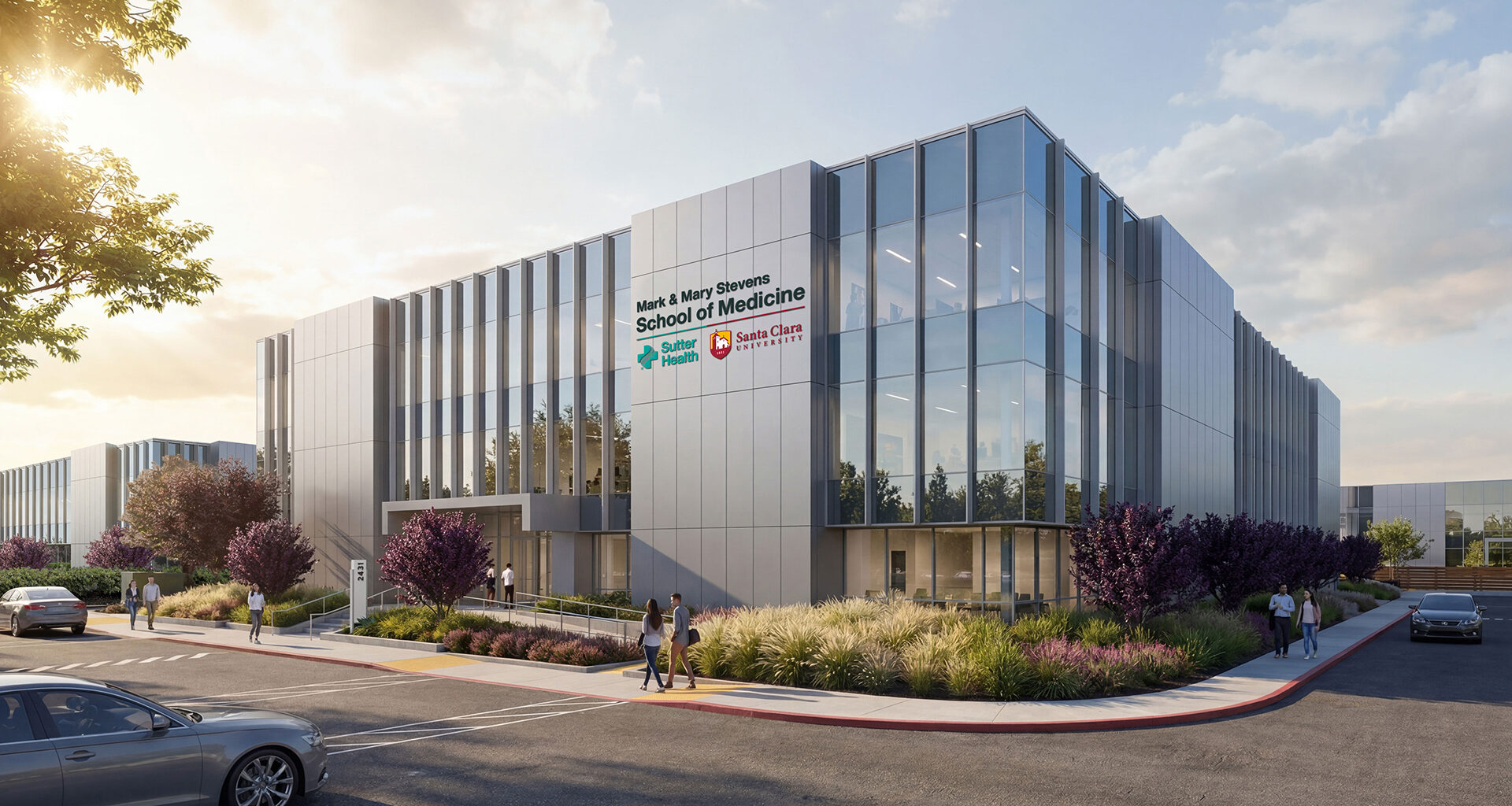
Santa Clara University and Sutter Health plan to open the first new medical school in the Bay Area in more than 100 years, leaders at the university and the health care provider announced Friday.
The school, funded in part by a $175 million gift to the university from venture capitalist Mark Stevens and wife Mary, a 1984 alum, will be named the Mark and Mary Stevens School of Medicine. Pending approval from accrediting bodies, the 82,000-square-foot school will be built in Santa Clara about 5 miles from the university’s main campus and adjacent to Sutter’s East Santa Clara medical center at 2441 Mission College Blvd.
It’s not clear when the school would open, as the accreditation process can take several years. But Sutter CEO Warner Thomas said he hopes it will be around 2030. The Liaison Committee on Medical Education accredits U.S. medical schools.
It will be the third major medical school in the Bay Area after UCSF and Stanford, which were founded in 1864 and 1908, respectively. Touro University in Vallejo, which grants a Doctor of Osteopathic Medicine degree, or D.O., opened in 1997.
The school aims to initially admit about 30 to 40 students per class, and gradually expand to 120 students per class. Santa Clara University will grant the degree, a Doctor of Medicine (M.D.), and Sutter will be the school’s exclusive clinical partner — meaning the students will do their rotations at Sutter clinics and hospitals for their third and fourth years of medical school. The clinical faculty will be Sutter physicians.
Thomas said one of the goals of opening a new medical school in the Bay Area is to try to get would-be doctors from California to stay in state for their medical education and subsequent medical practice. This could help alleviate the nationwide physician shortage that’s projected to be as high as 86,000 by 2036, according to a 2024 analysis by the Association of American Medical Colleges. As of 2025, California had a primary care physician shortage of nearly 3,500, according to the National Center for Health Workforce Analysis.
The shortage is happening largely because the population aged 65 and older is growing, increasing the need for specialists who care for older adults. At the same time, about a third of U.S. doctors are expected to retire in the next decade, according to the AAMC report.
“With the aging of the population, we see the aging of our physician population too,” Thomas said. “More and more are retiring. So we need to be building a pipeline of new physicians coming into the industry to be able to take care of patients in the future.”
Santa Clara University President Julie Sullivan said building a new medical school curriculum is an opportunity to shape the future of medicine, particularly around how to apply new and emerging technology like AI.
“The idea of doing this from scratch, with a fresh view of where we are today, is going to be exciting and a huge opportunity for all of Northern California,” Sullivan said.
The medical school is part of a multiyear expansion in Santa Clara by Sutter, which is headquartered in Sacramento. It will be located about a mile from the Sutter West Santa Clara campus, where a new hospital will open by 2031.