

Track your investments for FREE with Simply Wall St, the portfolio command center trusted by over 7 million individual investors worldwide.
AT&T, Verizon and T-Mobile are forming a joint venture to address U.S. mobile dead zones using satellite-based direct-to-device connectivity.
AST SpaceMobile (NasdaqGS:ASTS) is expected to be a key technology partner helping deliver space-based mobile service directly to standard smartphones.
The collaboration aims to extend coverage beyond traditional towers, targeting rural areas, highways and other hard-to-reach locations.
For AST SpaceMobile, which is focused on building a space-based cellular broadband network that works with everyday mobile phones, this carrier tie-up speaks directly to its core business model. Direct-to-device satellite links have become a priority topic across telecom, with multiple players testing ways to close connectivity gaps. Having the three largest U.S. carriers move together puts real commercial weight behind this part of the industry.
For investors following NasdaqGS:ASTS, the joint venture introduces a different scale of potential demand compared with one-off carrier partnerships. As details around contracts, deployment timelines and service pricing emerge, it will be easier to evaluate how this may affect capacity needs, capital requirements and potential revenue opportunities.
Stay updated on the most important news stories for AST SpaceMobile by adding it to your watchlist or portfolio. Alternatively, explore our Community to discover new perspectives on AST SpaceMobile.
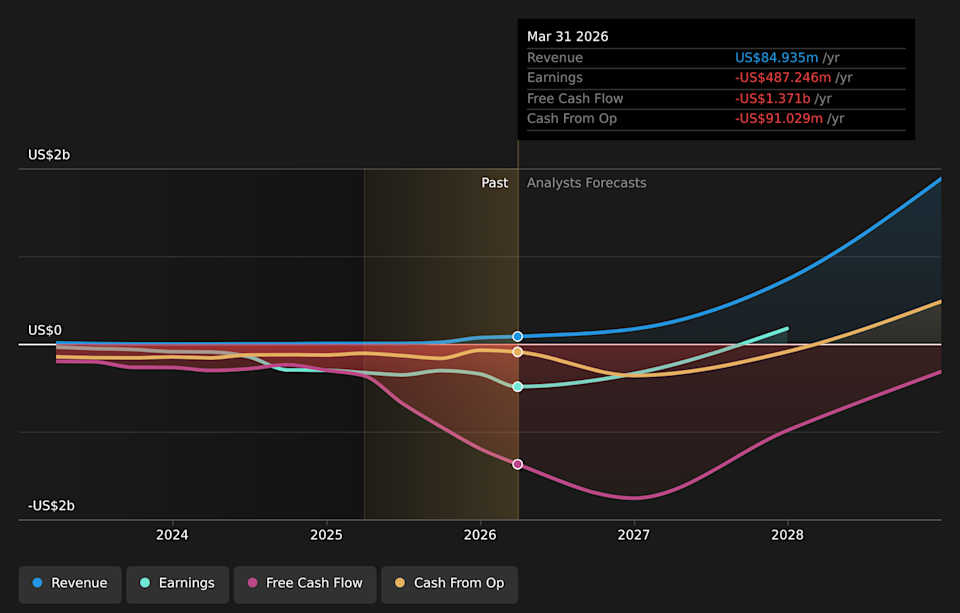 NasdaqGS:ASTS Earnings & Revenue Growth as at May 2026
2 things going right for AST SpaceMobile that this headline doesn’t cover.
For AST SpaceMobile, the joint venture between AT&T, Verizon and T-Mobile serves as both a potential volume driver and a reality check on execution. The carriers have signalled that direct-to-device satellite links should be part of a shared, standards-based coverage layer, which lines up with AST SpaceMobile’s focus on connecting ordinary smartphones without extra hardware. That could help turn existing memorandums of understanding and commercial agreements into clearer traffic expectations, especially in rural and emergency-use cases, and supports management’s emphasis on mobile network partners as a key revenue source for 2026.
How This Fits Into The AST SpaceMobile Narrative
The joint venture leans on carrier partnerships to tackle coverage gaps. This supports the narrative that deep relationships with large mobile network operators can underpin long-term service demand.
Pooling spectrum and potential satellite options may increase bargaining power for AT&T, Verizon and T-Mobile. This could challenge assumptions about pricing and margins embedded in earlier expectations.
The focus on common technical standards and redundancy may create new requirements or integration work that were not fully reflected in earlier narratives that centered mainly on constellation scale and regulatory approvals.
Knowing what a company is worth starts with understanding its story. Check out one of the top narratives in the Simply Wall St Community for AST SpaceMobile to help decide what it’s worth to you.
The Risks and Rewards Investors Should Consider
⚠️ AST SpaceMobile is still reporting sizeable losses and has significant capital needs for satellite deployment, so any delay in carrier procurement decisions or integration could weigh on cash usage.
⚠️ Direct-to-device rivals such as SpaceX’s Starlink, Viasat and Globalstar are also working with telecom partners, which may limit how much traffic flows to any single provider.
🎁 The joint venture confirms that the largest U.S. carriers see satellite-to-phone coverage as important, which aligns with AST SpaceMobile’s focus on this segment and its agreements with major operators.
🎁 If the carriers prioritize a unified technical standard that fits AST SpaceMobile’s existing design, the company could benefit from faster integration and clearer revenue visibility from U.S. usage.
What To Watch Going Forward
From here, pay close attention to how the joint venture translates high level intent into signed capacity contracts, service-level commitments and deployment milestones, and whether AST SpaceMobile is formally named in those arrangements. Investors should watch updates on satellite launch schedules, FCC-related progress and any new disclosures around pricing or revenue-sharing with AT&T, Verizon and T-Mobile. It will also be important to see how often management ties 2026 revenue guidance to specific joint-venture programs, compared with other government and partner contracts.
To ensure you’re always in the loop on how the latest news impacts the investment narrative for AST SpaceMobile, head to the community page for AST SpaceMobile to never miss an update on the top community narratives.
This article by Simply Wall St is general in nature. We provide commentary based on historical data and analyst forecasts only using an unbiased methodology and our articles are not intended to be financial advice. It does not constitute a recommendation to buy or sell any stock, and does not take account of your objectives, or your financial situation. We aim to bring you long-term focused analysis driven by fundamental data. Note that our analysis may not factor in the latest price-sensitive company announcements or qualitative material. Simply Wall St has no position in any stocks mentioned.
Companies discussed in this article include ASTS.
Have feedback on this article? Concerned about the content? Get in touch with us directly. Alternatively, email editorial-team@simplywallst.com