
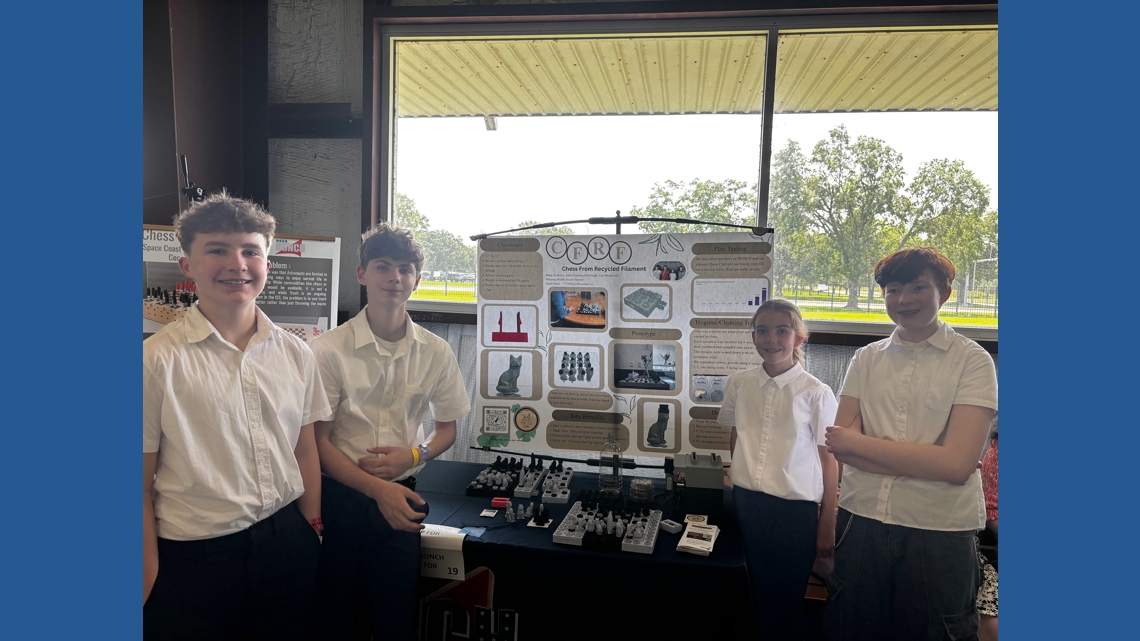
The scientists from The Manning School of Academics and Arts in Golden may just be in 8th grade, but they’re already working with NASA.
GOLDEN, Colo. — Two teams of eighth graders from The Manning School of Academics and Arts in Golden recently traveled to NASA’s Johnson Space Center in Houston to present yearlong engineering projects, including a 3D printed chess set made from recycled plastic and biodegradable medicine packaging. Through this partnership, NASA could patent, build and even send their work into space.

This story continues below.
The students participated in HUNCH, which stands for High School Students United with NASA to Create Hardware, a competitive NASA educational program. Manning teacher Sarah Maud said the program typically involves high schoolers, but Manning is among a small number of middle schools in the country allowed to participate.
“The kids sign up as NASA contractors,” Maud said. “So they legitimately are NASA contractors, and they get to put that on their resumes, which, you know, 8th graders are not super concerned about yet, but later, they’ll quite like that!”
HUNCH challenges student teams to design solutions to real problems NASA faces. Students register as official NASA contractors — a credential Maud noted they can list on resumes and university applications. The two Manning teams were notified in March that they had advanced to the national showcase in Houston, held in late April beneath the Saturn V rocket at Johnson Space Center.
Student Zuri Westerfield’s team designed a chess set that can be manufactured in space using a 3D printer loaded with filament made from recycled plastic waste. Because the game would be played in microgravity, the team engineered chess pieces with a screw-in attachment mechanism so they stay fixed to the board during play. The set features an animal-and-nature theme — a choice shaped by feedback from a NASA engineer during an October design review.
“They were like, ‘Well, they’re already around space and rocket ships all the time,'” Westerfield said. “What are they not around? And we were like, they’re not around animals.”
Westerfield said the experience of showing the project to NASA engineers in Houston was meaningful.
“The NASA engineers and workers that came to see it, they looked at our chessboard and they went, ‘Oh wow, that’s cool,'” Westerfield said. “It’s a crazy idea to think about, and like as an eighth grader, you don’t think that work you are doing now will change the world.”
Student Hannah House’s team developed two prototype designs for biodegradable, waterproof, UV-resistant medicine packaging suited for long-duration space missions. The team contacted roughly 10 companies before obtaining free material samples from manufacturer NatureFlex.
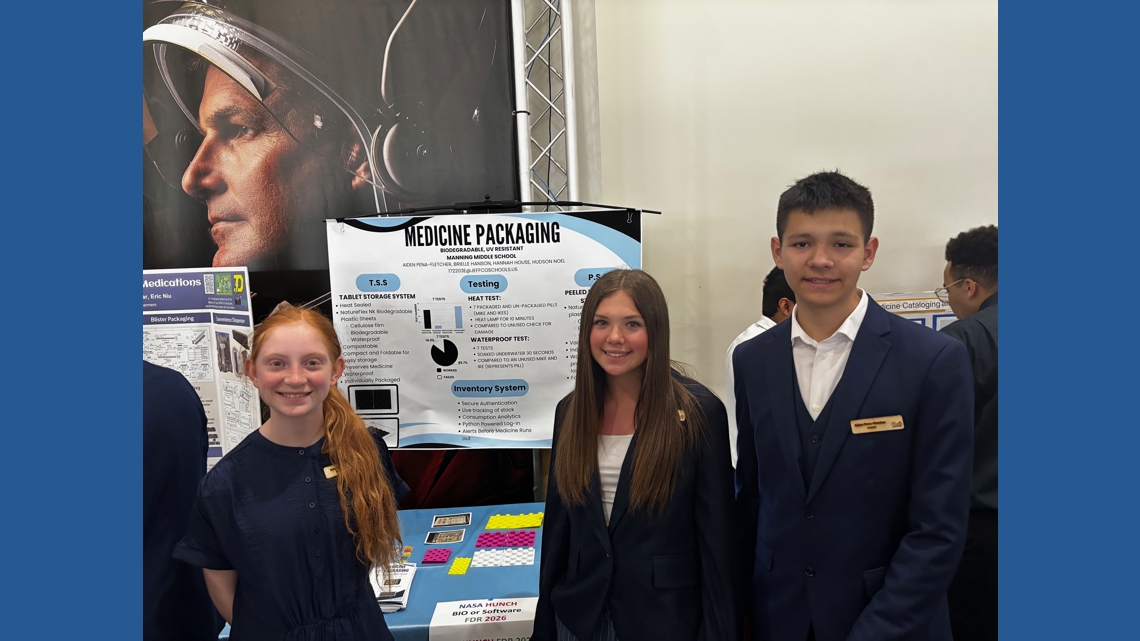
“One of the main problems we’re trying to solve was just what materials to use,” House said. “It has to be biodegradable but still waterproof, which that’s a really hard thing to find.”
House said the Houston trip gave students a chance to meet NASA engineers and an astronaut candidate.
“Even if we’re not going directly up to space, we can still make a difference in helping people who are going directly up to space,” House said.
If NASA selects a project, the agency works with students to patent and build the design for an actual mission. Maud said NASA can reach out at any time to advance a project.
“It just amazes me how much they grow,” Maud said. “Their confidence, their ability to manage things themselves. That’s really one of the goals of my program: to teach them to build that responsibility.”