
Normally, when I approach the incognito San Francisco headquarters of OpenAI, a benignly terrifying security guard in a rugby shirt stares me down.

Last week, though, I got to waltz right past him.
Well, almost. Apparently I waltzed a bit prematurely. As I first entered the lobby, he professionally but firmly walked me back outside and showed me how to properly scan a QR code that would grant me access to the beating heart of the buzziest, most controversial company in tech.
Article continues below this ad
After that, the waltzing could continue unimpeded, because I had been formally invited inside OpenAI’s secretive mothership. And what I saw there told me a lot about the company’s future.
Kimpton’s baby
I was invited to OpenAI’s headquarters because of my role as a tech journalist, to attend an off-the-record educational seminar.
Thomas Smith in front of the OpenAI building in San Francisco.
Courtesy of Thomas Smith
Stepping off the MUNI T Line and arriving at OpenAI’s building, I was greeted, as I always am, by nothing. The AI giant’s offices are entirely unlabeled. There’s nary a sign or logo anywhere to tell the casual visitor that they’ve stumbled upon the locus of all AI power in the universe. Next door, Uber’s headquarters scream “UBER” from every glass-fronted, glimmering surface. OpenAI — subletting from Uber — keeps its building silent.
Article continues below this ad
That ends as soon as you step inside.
After signing in with front desk staff (who have the friendly demeanor of people who know they’re being protected by a rugby-shirted man with biceps like tractor tires) I was escorted to a lobby to wait for our session to begin.
The exterior of a former Uber office building with the Uber sign visibly removed, at 1515 Third St., San Francisco, Aug. 20, 2024. Artificial intelligence company OpenAI signed a lease in 2023 to move into the office space.
Smith Collection/Gado
OpenAI’s lobby is loud — aesthetically, if not aurally. The space looks like a Kimpton hotel and a Victorian cabinet of curiosities had a baby.
Article continues below this ad
Every object — a 1950s metal robot figurine, a copy of Roger Fouts’ “Next of Kin,” a vintage camera — had clearly been placed there with intention, to communicate a message.
A copy of “On the Origin of Time,” which details Stephen Hawking’s theories about the universe, lay open next to comfy reading chairs, as if to suggest that OpenAI’s engineers often casually thumb through such books. For reasons that are opaque to me, a vase of white flowers and also a disembodied deer antler sat beside it.
A lone gold pocket watch, sitting nakedly in the middle of a vast wooden table, felt like a test. Grabbing it as a memento seems like it’d be easy, until you remember that it’s sitting in the house of the company building much of America’s AI surveillance apparatus.
After a brief wait, a staff member walked me and several colleagues back to a fairly unremarkable seminar room, somewhat surprising given all the quirky detritus I’d just passed by.
Article continues below this ad
Facade of OpenAI offices in Mission Bay, San Francisco, Dec. 11, 2025.
Smith Collection/Gado
Also surprisingly, though, OpenAI left us relatively free to wander before the presentation started (albeit with a directive not to photograph anything). So I left the room.
Inside OpenAI’s lobby, I found a concert grand piano. It’s a player piano, and there’s not even a stool for a human musician to sit on. This feels ominously on-brand.
Deeper in the building, I found a booth filled with themed books and pamphlets that urge the visitor to “Feel the AGI immersion.” It was staffed by a gigantic, papier-mache frog.
Article continues below this ad
I took a pamphlet. It was covered in vague word soup about human flourishing. I realized ChatGPT almost certainly wrote it.
In the bathrooms, I found trays of toothbrushes and anti-redness eye drops, presumably to fix yourself up after a long night spent iterating on foundation models.
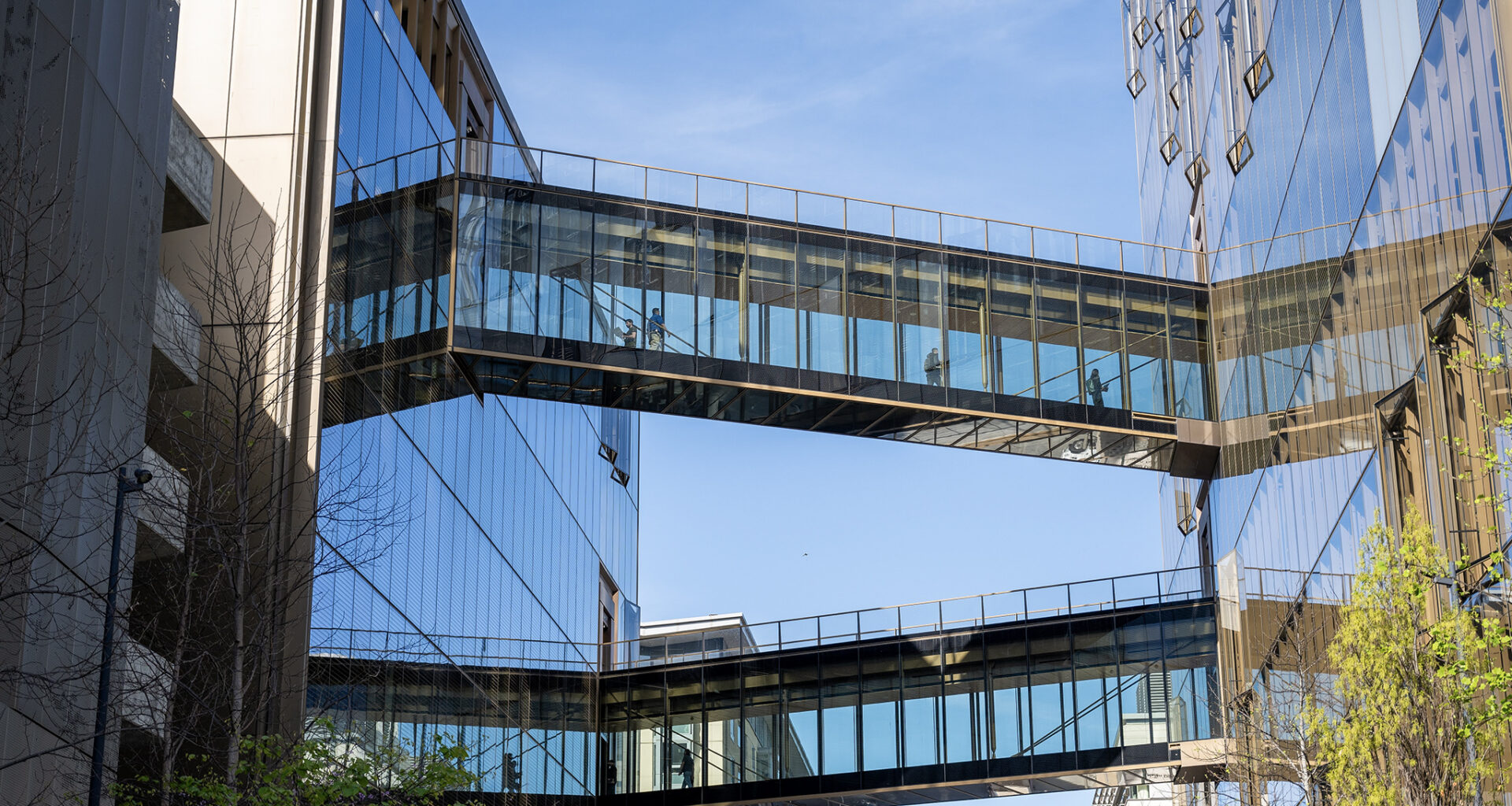
Facades of the offices of artificial intelligence company OpenAI in San Francisco, with view of sky bridges, March 25, 2026.
Smith Collection/Gado
I circled back to the seminar room. A digital sign outside read, “We’re making AGI–and friends!”
Article continues below this ad
The gospel of Sam
For OpenAI, that last bit has proven challenging. The company is facing a massive lawsuit from Elon Musk that’s revealing juicy details daily about the company’s origins and leadership. Another suit accuses it of wrongful death over ChatGPT’s alleged role in a school shooting.
Amid this onslaught, the company has lately felt walled-off. OpenAI’s building, again, is entirely incognito. Reaching an actual human at the company, even as a member of the media, feels almost impossible. Cryptic messages on X from Sam Altman are often the only hint that OpenAI is about to do something big.
That wasn’t always the case. When I served as an independent OpenAI beta tester in 2021, the company had a chummy, academic lab feel. You could send a Slack DM to OpenAI’s VP of product in the middle of the night and get an immediate response.
Article continues below this ad
After ChatGPT took over the world, that vibe changed. OpenAI stepped back and locked down.
Office buildings of Uber and OpenAI in the Mission Bay neighborhood, San Francisco, Dec. 11, 2025.
Smith Collection/Gado
New models dropped at random times, and both tech journalists and the company’s own customers scrambled to understand what had landed in their laps.
Besides a few high-profile stories — like the attempted ouster of CEO Sam Altman in 2023 — not much happening internally at OpenAI ever made it out to the broader public.
Article continues below this ad
On my visit, though, I saw indications that OpenAI is working to shift this narrative. That fact that I — a journalist who once accused the company of lobotomizing ChatGPT — was allowed in the door in the first place is one indicator of a change.
And while there’s plenty of bizarre kitsch inside OpenAI’s headquarters, the walls are also covered in signs that talk about the company’s origins and future, connecting its work to the artificial intelligence pioneers who came before it (including, encouragingly, early female scientists like Grace Hopper) and an imagined future where AGI becomes a utopian “infrastructure stretched across continents.”
Facebook famously had an on-site sign shop, too. But its blocky, letterpress signs always felt like tech-themed Soviet propaganda posters, sporting simple, vaguely Orwellian slogans like, “Do it faster” and, “Our work is never over.”
Facade of the offices of artificial intelligence company OpenAI in San Francisco, March 25, 2026.
Smith Collection/Gado
OpenAI’s signs are more deliberately crafted and narrative, with paragraphs of explanatory text, historical photos, charts and illustrations. They look like museum exhibits.
Article continues below this ad

Stay informed, and entertained.
By signing up, you agree to our Terms Of Use and acknowledge that your information will be used as described in our Privacy Policy.
The company seems to be realizing — perhaps belatedly — that if it doesn’t actively tell its story, other people will. And other people’s version won’t necessarily be flattering.
OpenAI probably isn’t ready to send my rugby-shirted friend home and throw open its doors — or its models — to the world. But the company no longer seems content to sit, walled-off, in its glass-fronted Mission Bay tower either.