
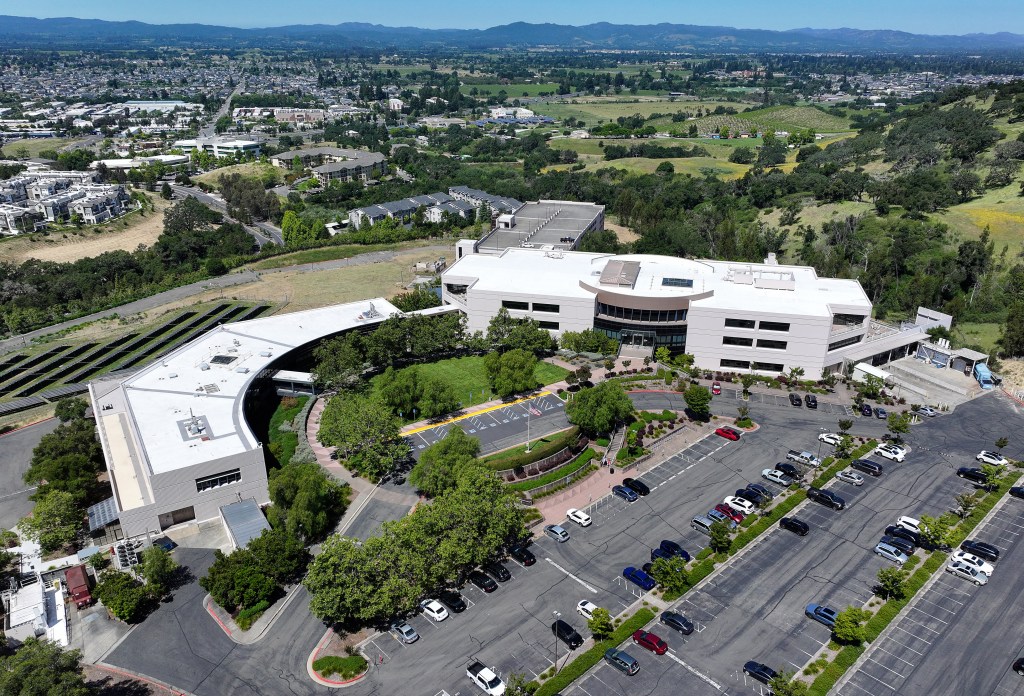
The planned departure of Medtronic from Sonoma County over the next two years is being viewed by local economists and business leaders as both an immediate economic loss and a warning sign about broader pressures facing advanced manufacturing in the North Bay.
The medical device maker told its 370 Santa Rosa employees this month that it plans to leave the area by spring 2028, the Journal reported May 7. The company said operations tied to its Fountaingrove campus would shift primarily to Santa Ana, Minnesota and Galway, Ireland.
The move affects one of Sonoma County’s better-known advanced manufacturing employers. Medtronic traces its local roots to its 1998 acquisition of Arterial Vascular Engineering, or AVE, a Santa Rosa stent maker that at one point employed roughly 1,200 people locally.
Robert Eyler, an economist and professor at Sonoma State University, said the company’s departure carries symbolic weight beyond the direct job losses.
“It’s a stalwart, recognized name that does manufacturing business here in Sonoma County,” Eyler said. He called the decision “tough to see.”
At the same time, Eyler said the closure reflects longer-term structural challenges that have weighed on manufacturers throughout California. Controlling costs and managing the supply chain are key pain points.
“It’s not shocking. It’s just disturbing,” he said.
A shrinking manufacturing base
The Medtronic announcement arrives as Sonoma County’s manufacturing sector continues to evolve away from the large industrial employers that once helped define the region’s economy.
Medtronic was among the county’s larger employers in 2025, with 682 employees listed at the time, according to figures compiled by the Sonoma County Economic Development Collaborative. The company now says it employs 370 workers locally.
Today, Sonoma County’s largest employers are dominated by government, health care, hospitality and education institutions, including the county of Sonoma, Kaiser Permanente, Providence Health System and Santa Rosa Junior College.
Eyler said manufacturing employment in the North Bay has “flattened out a little bit,” with advanced manufacturing — production that involves highly skilled workers and automated systems — facing gradual decline under mounting cost pressures.
From the third quarter of 2021 through the third quarter of 2025, manufacturing jobs in Sonoma County decreased by 3,450 and about $121 million of payroll, despite eight new employers arriving in that time, Eyler said, noting that the figures don’t count single-employee operations like bakeries. About 1,230 of those lost jobs were in advanced manufacturing, with about 325 at breweries and wineries.
Still, he argued the region retains significant strengths in life sciences and related industries.
“We still have a pretty decent life sciences core in the North Bay,” he said, describing a corridor stretching from Novato east into Solano County. Key companies include drug makers like BioMarin and Ultragenyx in Marin County, Endomatrix in Sonoma County and Lonza in Solano County.
Eyler said local leaders should closely examine the reasons behind Medtronic’s exit.
Such information, Eyler said, could help determine whether the departure was driven primarily by company-specific decisions or reflects broader competitive disadvantages facing the region. Ethan Brown, director of the county business booster collaborative, said those conversations with the company have been ongoing.
Eyler framed the challenge as a strategic question for local policymakers and economic developers.
“Is your local commercial real estate, your local power and water, your local workforce, is it ready to take on manufacturing, or are you better off leaning more toward the science side?” he asked, referring to more office-oriented, higher-paid research and development roles.
Real estate market faces headwinds
The industrial real estate market tied to life sciences has also struggled in recent years, according to Brooks Pedder, a commercial real estate broker with CBRE specializing in industrial properties in Napa and Solano counties.
“With interest rates doubling thanks to Build Back Better, funding for life science research went to the wayside, and we’ve been slow ever since,” Pedder said, referring to the 2021 federal legislation by that name.
He pointed to several life-science users that purchased land in Vacaville but never fully developed projects as financing conditions tightened. Lonza’s purchase of the giant Genentech facility there helped save hundreds of jobs. Agenus’ purchase of 120 acres for a biomanufacturing campus in the northern Solano city made waves in 2021, particularly when it started selling off portions to other biotech companies, including LG Chem, and developer Transwestern Ventures. But those projects haven’t moved forward.
Pedder described the Medtronic Santa Rosa property, which he at one time researched for a proposal, as potentially difficult to reposition in this market. The Fountaingrove campus includes two office buildings and a four-story parking structure on 27 acres at 3540 and 3576 Unocal Place, totaling roughly 195,000 square feet of office space.
“We’re not seeing any life science traction right now,” Pedder said.
Still, Pedder said there are tentative signs of improvement in the industrial market, noting that some recently completed projects may finally be attracting activity.
“Something is cooking on most of the new buildings,” he said, noting that many of the larger industrial buildings, mostly in Solano County, have been vacant since completion stretching back to 2023. “We might start getting some good news.”
Betting on local innovation
Some regional leaders argue the North Bay’s future growth may depend less on recruiting large outside employers and more on cultivating locally grown companies.
Marin Sonoma Impact Ventures, known as MSIV, has been pushing to expand the region’s startup ecosystem through venture investment and entrepreneur support programs.
“Our venture effort, as I mentioned, has now deployed $7.8 million into those 19 companies,” MSIV founder Zachary Kushel said at a recent meeting.
According to Kushel, those investments have already helped support “over 60 high paying local jobs.”
“If we want to make a dent in job creation, if we want to have economic opportunity in the region, we need to invest in startups,” he said.
MSIV says its North Bay Founder Network now includes 235 active members and has served nearly 400 founders overall.
Eyler said initiatives such as MSIV could help create what he described as a “new breed of manufacturing in the North Bay,” while encouraging local officials to “stay in relatively constant contact, specifically with your larger employers.”
Jeff Quackenbush joined North Bay Business Journal in May 1999. Reach him at jeff@nbbj.news or 707-521-4256.