

 Sun news for May 19, 2026. This video from NOAA’s GOES-19 SUVI in the 304 angstrom channel captures the fiery northeast horizon that persisted through most of the observation period. Video via NOAA/GOES.
Sun news May 19: CME glancing blow may have arrived
Today’s top story: The glancing blow we have been waiting for may be here. Solar wind speeds started climbing to moderate-high levels at 5:30 UTC this morning. Meanwhile, the interplanetary magnetic field (IMF) also showed a slight increase around 6:30 UTC. These signatures suggest the glancing effects of the coronal mass ejection (CME) that left the sun on May 16 are starting to arrive. Adding to the mix, the Bz component pointed mostly southward through the period. Sustained southward dips occurred, particularly from 1 UTC on May 19 onward. A sustained southward Bz favors auroral displays. Forecasters expect unsettled-to-active conditions today. An isolated G1 (minor) geomagnetic storm is possible as the CME material sweeps past. Aurora watchers at high latitudes should stay alert! On the solar front, activity returned to low levels. The sun fired only 2 C-class and 6 B-class flares. AR4436 once again dominated, producing 7 of the 8 events. Even so, the region still packs energy.
Past 24 hours of sun news
(11 UTC May 18 – 11 UTC May 19)
Flare activity
Over the past day, solar activity returned to low levels. In total, the sun fired 8 flares: 2 C-class (common) and 6 B-class (weak).
Strongest flare: C2.1 from AR4436, peaking at 7:40 UTC on May 19.
Lead flare producer: AR4436 once again topped the list. It fired 7 of the 8 events. These included both C-class flares and 5 B-class blasts.
Sunspot regions
Currently, 5 numbered active regions populate the Earth-facing side of the solar disk. All five sunspot regions stayed stable during this period. They carry simple alpha or beta configurations. As a result, the risk of strong flares remains low from the currently numbered regions.
Blasts from the sun?
Available coronagraph imagery showed no Earth-directed coronal mass ejections (CMEs) over the past day.
Past 24 hours in space weather
Solar wind
Solar wind speeds averaged moderate levels through most of the period. However, starting at 5:30 UTC this morning on May 19, speeds began climbing to moderate-high levels. This increase may signal the glancing arrival of the CME that left the sun on May 16. Meanwhile, the total interplanetary magnetic field (IMF) held at weak levels for most of the period. Then, around 6:30 UTC this morning, it also showed a slight increase.
Bz and magnetic coupling
The Bz component pointed mostly southward through the period. A couple of northward peaks occurred. However, the dominant story was the sustained southward orientation. In particular, a sustained southward dip began at 1 UTC on May 19 and continued through the morning. As always, a sustained southward Bz favors auroral displays.
Earth’s magnetic field
Over the past day, Earth’s magnetic field ranged from quiet to unsettled (Kp 2–3). Currently, the Kp index sits at level 3. However, with the CME material potentially arriving, that number could climb.
What’s ahead? Sun–Earth forecast
Flare activity forecast
Forecasters expect low levels to continue in the coming days. Even so, a 40% chance exists for M-class flares. AR4436 remains the most likely source. Its continued C-class output demonstrates it still packs energy.
We continue watching AR4441, now located at a geoeffective position. As AR4436 nears its departure to the far side, AR4441 is the next region to keep an eye on. X-class (strong) flares are not expected right now. However, they cannot be entirely ruled out (5% chance) if AR4441 continues to evolve rapidly.
Geomagnetic activity forecast
May 19 (Monday): Expect unsettled-to-active conditions. An isolated G1 (minor) geomagnetic storm is possible as the glancing blow from the May 16 CME sweeps past Earth. With the Bz currently pointing south, conditions could ramp up quickly. Aurora watchers at high latitudes should stay alert!
May 20 (Tuesday): Expect Earth’s magnetic field to return to quiet-to-unsettled levels (Kp 1–3). Both CME effects and coronal hole influences should wind down. However, lingering glancing CME material could maintain brief active intervals early in the day.
May 21 (Wednesday): Expect quiet-to-unsettled conditions to continue as residual effects fully fade. Solar wind should return toward background levels.
 Sun news for May 19, 2026. This video from NOAA’s GOES-19 SUVI in the 304 angstrom channel captures an eye-catching filament eruption in the vicinity of active region AR4436. Video via NOAA/GOES.
 Sun news for May 19, 2026. This video from the CCOR-1 coronagraph aboard NOAA’s GOES-19 spacecraft captures a celestial double feature in its field of view. Watch as Mercury drifts out of the frame while the Pleiades star cluster glides in from the opposite side. Mercury appears as a bright point moving through the frame as it continues along its orbit. Meanwhile, the Pleiades, also known as the Seven Sisters, enter the field of view as this famous open star cluster passes behind the sun during its annual conjunction. Video via NOAA/GOES.
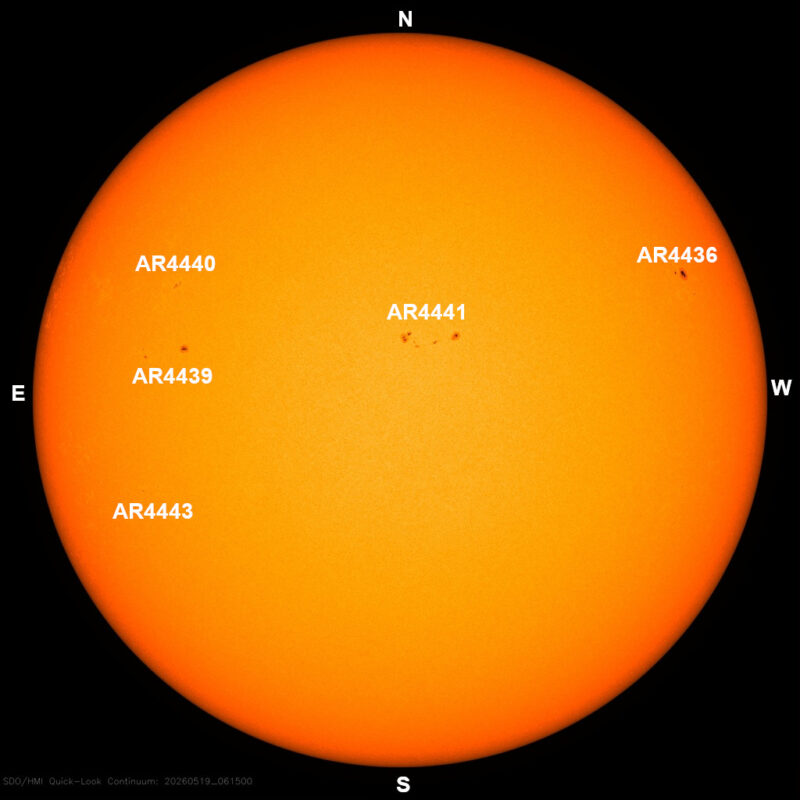 This image shows sun activity – with the most active regions labeled – as of 6 UTC on May 19, 2026. Original image, without labels, via NASA SDO. Courtesy of NASA/SDO and the AIA, EVE, and HMI science teams, with labeling by EarthSky. Armando Caussade posted today’s sun. Why are east and west on the sun reversed?
Sun news May 18: Sun-stuff racing toward Earth, aurora possible
Today’s top story: A knotty blob of sun-stuff launched from the sun on Saturday is now racing through interplanetary space. Analysts currently think this coronal mass ejection (CME) could give Earth a glancing blow as early as overnight tonight. The impact could spark G1 (minor) to G2 (moderate) geomagnetic storms. And that could mean auroras visible from northern latitudes, including northern Scotland and Scandinavia. Share your aurora photos with us!
Past 24 hours of sun news
(11 UTC May 17 – 11 UTC May 18)
Flare activity
Over the past day, solar activity held at moderate. In total, the sun fired 9 flares: 4 C-class (common) and several B-class (weak) events.
Strongest flare: C9.7 from AR4436, peaking at 20:42 UTC on May 17. This event was accompanied by a notably strong 370-solar-flux-unit radio burst.
Lead flare producer: AR4436 topped the list. It fired at least 6 of the 9 tracked events, including the C9.7 and multiple B-class flares.
Sunspot regions
The Earth-facing solar disk currently shows 7 numbered active regions.
Blasts from the sun?
The major CME story centers on the complex eruption on May 16, which is now en route to Earth. A wide, fast CME appeared in SOHO LASCO C2 and C3 imagery at 16:36 UTC on May 16. It was tied to the M1.9 flare from AR4436. Coronal dimming and a Type IV radio sweep accompanied the eruption. The bulk of the ejecta soared out to the northwest. However, modeling indicates some will give Earth a glancing blow around 0:00 UTC on May 19. Kp estimates range from 3 to 5, depending on the CME’s magnetic orientation upon arrival. That points to potential G1 (minor) storm conditions, with a chance of borderline G2 (moderate).
Past 24 hours in space weather
Solar wind
Solar wind speeds gradually decreased through the period. That’s as the coronal hole’s high-speed solar wind stream continued its slow fadeout. Meanwhile, the total interplanetary magnetic field stayed relatively weak.
Bz and magnetic coupling
The Bz component remained near neutral. No sustained southward dips occurred. That explains why geomagnetic conditions stayed quiet despite the elevated solar wind speeds. Without a sustained southward Bz, Earth’s magnetic shield stays effectively closed.
Earth’s magnetic field
Over the past day, Earth’s magnetic field stayed at quiet levels (Kp 1–2).
What’s ahead? Sun–Earth forecast
Flare activity forecast
Forecasters expect low levels to continue through May 20. A chance (40%) exists for additional M-class flares. AR4436 remains the most likely source despite its ongoing decay. Its continued C-class output and the notable radio burst demonstrate it still packs energy.
AR4441 deserves close attention. It’s showing signs that it could develop into a more complex magnetic configuration. That would increase flare risk. While X-class (strong) flares are currently not expected, they cannot be entirely ruled out (5% chance) if AR4441 continues to evolve rapidly.
Geomagnetic activity forecast
May 18: Expect mostly quiet-to-unsettled conditions (Kp 1–3) as the coronal hole high-speed stream continues to slowly fade. A slight chance of active intervals (Kp 4) exists.
May 19: The glancing CME should arrive around 0:00 UTC. G1 (minor) geomagnetic storm periods are likely. A chance for G2 (moderate) levels exists as well. Aurora may reach Minneapolis, Edinburgh and northern England at G1 levels. Under G2 conditions, displays could extend to Toronto, Chicago and London.
May 20: Expect conditions to gradually settle to quiet-to-unsettled levels (Kp 1–3). Both CME effects and coronal hole influences should wind down. Lingering glancing CME material could maintain brief active intervals early in the day.
 Sun news for May 18, 2026. A computer simulation of Earth’s magnetic field being impacted by a coronal mass ejection (CME). The sun is out of view on the left. Video via NASA/SVS.
The sun in recent days
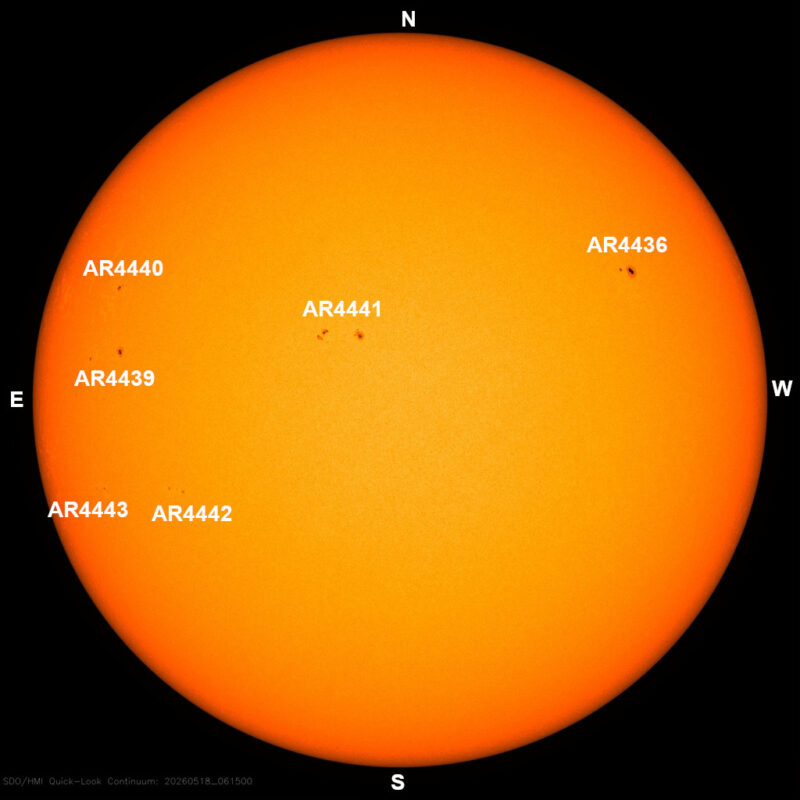 This image shows sun activity – with the most active regions labeled – as of 6 UTC on May 18, 2026. Image via NASA/ SDO.
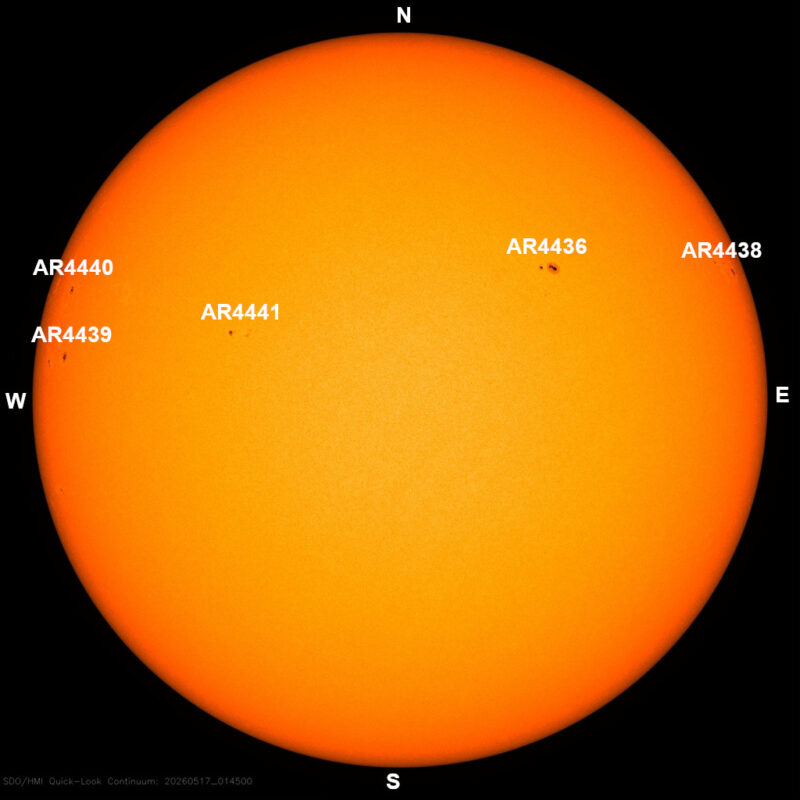 This image shows sun activity – with the most active regions labeled – as of 1 UTC on May 17, 2026. Image via NASA/ SDO.
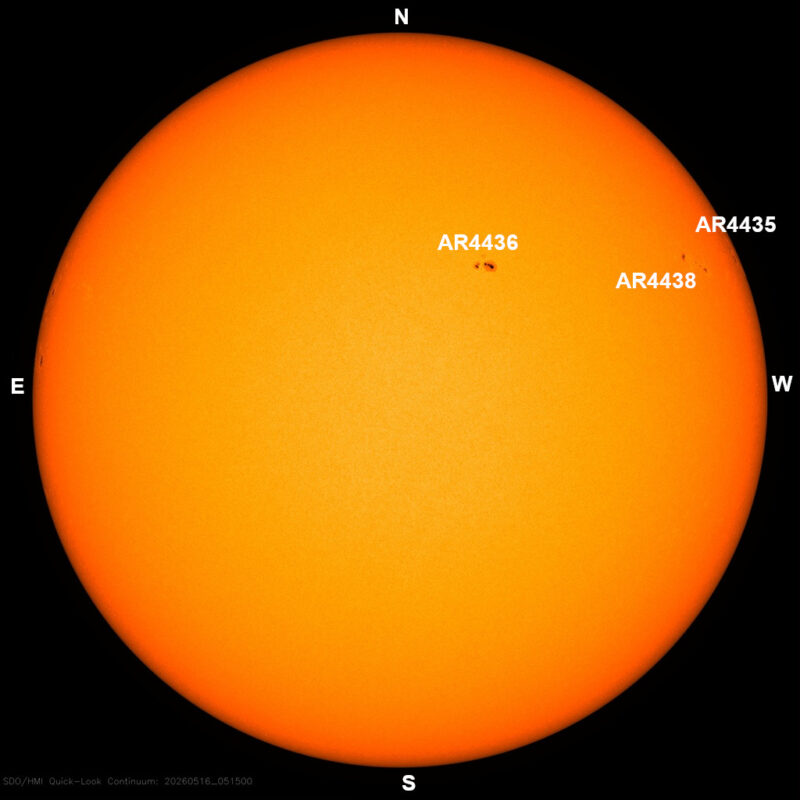 This image shows sun activity – with the most active regions labeled – as of 5 UTC on May 16, 2026. Image via NASA/ SDO.
Sun images from our community
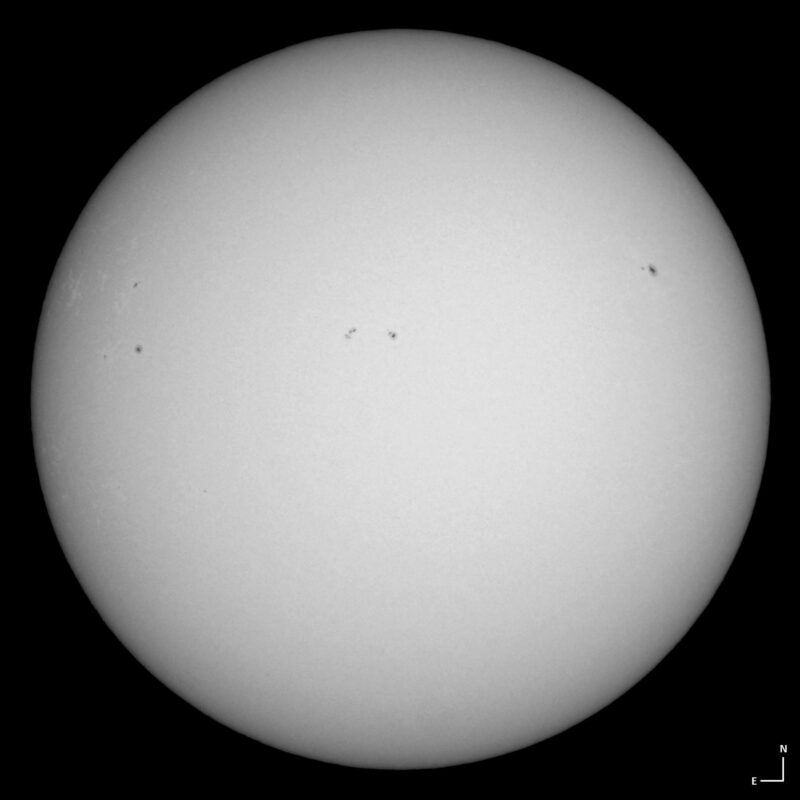 View at EarthSky Community Photos. | Patricio León in Santiago, Chile, captured this filtered image on May 18, 2026. Patricio wrote: “No changes in sunspots. Solar and auroral activity in low levels. All quiet.” Thank you, Patricio!
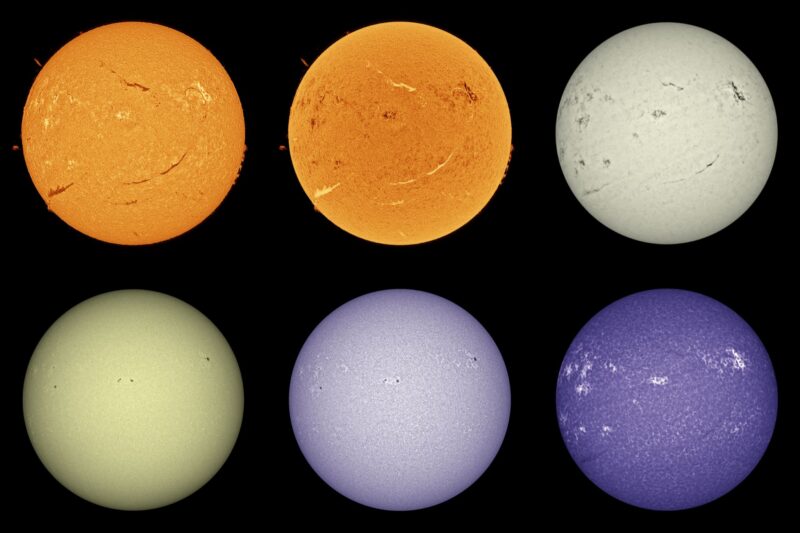 View at EarthSky Community Photos. | Mario Rana in Hampton, Virginia, captured these filtered images on May 18, 2026. Mario wrote: “The sun in hydrogen-alpha, helium D3, iron, G-band, and calcium-H.” Thank you, Mario!
We sometimes feature sun images obtained using hydrogen-alpha filters. Read why.
Bottom line: Sun news for May 19, 2026: CME glancing blow arrives as solar wind climbs. G1 storm possible today. Bz points south. Aurora watchers, stay alert!
C. Alex Young
View Articles
About the Author:
C. Alex Young is a solar astrophysicist studying the Sun and space weather. Alex is passionate about sharing science with diverse audiences. This led him to start The Sun Today with his designer wife, Linda. First through Facebook and Twitter then adding an extensive website thesuntoday.org, the two work together to engage the public about the Sun and its role in our solar system. Alex led national engagement efforts for the 2017 total solar eclipse. He is the Associate Director for Science in the Heliophysics Science Division at NASA Goddard Space Flight Center.
Armando Caussade
View Articles
About the Author:
Armando is known primarily as an astronomy educator, after 30+ years of extensive public outreach and 10 years teaching in colleges. As one of only a handful of science communicators in Puerto Rico during Comet Halley’s last visit, he assumed a pioneering role starting in 1985 when science was just beginning to enter the collective mindset. Over the years, his work as a teacher, speaker and writer, inspired people to pursue interests in science and brought enduring change to Puerto Rican culture. After being accepted into the 2014–2015 Antarctic season of PolarTREC, Armando was assigned to the Amundsen-Scott South Pole Station, where in 2015 he successfully conducted 10 days of work at the IceCube Neutrino Observatory. His affiliations include Ana G. Méndez University, Cupey campus (2014 to 2021), the University of Puerto Rico, Aguadilla campus (2015 to 2017), NASA JPL’s Solar System Ambassadors (2004 to 2006), and NASA Space Grant (2017 to 2019) where he served as an affiliate representative.
Raúl Cortés
View Articles
About the Author:
Raúl Cortés studied engineering at the Autonomous University of Nuevo León in Monterrey, Mexico, obtained a scholarship to continue his studies in Japan and after returning to Monterrey he got credits on MBA from the Graduate School of Mechanical and Electrical Engineering Faculty. He became a teacher at the University UANL teaching Math and Physics and dedicated the rest of his professional career to serve in engineering areas for USA, Japan and Germany based corporations. His passion for the skies go back to when he was a child, always intrigued about the stars and constellations and reading and researching about the matter. From 2010 on, he dedicated his attention to photographing the stars, constellations, the moon and the sun. Raúl’s work on his photography has been published and posted on the ESC as well as in other platforms and has gained attention to be published by local Monterrey newspapers.