
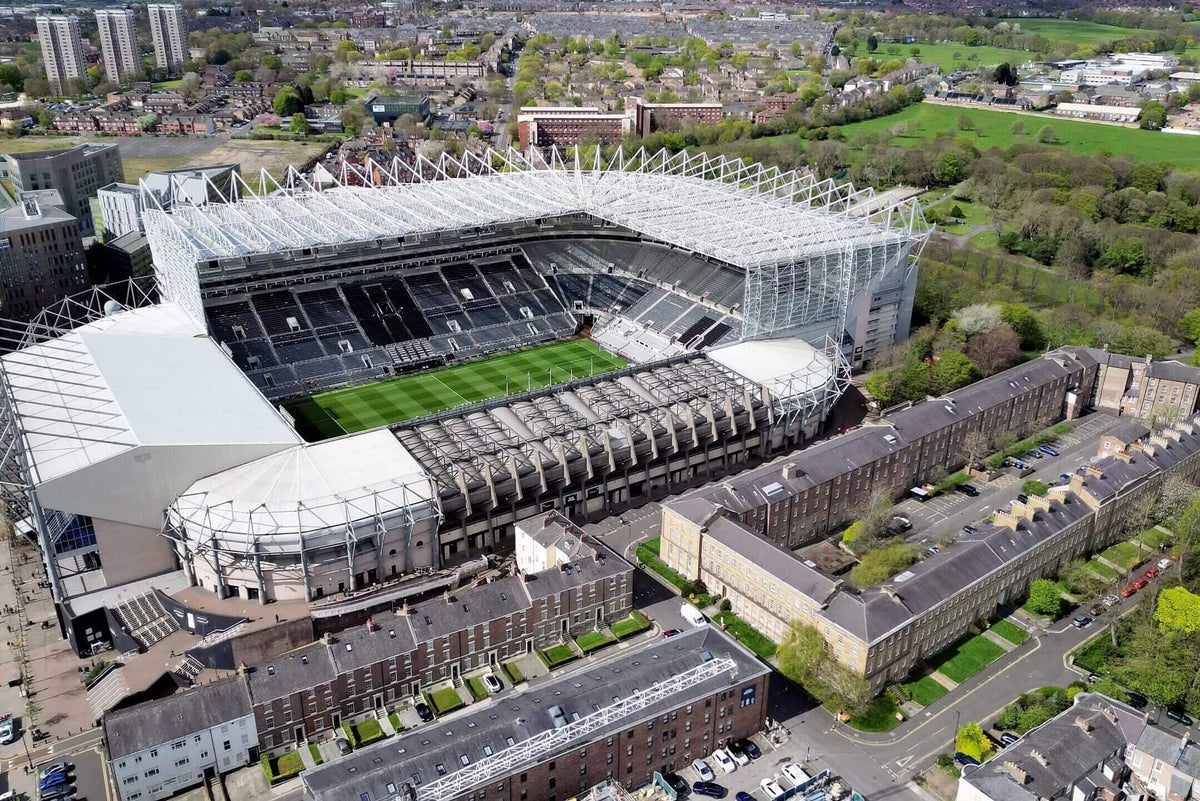
Newcastle United have bought the majority of Grade 1-listed Leazes Terrace for a figure believed to be in the region of £20million-£25million ($26.8m-$33.5m).
The enclosed, ring-shaped Georgian crescent, is adjacent to St James’ Park and its western elevation is directly opposite the East Stand, which has long restricted the expansion of Newcastle’s current ground.
While the obvious and understandable assumption will be that Newcastle are now prioritising remaining at and enlarging St James’ over moving to a new state-of-the-art stadium next door, club sources insist that is not the case.
Insiders are adamant that a final decision has not been made and that both remain live possibilities. However, as The Athletic has long reported, over the past few years several senior figures at Newcastle have expressed internally that the preference would be to move. This purchase has not materially altered that.
Instead, Newcastle sources, briefed on the purchase but not authorised to discuss it publicly, insist this acquisition offers the club “optionality” in both directions. Newcastle view it as being of strategic benefit, whatever they ultimately decide to do.
The insistence is that this shows Newcastle are making moves towards creating “oven-ready options” either way, rather than merely continuing to run feasibility studies, as has been the case for much of the past three years, when material progress towards a final call has felt glacial.
At least theoretically, expansion of the East Stand — which has not been significantly redeveloped since 1972 — becomes slightly more feasible now.
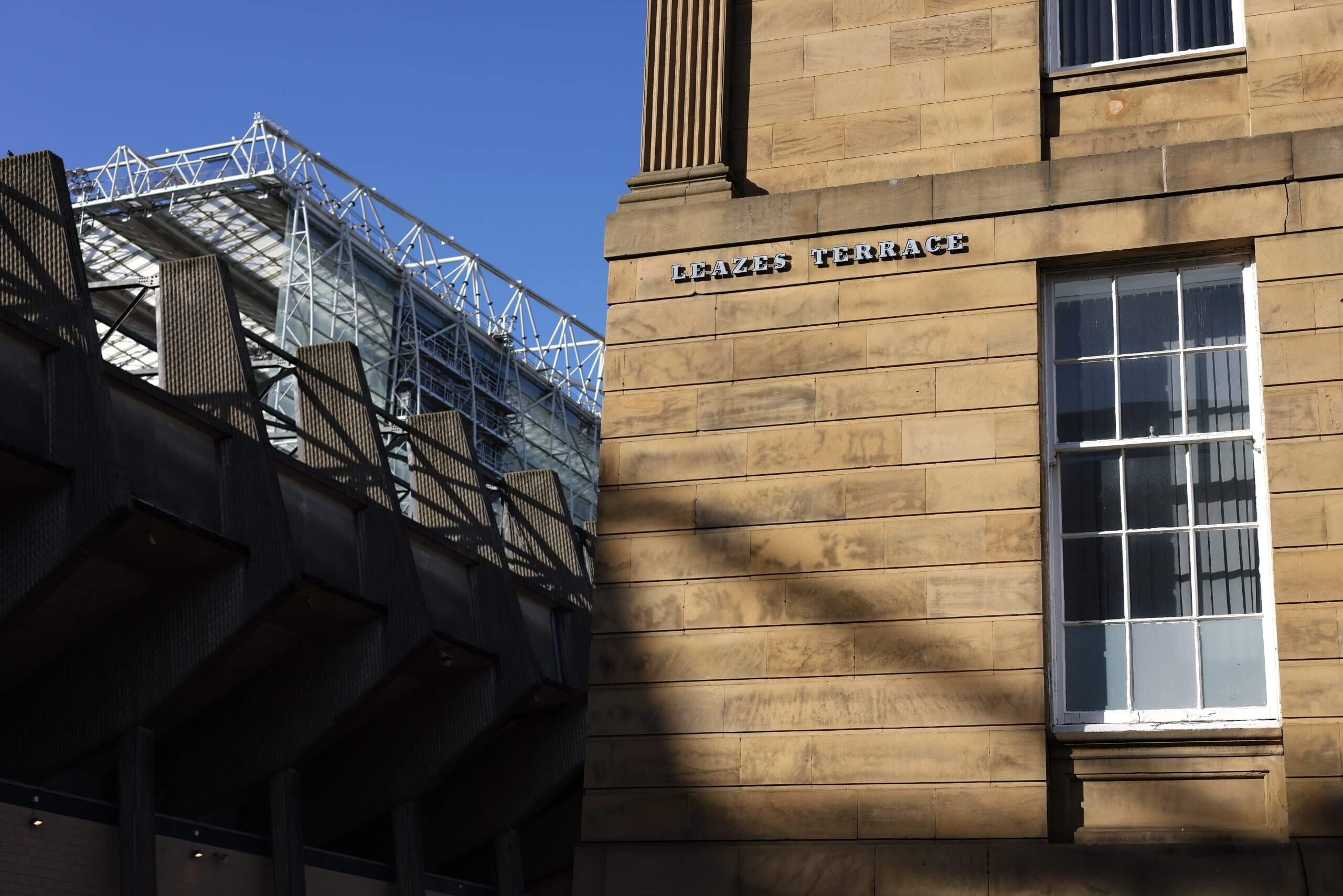
The buildings on Leazes Terrace are listed and cannot be knocked down. (George Wood/Getty Images)
The protected Grade 1-listed buildings cannot be demolished — and Newcastle insist they intend to preserve the historically important architecture — but the legal “right to light” which property owners on Leazes Terrace hold will become less of an issue should the East Stand increase in height and/or width, given the club now own the buildings themselves.
Alternatively, if Newcastle were to try and build a new stadium on Leazes Park, then the club feels that owning the western side of Leazes Terrace potentially offers them a greater say in what the reimagining of the present St James’ footprint would look like. Returning the site to parkland has been mooted, though Newcastle may look to explore whether redevelopment is possible.
Regardless, there is a financial dividend — especially on the UEFA SCR (squad-cost rules) front.
The revenue gained from the rent of the Leazes Terrace properties — while Newcastle will own the buildings, the flats, student accommodation and offices will still be managed by the present property management companies — is expected to count towards their football income figure in UEFA’s calculations, potentially aiding compliance in future years. Interestingly, the actual capital outlay should not negatively affect where Newcastle stand in relation to meeting UEFA’s financial restrictions.
A cash injection from Newcastle’s ownership — Saudi Arabia’s Public Investment Fund (PIF) has an 85 per cent majority stake, while the billionaire Reuben Brothers have a 15 per cent minority share — has at least part-funded the acquisition.
A subsidiary company, used to purchase properties, has bought the buildings on Leazes Terrace, rather than Newcastle United Limited itself.
Newcastle have spent up to £25m to acquire the western section (closest to the East Stand) of Leazes Terrace, plus the majority of the northern and southern elevations, as well as part of the eastern side of Leazes Terrace, via one transaction from the previous owner. Much of the eastern side which faces the tennis courts on Leazes Park remains privately owned, however.