
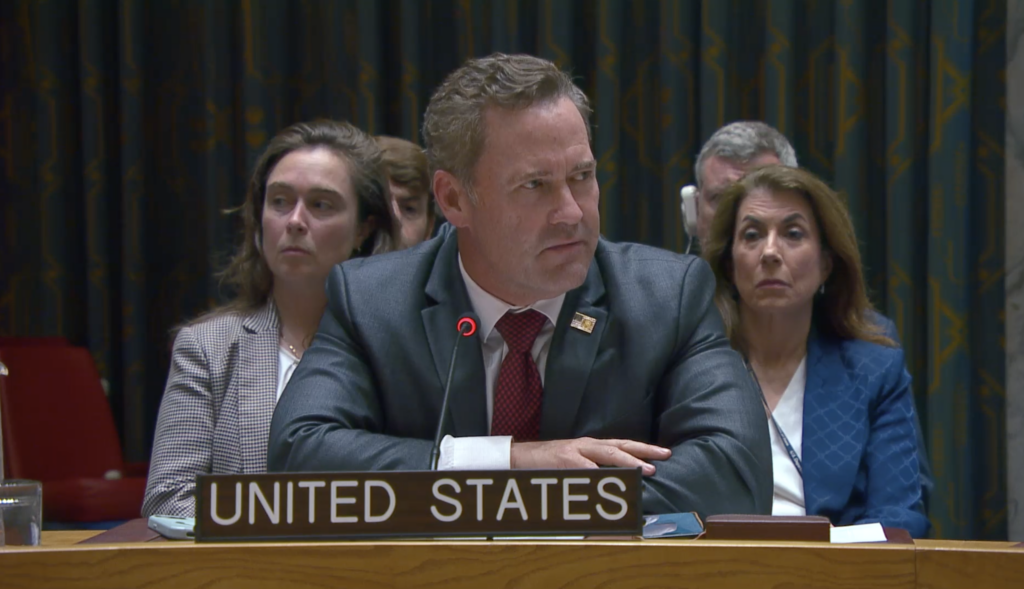
Ambassador Mike Waltz
U.S. Representative
New York, New York
AS DELIVERED
Thank you, Mr. President. Thank you, Director General, for your remarks and thank you, my colleagues in Bahrain, for calling this emergency meeting.
Colleagues, let’s be very clear. We should truly, collectively as a global community, be thankful to God that today is not a very different meeting, after this attack. This very well could have been an attack where we were discussing the meltdown of a nuclear reactor, and the untold and unprecedented humanitarian and environmental crisis that would have caused.
One can only think if that reactor’s power plant—which was hit—was no longer able to cool the plant in a sufficient way, and you had a meltdown, across the Middle East. But, one can only wonder if this was Iran’s objective as it sent drone strikes on to the Barakah nuclear power plant in the United Arab Emirates. And we have to ask ourselves, what responsible–what sane nation, either directly or indirectly through proxies, sends drone attacks into an active and ongoing nuclear power plant.
Let’s be honest, this is a little different from Iran’s decades-long pursuit—in violation of many Security Council resolutions—of a nuclear weapon. And it’s only by luck and the grace of God, that this plant, which provides up to a quarter of the UAE’s energy needs, continues to operate and radiation levels remain normal.
But again, what is the world left to believe? That if Iran, I guess, can’t achieve a nuclear weapon, and it can’t use it as it has threatened over and over again on its neighbors, that it’s now going to find a clever and dangerous way to weaponize a nuclear power plant? Is that what we’re left to believe? I struggle to come to any other conclusion.
I have to say, clearly, the United States condemns Iran’s outrageous and unacceptable attacks in the strongest possible terms.
And by the way, we should make note that the agreements and the way the UAE has abided by the agreements, that it has subjected itself to, are considered the gold standard of nuclear agreements, the gold standard of nuclear nonproliferation, the abiding by IAEA safeguards, the no domestic enrichment of fuel, and the peaceful—the actual peaceful use of nuclear power in the Middle East. Contrast that, with the decades of meetings we have had in this chamber around Iran’s evasion of IAEA safeguards, pushing back on appropriate inspections, and the conflict that we find ourselves in today.
Well, President Trump and the United States have been second-guessed over and over again in this conflict, but I think this makes it clear yet again: that the President is taking the actions necessary to safeguard a secure and safer future for the world. What we should be focused on is a nation that just attacked a nuclear power plant in a neighboring country.
The UN Security Council, colleagues, cannot be a place for strongly-worded statements and hand-wringing.
Just minutes before this Council meeting, the United Arab Emirates stated the intercepted six more attack drones, just in the past 48 hours. Saudi Arabia as we’ve noted already had a similar recent experience.
Contrast all of this with Resolution 2817, where this Council demanded that Iran and its proxies immediately cease attacks, provocation, and threats against its neighbors. The resolution garnered 136 cosponsors, a near-unanimous global outcry for Iran to stop its flagrant violations of international law, stop attacks on shipping, stop the mining of international water, stop the illegal tolling, stop attacking the airports, resorts, and neighborhoods of its neighboring states.
And yet, two months later, we find Iran’s dictatorship now in shambles, we find the U.S. Treasury Department enacting new sanctions in place—these are in addition to the snapback sanctions that are already in place. They’re running out of money and their economy is in shambles. But rather than embrace some peaceful new approach, the Iranian military is engaging in repeated and reckless attacks, now on civilian power infrastructure. And clings to a nuclear weapons strategy that risks plunging the world into darkness. We cannot tolerate it, we will not tolerate it.
We will continue to fight in this Council, and in every appropriate diplomatic forum, for Iran to abide by its obligations in international law. We have introduced, again, we have table an additional resolution focused on those violations of basic freedoms of navigation that the entire world’s economies depend upon.
This attack is only the latest example of the dangerous and destabilizing activities that have come to define this regime, that this regime is now known for around the world. And it is time for every nation—everyone in this Council—to call out this behavior.
The regime has threatened global peace for 47 years. From the Houthis, to Hizballah, to Hamas, to the militias in Iraq and has brought nothing but misery and bloodshed in the Middle East and beyond.
And I truly hope that this body will take the opportunities before it to put an end to it. So we will continue to condemn Iran’s actions, we will demand it cease its attacks. I hope and pray this Council will act. The greatest irony here is that as the Iranians recklessly sought to produce nuclear weapons, the U.S. took actions to stop it, and now out of sheer desperation and true recklessness, they’re now weaponizing the peaceful nuclear power of a neighbor. This is precisely why the United States has said Iran can never have a nuclear bomb. And today is a reminder of that danger.
I thank you, colleagues.
###