
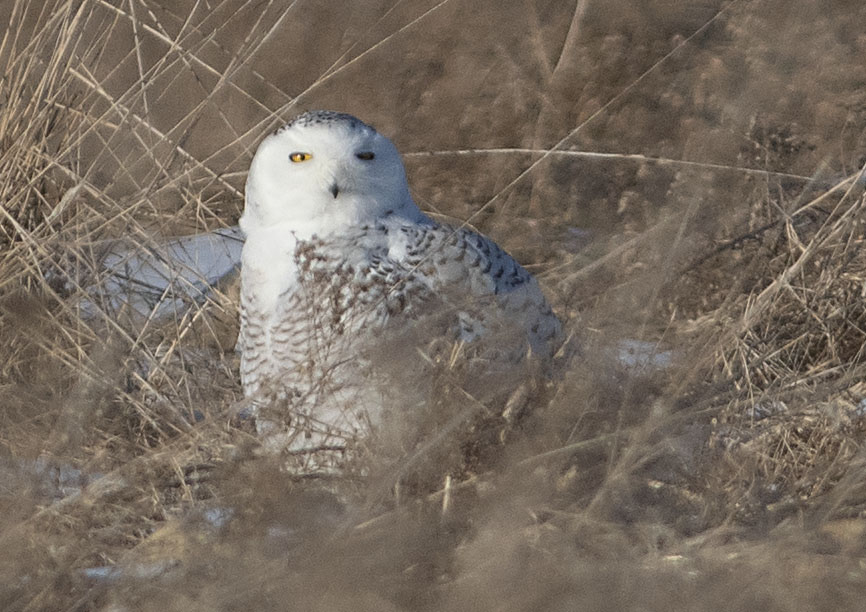
This snowy owl was spotted in 2022 in the Fort Edward Important Birding Area. The Grassland Bird Trust is willing to end its battle with Boralex after the energy company agreed to help the organization buy land for bird habitat and shrink the size of its proposed solar array.
Lori Van Buren/Times Union
Solar panels will soon cover 530 acres of the designated Important Birding Area in Fort Edward. The developer originally proposed placing panels on 750 acres.
Courtesy of Grassland Bird Trust
FORT EDWARD — The Grassland Bird Trust expects to withdraw its pending appeal with the state Office of Renewable Energy Siting to limit a Canadian company’s plans for a solar array in exchange for funding to buy more habitat for threatened and endangered birds.

The agreement ends more than five years of conflict between the not-for-profit land trust and Boralex, an energy company. It also includes shrinking the footprint of a 100-megawatt array from the 750 acres it originally proposed to 530 acres.
Article continues below this ad
Boralex’s undisclosed financial contribution to the trust will expand the 153 acres it currently owns in the 102,000-acre Important Birding Area in Washington County. Trust leaders say the additional acreage will help the survival of short-eared owls, Northern harriers, bobolinks, Eastern meadowlarks and others that feast and nest on the ground.
“This agreement is the result of years of meaningful engagement, thoughtful project design, and a shared understanding of what makes this landscape so important,” said Darren Suarez, Boralex’s vice president of public affairs and communications. “We appreciate the opportunity to continue working with the Grassland Bird Trust and local stakeholders to help conserve this critical grassland habitat in Washington County Grassland Conservation Center while advancing New York’s clean energy goals.”
In an interview Monday, Terry Griffin, chair of the Grassland Bird Trust, said the agreement will help the organization “achieve our mission to preserve grassland habitat for grassland birds.”
Make the Times Union a Preferred Source on Google to see more of our journalism when you search.
Add Preferred Source
“We will be acquiring as much land as we can over the rest of our history,” Griffin said. “We have not yet identified the properties, but it will be in Washington County’s Important Birding Area.”
Article continues below this ad
Kathy Roome, the trust’s board secretary, called the donation “substantial” and said the trust will maintain the property to ensure the meadows are not overrun with invasive species and restored with native plants. She also said the fields will have to be mowed in a way “consistent with the birds’ habit to maximize the birds’ chances of surviving.”
Since 2020, Boralex has sought to build the Fort Edward Solar Project on private lands inside the designated Important Birding Area. That area, which includes the state Department of Environmental Conservation Wildlife Management Area and the Washington County Grassland Bird Conservation Center, is habitat for 100 species of birds. These include threatened and endangered species that nest, breed and winter there.
The trust has always emphasized that it is not opposed to renewable energy development. However, it wanted Boralex to purchase, lease or conserve an equivalent number of acres for the birds. It also wanted Boralex to reconfigure its panels so that they were not boxing in meadows that it feared would discourage the birds from settling in the area.
Without providing details, Suarez said on Monday that “we have changed the layout … and that we will continue to optimize the layout to mitigate the impact going forward.”
Article continues below this ad
“There will be more opportunity to reduce the impact,” Suarez said.
The trust filed an appeal to the state Office of Renewable Energy Siting in December, which was argued at the end of March. A decision was expected by the end of this month.
Fort Edward Supervisor Tim Fisher said in a statement he is pleased that an agreement has been reached and that the solar panels, expected to be operational by 2030, “will be well-received within the community.”
Boralex said that it will employ 120 people during construction. Suarez said construction will begin as soon as Boralex secures all of its permits for panels that will be built on private farmlands.
Article continues below this ad
“We developed a project that makes sense and we will continue to work with the (Trust) and private landowners,” Suarez said, adding he “enjoyed” the working relationship with the Trust.
Griffin said, “We didn’t see it from the same perspective,” but added, “We will continue to talk.”