
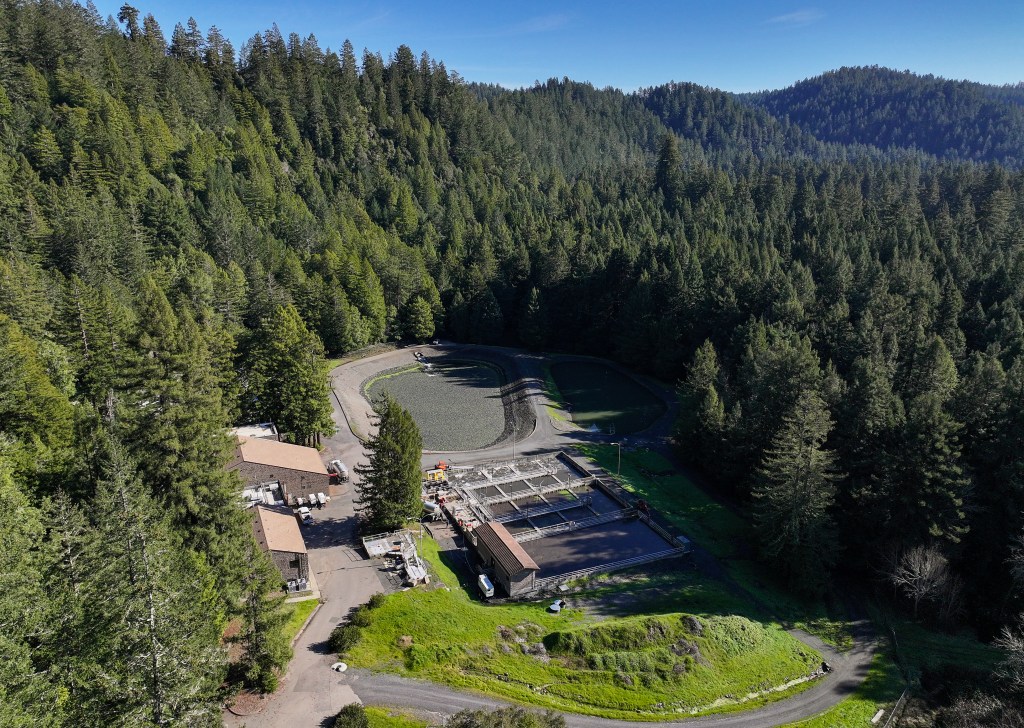
A long-awaited overhaul of the lower Russian River’s aging wastewater system is on deck after Sonoma Water was awarded a $47.8 million grant from the state.
The money, funded through California’s Clean Water State Revolving Fund program, will support the Russian River Sanitation District’s efforts to rehabilitate the system’s 34 miles of sewer lines and four miles of mains, serving 3,300 parcels between Rio Nido to Vacation Beach in Guerneville.
“I can’t promise anything, but I think we’re going to see a significant benefit and improvements to the overall functionality of the system,” Carlos Diaz, deputy director in engineering design with Sonoma Water said.
The award is the largest ever for Sonoma Water, the parent agency that first applied for the grant in 2019. It has seen repeated spills on its watch linked to the Neeley Road plant. The latest, and largest in more than 40 years, came in January, when an estimated 5.5 million gallons of wastewater, including untreated sewage, overflowed from the treatment plant into the lower Russian River for more than three days.
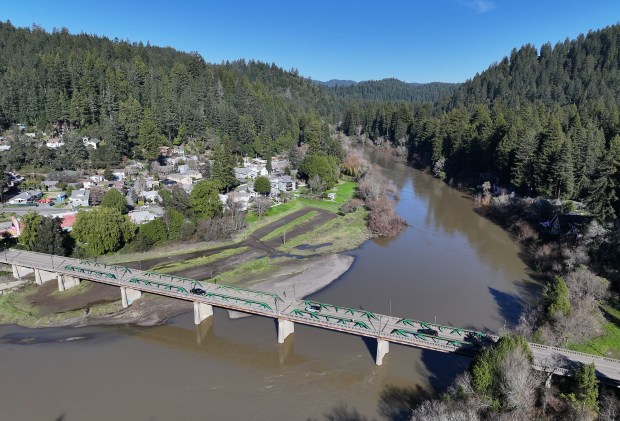 The Russian River flows through Monte Rio, at the Monte Rio Bridge, on Friday, January 9, 2026. Untreated wastewater, including sewage, overflowed for three days starting Jan. 6 into the Russian River from the treatment plant operated by Sonoma Water on Neeley Road, near Guerneville. (Christopher Chung/The Press Democrat)
The spill came as the Russian River region received about 5.5 inches of rain, causing the river to rise more than 20 feet over the course of six days, though topping out two feet under minor flood stage.
“We just got hammered,” David Royall, assistant manager of operations and management with Sonoma Water, said at the time. The fallout led water and public health officials to issue advisories closing beaches along more than 13 miles of the lower river and a 40-mile stretch of the Sonoma Coast.
State regulators launched an investigation that found four violations, including illegal discharge of waste into the Russian River, according to the state water board website. Sonoma Water officials said at the time it was caused by the high volume of stormwater that entered the system over a short period of time, quickly overwhelming it.
The county also received a notice from a Sebastopol environmental watchdog group threatening to sue the water agency and the Russian River Sanitation District over alleged water quality violations tied to the multi-day spill.
The state grant will support modernization of the sewer plant’s headworks, where sewage enters the facility as well as its lift or pump stations and its force mains — all critical junctures to reduce the risk of overflows and improve system reliability, Sonoma Water officials said.
Over the next four years, Sonoma Water and the Russian River Sanitation District will use the funding to replace mechanical and electrical equipment along 11 lift stations, Diaz said. Three of the system’s force mains — pressurized metal pipes that convey wastewater — will be replaced or lined with plastic, which Diaz said is less vulnerable to sulfur dioxide and corrosive gases that factored in previous sewer overflows.
“Force mains have failed in the past,” Diaz said. “It is a big hole in the pipe that can lead to sink holes. We’ve had to close down a lane of River Road in the past to replace these force mains.”
The system has experienced at least four failures over the last 12 years.
A February 2014 storm forced the river to rise rapidly, overloading the mainline until it ruptured and spilled roughly 100,000 gallons of wastewater into the river.
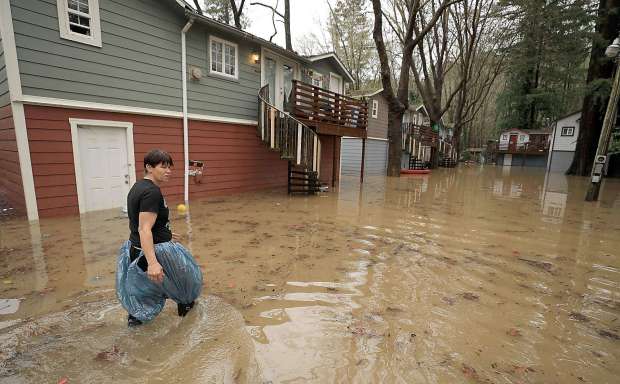 Sycamore Court resident Chris Tipton looks for floating toys and personal belongings of the park’s residents flooded by Armstrong Creek, Thursday, Feb. 14, 2019 in Guerneville. Sycamore Court flooding is one of the first indicators that the Russian River is backing up tributaries that feed into the river. (Kent Porter / The Press Democrat) 2019
In 2019, more than 885,600 gallons of untreated wastewater, including sewage, spilled into the river and streets at three places in Guerneville in February and early March 2019, after an unprecedented series of atmospheric rivers slammed the region.
And in 2024, roughly 277,000 gallons of untreated wastewater spilled into the river when a late February storm caused the waterway to rise about 18 feet over four days, triggering a power failure at the treatment plant.
Diaz said the state award will allow the agency to make the system more resilient in the face of the big storms that inundate the lower Russian River region.
That means expanding the pumping capacity of the lift stations. “They’ll be able to accommodate a lot more now,” Diaz said, “so if one fails, others can accommodate.”
The lift stations also will have a generator placed five feet above the 100-year flood stage.
“That way we can continue to operate without staff doing musical chairs with portable generators trying to keep the whole thing running,” Diaz said.
Lastly, the agency will also be able to increase treatment capacity at the Neeley Road plant.
Still, the major overhaul is not set to address the need for extra storage at the site, nor is it the long-term solution to a wider wastewater dilemma that has plagued the lower Russian River area for decades. That stems from the region’s reliance on aging septic systems across many of its homes — a large share of them heavily used by summer visitors.
A favored solution is to hook up many of those parcels, especially in the Monte Rio and Villa Grande neighborhoods, to the Guerneville system. But that step is likely years — or decades — away, at a cost of hundreds of millions of dollars.
Brenda Adelman, a longtime advocate for the health of the Russian River, said the region is expressing “happiness all around.”
“I know staff had to work very hard to make that happen,” she said. “To learn that they were granted the full amount absolutely astonished me.”
Amie Windsor is the Community Journalism Team Lead with The Press Democrat. She can be reached at amie.windsor@pressdemocrat.com or 707-521-5218.