
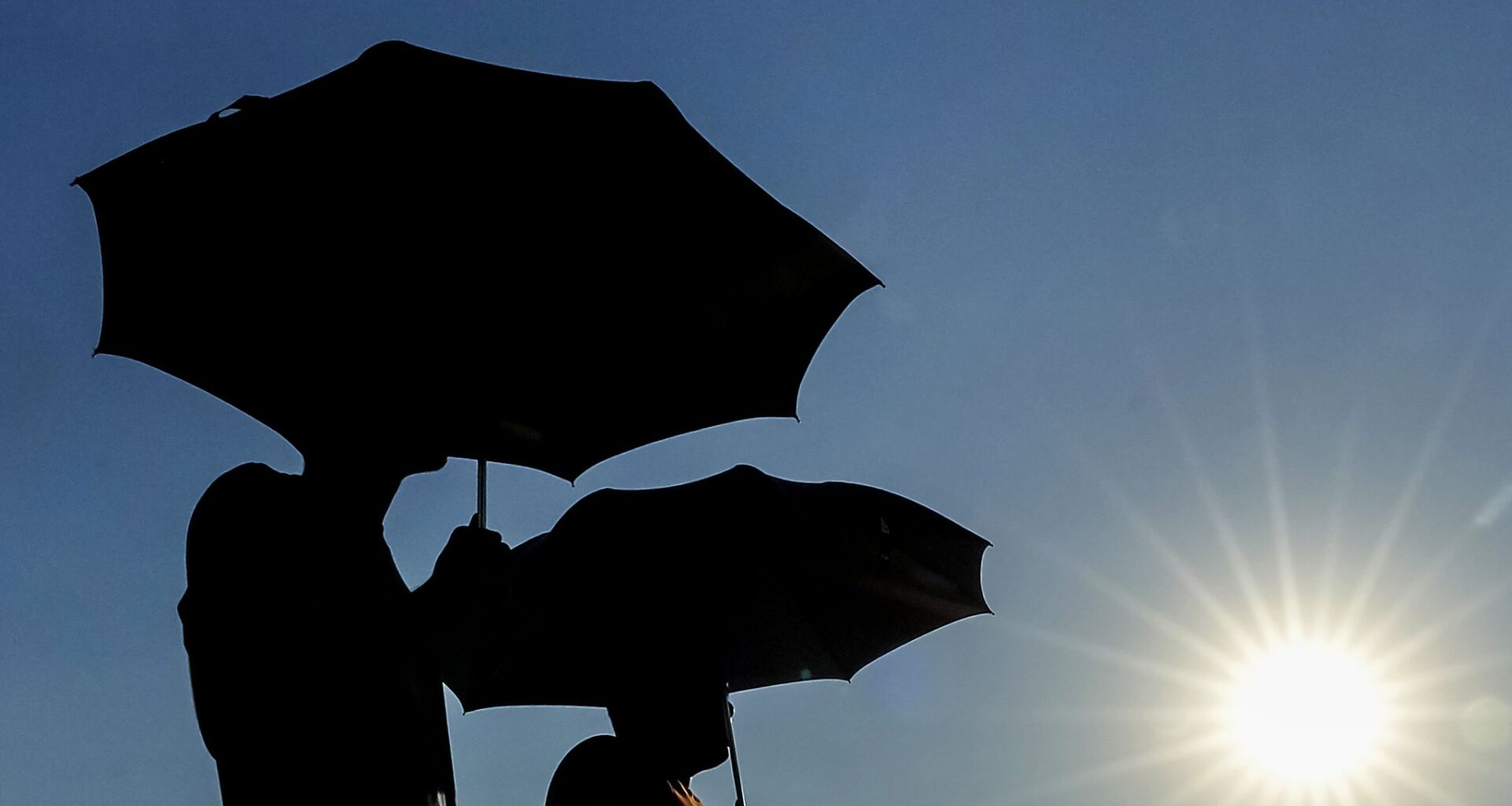
UTD students Jerin Pullan (right) and Naveen Georgi shade themselves with umbrellas as they walk to a store near campus on Sunday, Aug. 20, 2023, in Richardson. The high of 109 Sunday tied for the hottest day of the year with Thursday and Friday and continuing a streak of extreme heat so far this summer. The National Weather Service issued an excessive heat warning for all of North Texas through Monday.
Smiley N. Pool/Staff Photographer
As another Dallas summer approaches, city officials are preparing for a future where extreme heat is no longer treated as a weather inconvenience but as a growing public health emergency.

As part of that planning, the Dallas Office of Environmental Quality and Sustainability released its first extreme heat intervention guidebook.
Article continues below this ad
Rather than acting as a formal policy mandate, it is intended to be a living document that helps guide decisions and strategies across city departments, said Angela Hodges, director and chief resiliency officer.
With World Cup festivities set to begin June 11, including the opening of the Fan Festival at Fair Park, FIFA plans to use the guidebook to help shape its own heat manual, expected to be released in the coming weeks.
“This is an issue that everyone should be able to agree on,” said Hodges. “Not only for our residents, for whom this is an ongoing issue every single summer, but for visitors, regardless of whether it’s for the World Cup or otherwise, who end up in the area and aren’t used to what it feels like to have 106 degrees and 80% humidity.”
Make Dallas News a preferred source so your search results prioritize writing by actual people, not AI.
Add Preferred Source
The Dallas Heat Intervention Guidebook outlines ways the city can reduce extreme heat and protect residents as temperatures continue to rise. It focuses on issues such as tree canopy, shaded public spaces, cooling centers, reflective surfaces, public health, emergency response and home weatherization.
Article continues below this ad
The guidebook warns that Dallas is projected to get significantly hotter in the coming decades.
Under a “business as usual” emissions scenario, average summertime high temperatures could rise by nearly 5 degrees by 2050 and more than 12 degrees by 2100 compared to historical averages. It also notes that nighttime temperatures are increasing, making it harder for residents to recover from daytime heat exposure.
Heat hits some neighborhoods harder
The guidebook acknowledges that the city’s hottest neighborhoods are often lower-income areas with fewer trees and more pavement, and that residents who rely on walking, biking or waiting at uncovered bus stops may face some of the highest daily exposure to dangerous heat.
Article continues below this ad
West Dallas, downtown, South Dallas, the Medical District and south Oak Cliff can get up to 12 degrees hotter than other parts of the city.
Office of Environmental Quality and Sustainability staff present an urban heat island project update during an Environmental Commission meeting at Dallas City Hall, Wednesday, March 12, 2025, in Dallas.
Elías Valverde II/Staff Photographer
In 2023, the city partnered with the National Oceanic and Atmospheric Administration to launch the Urban Heat Island Mapping Study. The study concluded last year, revealing that more than ten neighborhoods are considered urban heat islands.
Heat islands are urbanized areas that experience higher temperatures than the surrounding region. Buildings and roads absorb and release more of the sun’s heat than natural landscapes. Areas where such structures are concentrated and green space is limited become “heat islands,” according to the Environmental Protection Agency.
Article continues below this ad
The guidebook shows that citywide tree canopy is about 32%, and nearly a quarter of Dallas census block groups have less than 20% tree coverage, far below the 30% to 40% canopy experts recommend for cooling neighborhoods.
Another issue is energy. While a significant portion of homes in Dallas have access to an air conditioner, local research and anecdotal evidence suggest that access to AC does not guarantee cooling, according to the guidebook. Rather, lower-income residents limit or avoid AC use to save money on energy bills.
The report also highlights the risk of power outages during heat waves because higher AC demand strains the electrical grid.
What Dallas wants to do
The guidebook emphasizes expanding tree canopy and preserving mature trees. It also proposes adding shade structures and trees around bus stops, sidewalks, playgrounds and public spaces to protect residents from direct sun exposure.
Article continues below this ad
Another major recommendation is the use of “smart surfaces,” including reflective roofs, cool pavement, green roofs and permeable pavement that absorb less heat and reduce stormwater flooding.
The guidebook also focuses heavily on public health and affordability measures.
It recommends expanding cooling centers, providing emergency heat alerts in multiple languages and offering free transportation to cooling spaces. Additionally, it proposes distributing cooling kits, fans and portable AC units during extreme heat events.
Oppong Hemeng, a senior climate coordinator for the Office of Environmental Quality and Sustainability, said the guidebook is also about actions residents can take in their own homes to reduce heat exposure and improve comfort.
Article continues below this ad
The guidebook recommends to residents simple cooling strategies like opening windows at night, using fans to improve airflow, closing curtains during the hottest parts of the day and using blackout curtains or window films to block sunlight.
The real challenge: implementation
The guidebook acknowledges that many of the proposed heat solutions will be difficult to implement because of cost, maintenance needs, coordination challenges and unequal access to resources.
Article continues below this ad
The report says implementation will require coordination across multiple departments and stronger public outreach. Dallas still lacks local data on heat-related deaths and hospitalizations, especially among homeless residents, making it harder to prioritize funding and emergency response.
Residents can access the guidebook at the Dallas Climate Action website.