
We’ve long treated The Athletic’s MLB mailbag the way managers once treated starting pitchers: give someone the ball and see if they can go the distance.
This time, we’re experimenting with a different approach.
It’s a mailbag bullpen game, and while I have the ball here in the top of the first, I’m more of an opener. My job is to give the team one good inning before a bunch of relievers come out of the bullpen, one after another — and we’re playing matchups. Specific writers are going to respond to specific questions based on expertise and experience. As always, some questions have been edited for clarity.
I’ll start us off.
Can someone explain the difference between the IL stints? Is there really a difference between IL10, IL15, and IL60? — Tom R.
Under the current system, the 10-day IL is for hitters, and the 15-day IL is for pitchers (and two-way players). The numbers mean what you think they mean: A player on the 10-day IL has to be on the injured list for at least 10 days, and a player on the 15-day is out for at least 15 days. An IL stint can be longer but not shorter.
The 60-day IL is for long-term injuries, and the designation matters because players on the 60-day do not count against 40-man roster limits. So, if a team needs to open a 40-man spot, it can do so by moving a player to the 60-day IL, but that player has to miss at least 60 days (if a player has been on the 15-day IL for 20 days, then goes on the 60-day, he only has to miss 40 more days).
To make sure I wasn’t missing anything, I texted a longtime executive:
“That pretty much covers it,” he said. “There’s also a 7-day concussion IL. Also, there is some nuance to the 60-day IL, but that detail may be unnecessary.”
— Chad Jennings
What are the most likely rule changes in the next 1, 3, 5 years?? — Eric R.
First guy out of the pen is our resident Hall of Famer, Jayson Stark. Jayson, take it away:
With labor Armageddon hovering, it’s unlikely you’ll see anything new next year. You could see tweaks to ABS, but that wouldn’t qualify as a rule “change” in my dictionary. But once the labor clouds lift? Then the league could start implementing — and experimenting with — more impactful and creative rule changes. Such as:
High-tech checked swing calls — Not only is there technology that can do this, but it’s already being used in Triple A games in the Pacific Coast League. This just started a couple of weeks ago, but there’s an excellent chance you’ll see it in the big leagues sometime.
Crackdowns on stalling — Hitters don’t think they’re stalling when they call time out. Pitchers don’t think of it as stalling when they claim their PitchCom is on the fritz. But if this year’s minor-league experiments tell us anything, they tell us the league wants to tighten timeouts and limit PitchCom chicanery.
Moving second base — Did you know that for 100 years, second base has been in the “wrong” place? So, watch for how it goes when the International League inches the bag closer to the plate — and also closer to first/third base — in the second half.
— Jayson Stark
I think Jed Hoyer got trading prospects for one year of team control out of his system last year with the Kyle Tucker deal. That said, it’s looking like pitching (big surprise) is going to be a real need this season. What pitchers with term do you think are realistic targets for the Cubs to consider trading multiple prospects to get? — Bryan H.
You’re looking for an expert on the Cubs and the open market? On this one, let’s turn to Patrick Mooney, who has covered the Cubs for us since 2018 and also specializes in player movement around the league:
Given the state of their injury-plagued staff, as well as their fast start to the season, the Cubs will consider virtually every pitcher potentially available this summer: Logan Webb, Robbie Ray, Freddy Peralta, Sandy Alcantara and Joe Ryan, among others, plus high-leverage relievers with big-game experience.
While the Cubs don’t have much to offer in terms of pitching prospects, they could make major-league talent available. Matt Shaw’s name will likely come up often during trade discussions because he’s currently blocked by infielders Alex Bregman and Nico Hoerner and mostly limited to a super-utility role. Triple-A Iowa’s roster features potential everyday players such as Kevin Alcántara and Pedro Ramírez, and there are more interesting hitters at the lower levels of the farm system.
By acquiring pitching at the trade deadline, the Cubs can rationalize the cost by getting a jump on their offseason, when Shota Imanaga, Matthew Boyd and Jameson Taillon can all become free agents, and Cade Horton will still be recovering from elbow surgery.
The Cubs will have trade chips available. The question, again, is how far a model-driven organization is willing to go outside its comfort zone, and how much the club’s executives are prepared to give up to improve the team’s World Series odds.
— Patrick Mooney
I have been rereading “Dollar Sign on the Muscle,” the great book on baseball scouting. It is now very outdated, but still interesting. What are the best modern books on baseball (scouting or otherwise) that are worth purchasing? — Tom W.
Here’s Tyler Kepner, the author of two books about baseball, and also a guy who enjoys reading about the game as much as anyone I know:
You mentioned modern books, so I’d be a terrible salesman if I didn’t suggest my own: “K — A History of Baseball In Ten Pitches” (2019), which traces the origins and evolution of 10 different pitch types, and “The Grandest Stage — A History of the World Series” (2022), which explores seven different aspects of the World Series, plus a lot of bonus goodies.
If you’re interested in a biography, here are four that stand out: Andy McCullough’s “The Last Of His Kind,” on Clayton Kershaw (2024); Tim Brown’s “Nolan” on Nolan Ryan, which comes out this month; Howard Bryant’s “Rickey: The Life and Legend of an American Original” (2022), on Rickey Henderson; and David Maraniss’ “Clemente: The Passion and Grace of Baseball’s Last Hero” (2007), on Roberto Clemente. I’d also highly recommend “Skipper: Why Baseball Managers Matter and Always Will” (2025), by Scott Miller, a dear friend and wonderful writer who completed it while valiantly battling the cancer that took him way too soon. Scott’s love of the game — and deep appreciation for the men in the dugout — really shines through.
— Tyler Kepner
In 2008 the Rays opted for a HS SS in Tim Beckham over a college catcher in Posey, and have been searching for a franchise catcher ever since. Assuming Roch Cholowsky goes 1st, what do you think the odds are of the Rays picking Vahn Lackey 2nd over Grady Emerson? Rays have gone prep SS in 3 of the last 5 drafts, including Daniel Pierce last year. — James P.
It’s obvious who we’re turning to for this one. You knew it when you asked the question. Here’s our draft and prospects expert, Keith Law:
I am not assuming Roch Cholowsky goes first at all — in my last mock, I had the White Sox passing on him to take high school shortstop Grady Emerson. I also don’t think the choice for the Rays would be Vahn Lackey vs. Emerson; it would be Lackey vs Jackson Flora, the top pitcher in the draft class.
Lackey — Ga Tech C
Flora — UC Santa Barbara RHP
Cholowsky — UCLA SS
Emerson — Fort Worth Christian HS SS
— Keith Law
I absolutely loved the article on Matt Olson, Freddie Freeman, and their respective teams as a win-win-win-win in the changing of their uniforms. Historically, what other moves have created a similar high caliber win for the involved players and teams? — Jake M.
Let’s go straight to the guy who wrote that story, Ken Rosenthal:
It’s not quite the same — no two situations ever are! — but a recent example is the way the Yankees rebounded from the loss of Juan Soto. Obviously Soto will be great for the Mets — maybe not $765M great, but great. But the Yankees’ pivot was impressive. The signings of Max Fried and Paul Goldschmidt. The trades for Cody Bellinger, Fernando Cruz and Devin Williams. The Yankees proceeded to lead the majors in runs in 2025, improving upon their total from their one year with Soto. And with essentially the same cast, their offense this season is among the best in the league. Add in Fried and Cruz, and they came out of it just fine.
— Ken Rosenthal
What is the best path forward for Cleveland’s starting catching issue? Austin Hedges is a team leader, and he is definitely helping Parker Messick come into his own. Bailey is obviously a defensive wizard, but with Bo Naylor being torn down to the studs and Cooper Ingle sporting a 1.206 OPS in Columbus, what is the best path forward? How do they find at-bats for Ingle (and hide at bats for Patrick Bailey), while continuing to handle the staff effectively? — Mike K.
If I told you the catching story this guy is working on right now, you honestly might not believe me (he also happens to cover the Guardians). So here’s Guardians beat writer Zack Meisel to get into the details:
Here’s how Guardians manager Stephen Vogt answered this: “We have three really good catchers. We have a starting catcher every night.” After a grin, he added: “It’s going to be a tough puzzle to figure out, which is a good thing.”
Vogt noted Bailey’s playing time will increase in the next few weeks as he grows more comfortable with the pitchers and their tendencies. He likes pairing Hedges with Messick, and for good reason; the rookie left-hander has been Cleveland’s most consistent starter. I’d expect Bailey and Hedges to share the vast majority of the reps, with David Fry serving as a pinch-hitter and once-in-a-blue-moon starter, in addition to his other duties as right fielder or DH against lefties.
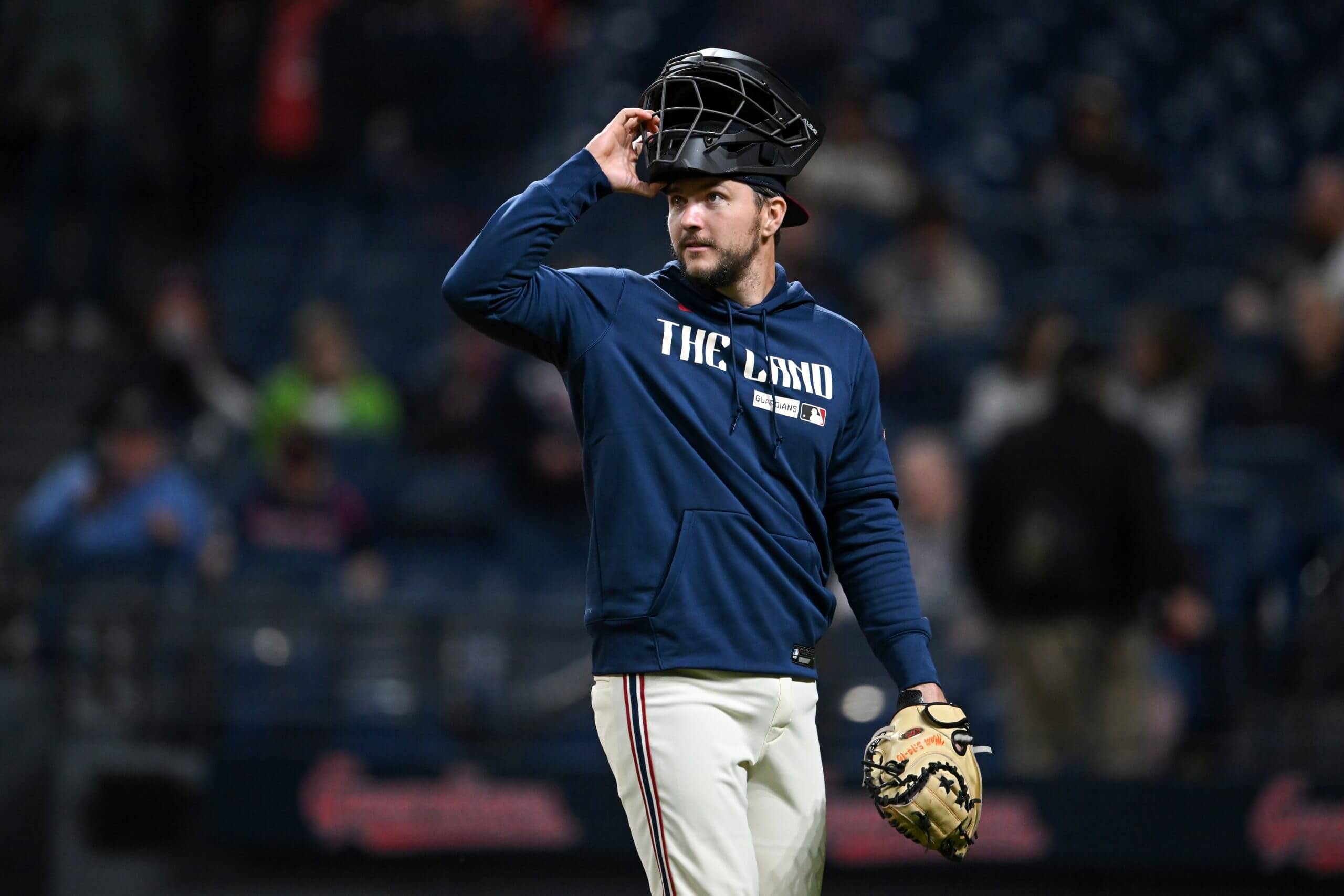
Patrick Bailey has fit in well so far in a crowded Cleveland catching rotation. (Nick Cammett / Getty Images)
Where that leaves Ingle, of course, is the conundrum. His bat is ready for a big-league audition. The Guardians are encouraged with defensive strides he’s made, but he’s nowhere near the Hedges/Bailey level, and team president Chris Antonetti admitted it’s possible he eventually works in some other positions. If the Guardians weren’t already devoting a roster spot to Fry, Ingle could ultimately fit well in a reverse Fry role, facing mostly right-handed pitching.
It’s worth noting, the organization is also high on Kody Huff, a well-regarded defender who has also raked this year.
That’s a lot of catchers. There’s no room for Naylor to chart a path back to the big-league roster, so don’t be surprised if some other catcher-desperate team swings a trade for him. The Guardians could also include a catcher in a prospect package in a midseason trade, assuming they stick atop the AL Central and want to get aggressive.
— Zack Meisel
MLB teams have a Trajekt pitching machine that can replicate any pitcher’s pitches. Are teams using the Trajekt to help train their batters’ (and catchers’) ability to recognize whether pitches are balls or strikes for ABS challenges? If they’re not, they should be! — Kenneth S.
We happen to know several teams that are doing this. Among them are the Washington Nationals, so here’s our Nats beat writer, Spencer Nusbaum, to explain…
At home, the Nationals catchers head into the cages with catching coach Bobby Wilson and go through dozens of ABS reps as they work on their framing. When it’s Keibert Ruiz’s turn to catch, he inputs his height into the machine for an imaginary zone. They test pitches all around the zone, with a particular emphasis on the bottom of the zone. This has helped them a good bit over the course of the season — at the start of the year, they were one of the worst teams in MLB at challenges (and one of the best at framing). Since late April, they’ve been a middle of the pack bunch in the ABS sphere.
Of course, it isn’t always perfect.
Said catcher Drew Millas: “There was one I can remember in Pittsburgh with Oneil Cruz. I’m catching a ball, like, waist high. And I’m thinking, like, ‘Oh, that might be there on a six-seven giant.’ And I check it, and it’s like a half an inch above. So the average-height hitters, it’s a lot easier. But the taller guys, like (Matt) Olson this week, it’s real tough, because everything at the bottom feels like a strike, because you’re catching it higher than where it would be a strike for an average height person.”
— Spencer Nusbaum
Which story are you most excited to keep tabs on? Something that’s developing but not quite yet narratively complete yet? It could be a player or team’s performance, a behind the scenes story, Olympics, etc. — Sam M.
We all have that one friend who brings up random thoughts and observations, seemingly plucked out of nowhere, and after about five minutes of discussion, it becomes clear that he’s actually onto something. For me, Stephen Nesbitt is that friend:
It’s dreadfully dull to write about the Los Angeles Dodgers in May, and arguably moronic to suggest Shohei Ohtani’s legacy is not yet narratively complete. He will go down as the greatest player in baseball history — a two-way talent the game has never seen. He’s a surefire Hall of Famer, a four-time MVP and two-time World Series champion, and still just 31 years old.
Yet until this year what would history say of Ohtani as a pitcher?
I reckon he’d be overwhelmingly remembered as a hitter. The narrative of Ohtani as a pitcher: Struggled to hold peak performance on the mound; couldn’t stay healthy; might have lasted longer as a reliever. Ohtani had an excellent 3 ERA through 100 career starts from 2018 to 2025, but he only once pitched above 132 innings as he navigated injuries.
Now, Ohtani is challenging that narrative — just like he did in 2024 by stealing 59 bases just to show he could. Ohtani, who starts Wednesday against the San Diego Padres, has breezed through his first nine starts of the season with alarming consistency.
March 31 vs. CLE: 6 IP, 1 H, 0 ER, 3 BB, 6 K
April 8 at TOR: 6 IP, 4 H, 0 ER, 1 BB, 2 K
April 15 vs. NYM: 6 IP, 2 H, 1 ER, 2 BB, 10 K
April 22 at SFG: 6 IP, 5 H, 0 ER, 0 BB, 7 K
April 28 vs. MIA: 6 IP, 5 H, 1 ER, 3 BB, 9 K
May 5 at HOU: 7 IP, 4 H, 2 ER, 0 BB, 8 K
May 13 vs. SFG: 7 IP, 4 H, 0 ER, 2 BB, 8 K
That’s an 0.82 ERA through 44 innings.
As Ohtani heats up at the plate, watching him waltz to a fifth MVP would not be surprising in the slightest. But winning a Cy Young Award would be his most incredible feat yet.
— Stephen Nesbitt