
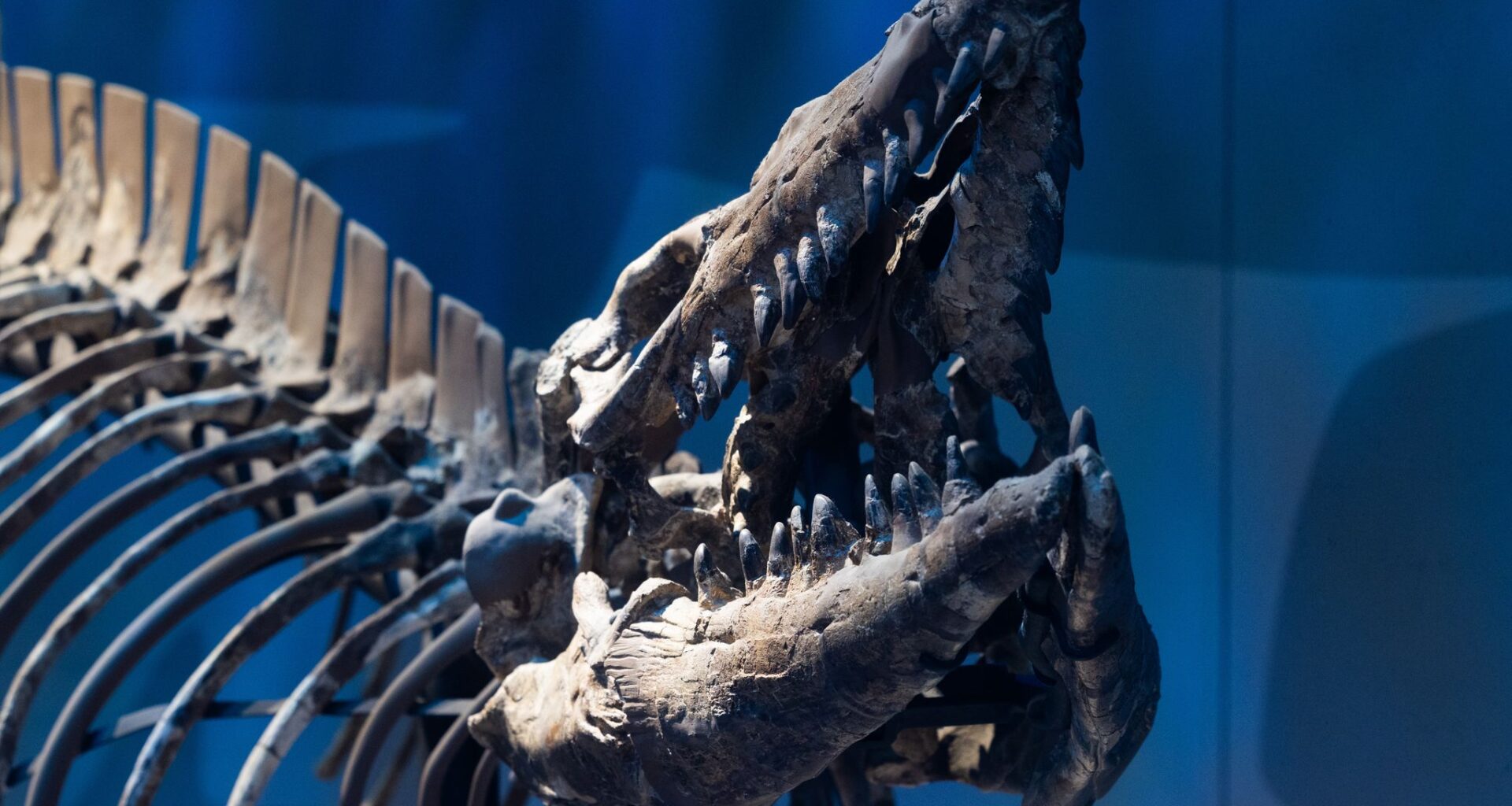
As the saying goes, everything’s bigger in Texas — it just so happens that applies to ancient marine lizards, too.

On Thursday, researchers at the American Museum of Natural History, the Perot Museum of Nature and Science and Southern Methodist University announced they have identified a school-bus-sized lizard that once prowled the seas above North Texas. The research team detailed its findings in a study published in the Bulletin of the American Museum of Natural History.
The species, called Tylosaurus rex, is a mosasaur, or a marine reptile that lived alongside dinosaurs. This “T. rex of the sea” ranged from approximately 25 to 45 feet long and was one of the later kinds of mosasaurs, which were wiped out by the asteroid impact 66 million years ago.
Article continues below this ad
Originally classified as Tylosaurus proriger, another mosasaur, the new species is distinguished by its serrated, steak knife-type teeth, a larger body and significantly stronger musculature, as evidenced by enlarged attachment sites on the fossil for larger and more powerful jaw and neck muscles.
The discovery is important because it adds to what paleontologists know about “the diversity of a really, really cool group that lived during the same interval of time the dinosaurs lived,” said Barry Albright, a professor emeritus of earth science at the University of North Florida, who was not involved in the research. Albright also said the discovery “can provide more information on what species are related, and where in history certain adaptations in the mosasaur lineage appear.”
Make Dallas News a preferred source so your search results prioritize writing by actual people, not AI.
Add Preferred Source
Researchers still don’t know how many species of mosasaurs there were, or how greatly they differed from one another. Studies like this can help inform future research in the field, said Takuya Konishi, an associate professor at the University of Cincinnati with more than 15 years of experience studying mosasaurs, who was not involved in the study.
Article continues below this ad
Found by kids on a family boating trip
The name-bearing specimen, or holotype, of T. rex was found in 1979, not by scientists, but by a family going on a boat ride in Lake Ray Hubbard.
“The kids got a little antsy, started getting a little whiny,” said Ron Tykoski, vice president of science and curator of vertebrate paleontology at the Perot, who was a co-author on the study. “So the parents beached the boat and told their kids to get out and play on the shore.”
The kids happened upon some weird-looking rocks, which they showed to their mom. She thought the rocks looked eerily similar to large bones and contacted the Dallas Museum of Natural History, the predecessor of the Perot. Researchers rushed to the site and quickly realized these strange rocks were actually the bones of an ancient marine reptile that had been exposed by waves lapping at the shore. The skeleton was then collected and has been on display for years.
Article continues below this ad
(From left) Michael Polcyn, Senior Research Fellow, ISEM at Southern Methodist University, and Ron Tykoski, Vice President of Science and Curator of Vertebrate Paleontology at the Perot Museum of Nature and Science, pose for a photo at the Perot in Dallas, Tuesday, May 19, 2026.
Juan Figueroa/The Dallas Morning News
Michael Polcyn, a senior research fellow at SMU and co-author on the study, said he first noticed something unique about these bones around 2012.
“There was a groove on the rim of the quadrate that was not in any of the other species,” Polcyn said. The quadrate, a multifunctional bone equivalent to the middle ear, is an anatomical feature frequently used by scientists to infer the relationships between species. “It was pretty unusual to see that in a tylosaurus.”
But Polcyn’s sneaking suspicion wasn’t new. In the late 1960s, when paleontologist John Thurmond was an SMU student, he noticed that the tylosaurus specimens recovered from northeast Texas were abnormally large and theorized they might belong to a new species. He informally dubbed the reptiles “Tylosaurus thalassotyrannus,” or “sea tyrant.” Polcyn said he stumbled across Thurmond’s note decades after it was written.
Article continues below this ad
“It was serendipity,” Polcyn said. “I came across that letter when I was looking for something else completely.” Polcyn recounted how the discovery brought a smile to his face, confirming the research team was on the right path.
Battle scars on some T. rex specimens suggest the species had a violent nature. A fossil discovered in North Texas in 2022 and nicknamed “The Black Knight” has a slew of horrific injuries, including a fractured jaw and a missing portion of its snout.
The only animal that could have inflicted that level of damage must have been from the same species, Tykoski said. There were also signs of healing, showing the mosasaur survived the injuries. It’s not the first mosasaur found with evidence of injuries likely inflicted by another of its kind, said Tykoski, but it is by far the worst.
Citizen scientists play a key role in fossil discovery
Most of the new species in North Texas that have been named by researchers were found by local collectors and amateur fossil enthusiasts walking creek beds and open fields. Specimens like the holotype fossil and “The Black Knight” are no exception, both being discovered by nonscientists.
Article continues below this ad
Albright likened the role of citizen scientists in paleontology to that of amateur astronomers. “Just think about how many amateur astronomers have found comets and asteroids,” he said.
“We couldn’t do this without the citizen scientists that actually are out there walking the outcrops every day,” said Polcyn.
Texas is one of the best places in the United States to hunt for these pieces of the past. Around 100 million years ago, during the Cretaceous Period, much of the state was covered by a shallow, nutrient-rich sea teeming with life.
“We’ve probably got the most complete record of mosasaur evolution in one geographic area in the entire world, right here in Texas,” Tyksoski said.
Article continues below this ad
A skeleton of a Tylosaurus rex, a type of mosasaur, on display at the Perot Museum of Nature and Science in Dallas, Tuesday, May 19, 2026.
Juan Figueroa/The Dallas Morning News
Although this research is rooted deep in the past, its implications extend far beyond it. As Tykoski put it, “These ancient animals show us what is possible: What was possible in the past, and what could be possible in the future.”
The sense of wonder brought on by their research, Tykoski says, is especially important for younger generations. Gesturing toward a rambunctious crowd of children ping-ponging from exhibit to exhibit in the Perot, Tykoski said: “Look at all these people who have come here to see amazing things, to see things that are beyond their imagination and be inspired by it. These kids — hopefully, they see something in an exhibit like this, and it triggers a lifelong desire to learn more about the world.”