
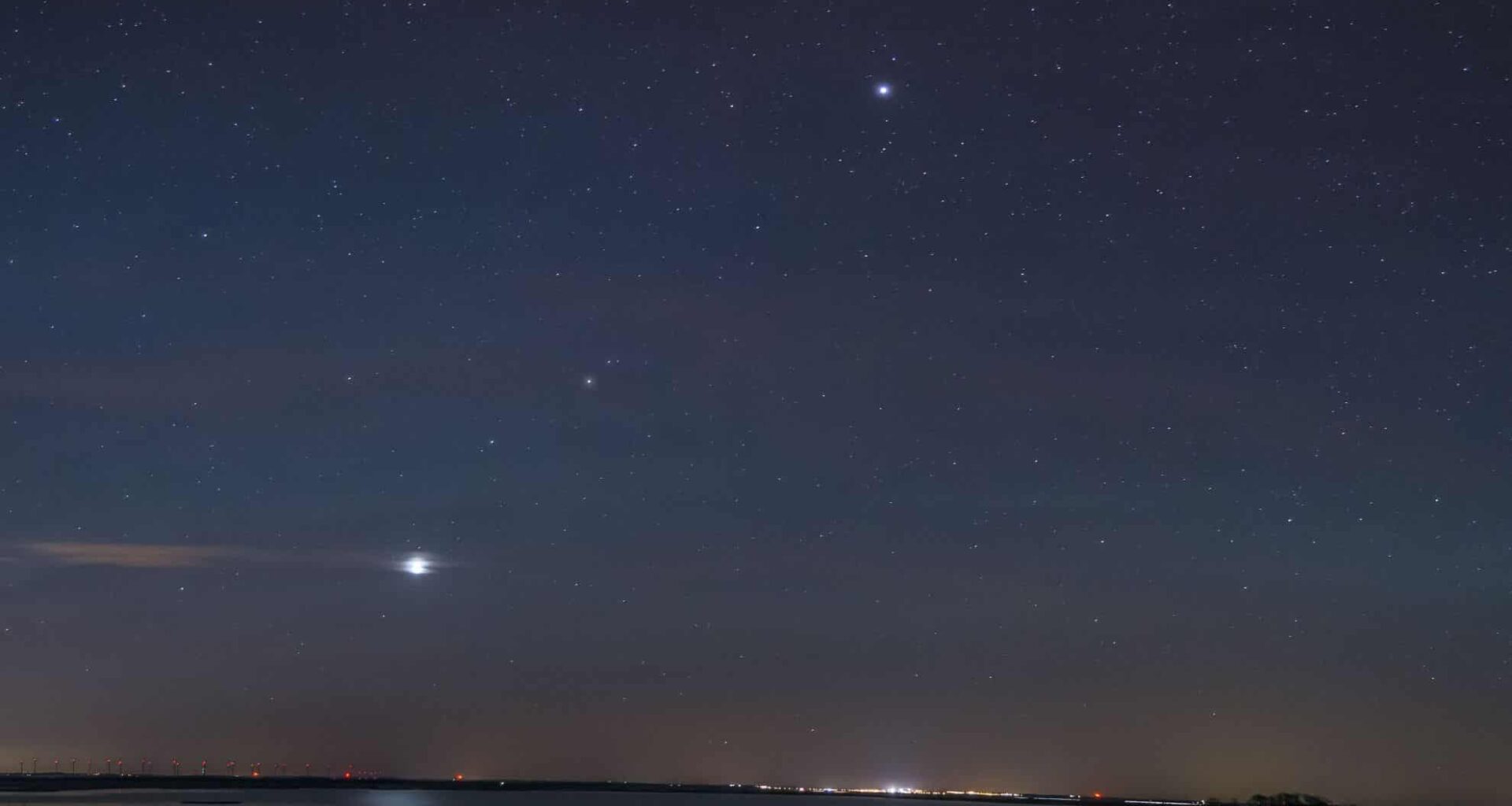
Skywatchers are in for a rare treat this August as six planets align in a stunning arc across the night sky. This planetary parade will be visible through the end of the month. While four of the planets—Mercury, Venus, Jupiter, and Saturn—can be seen with the naked eye, Uranus and Neptune will require a powerful pair of binoculars or a telescope to spot.
Though the alignment begins on August 10, the best viewing period occurs in the days leading up to August 23, when the moon will be minimal or absent, allowing for clearer skies.
Ideal Viewing Times and Locations
According to Earthsky.org, for those in the Northern Hemisphere, the planetary parade will feature Neptune and Saturn rising first, followed by Uranus, then Venus and Jupiter, with Mercury trailing behind. The planets will be visible at different times depending on where you are. For many locations in the Northern Hemisphere, Neptune and Saturn will rise between 8:30 pm and 10 pm local time, appearing in the southwest about 40 degrees above the horizon, with Uranus visible slightly higher, about 55 degrees above the horizon in the southeast. Venus and Jupiter will rise further to the east, around 20 degrees above the horizon, with Mercury just barely peeking over the eastern horizon.
If you’re in the Southern Hemisphere, the planets will be visible to the north. Neptune and Saturn will be seen in the northwest, followed by Uranus, while Venus, Jupiter, and Mercury will appear in the northeast, although they’ll be slightly lower on the horizon compared to their Northern Hemisphere counterparts.
Saturn and Neptune: The Bright and the Faint
Saturn, one of the most iconic planets in our solar system, will be easy to spot with the naked eye due to its brightness. Its stunning rings can be observed through binoculars or a backyard telescope. Saturn’s largest moon, Titan, is also visible through a telescope, offering a rare glimpse at the second-largest moon in the solar system, which is even larger than Mercury.
On the other hand, Neptune is much more elusive. While Saturn’s rings are easy to see, Neptune requires more powerful equipment. The planet will be harder to spot due to the bright moonlight on August 10 but will be visible on clearer nights, especially around the New Moon on August 23. During that week, Neptune will rise just before Saturn, appearing slightly above it in the sky.
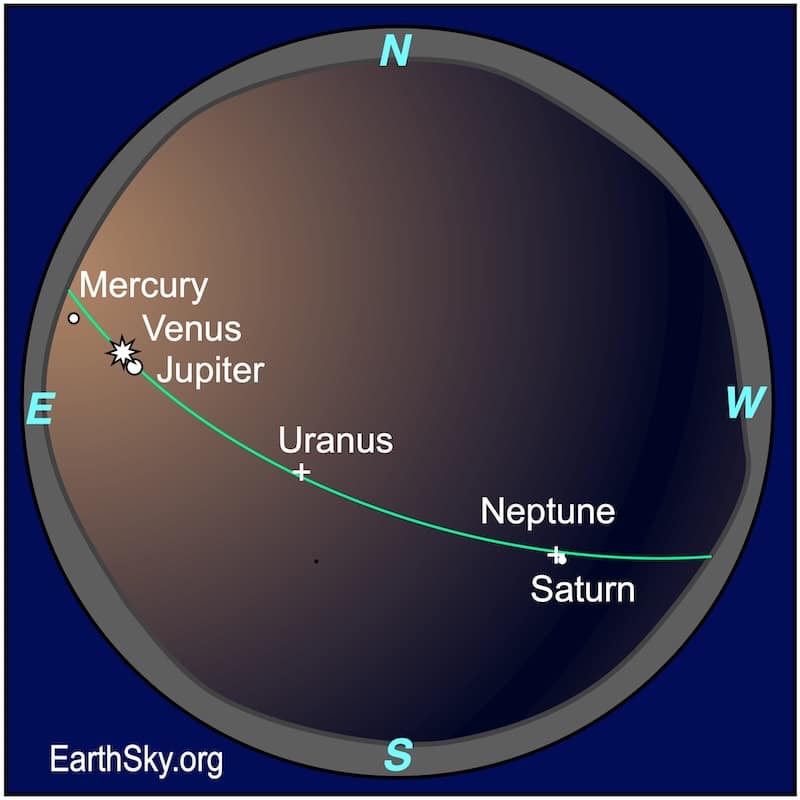 Credit: EarthSky.org
Uranus: A Blue Disc in the Sky
Uranus will also be visible, but you’ll need a good pair of binoculars or a telescope to see it. This distant planet will rise later than Saturn and Neptune, between 11:45 pm and 12:45 am in most parts of the Northern Hemisphere. In southern latitudes, Uranus will rise closer to 1:30 to 2:30 am. Through a telescope, Uranus will look like a faint, pale blue disc—don’t expect to see its vertical rings, as they are too faint for amateur equipment to capture.
Uranus will appear just under the star cluster Pleiades, making it easier for stargazers to locate. If you can’t find Uranus, the Pleiades cluster itself is a beautiful sight, containing several bright stars and thousands of fainter ones grouped together.
Jupiter and Venus: The Brilliant Pair
Among the most prominent of the visible planets will be Jupiter and Venus, which will rise in the early morning hours. In the Northern Hemisphere, they will appear between 2:30 am and 3:30 am, while in the Southern Hemisphere, you’ll need to wait until around 4:00 am. The two planets will be positioned incredibly close together—less than 1 degree apart—as they nearly reach conjunction on the night of August 11–12. Jupiter and Venus will both be located in the constellation Gemini.
These two planets are among the brightest in the sky, so they’re easy to spot even without binoculars or a telescope. However, if you do have equipment, you’ll be able to see Jupiter’s famous cloud bands, including the iconic Red Spot, a massive storm that has been raging for centuries. Jupiter’s four largest moons—Io, Europa, Ganymede, and Callisto—are also visible through telescopes, making Jupiter a fascinating target for stargazers. Venus, while lacking Jupiter’s cloud bands, will show its phases—similar to the Moon’s—through telescopic observation. Look for a crescent Venus as it moves through its phases.
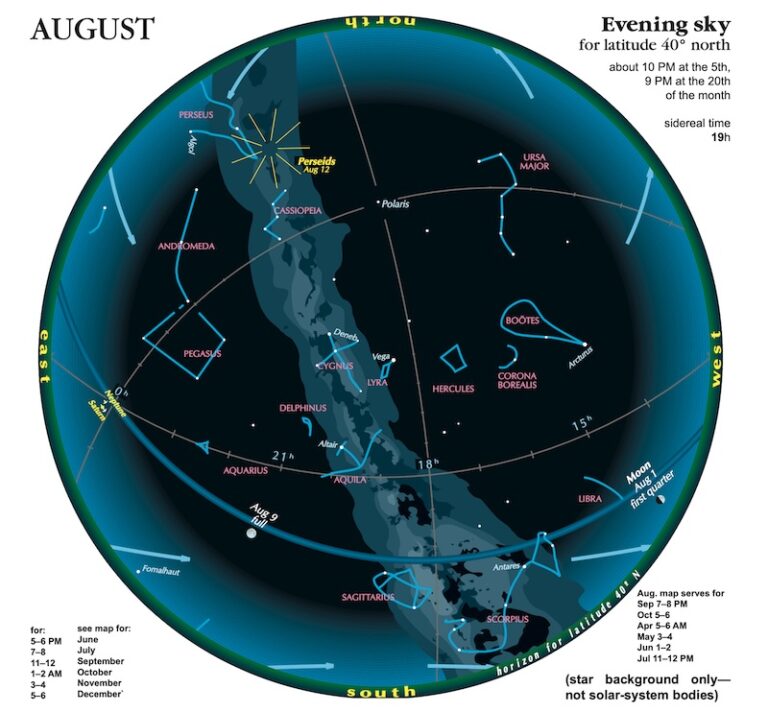 Credit: Guy Ottewell’s 2025 Astronomical Calendar
Mercury: The Elusive Planet
Mercury will be the last of the planets to rise, appearing between 4:30 am and 5:30 am in most Northern Hemisphere locations. However, it will rise closer to 6:30 am in more southern regions. Since Mercury will be so low on the horizon, you’ll need a flat, unobstructed view to catch a glimpse of it just before sunrise.
While Mercury will join the planetary parade on August 10, the best time to observe it will be between August 18 and August 23, when it reaches its greatest western elongation on August 19. This is the point when Mercury is furthest from the Sun and visible for the longest period before sunrise.
However, viewing Mercury requires caution, as it will be dangerously close to the Sun. If you’ve ever wanted to see all six planets together, now is the time. The next opportunity won’t come until February 2026.