
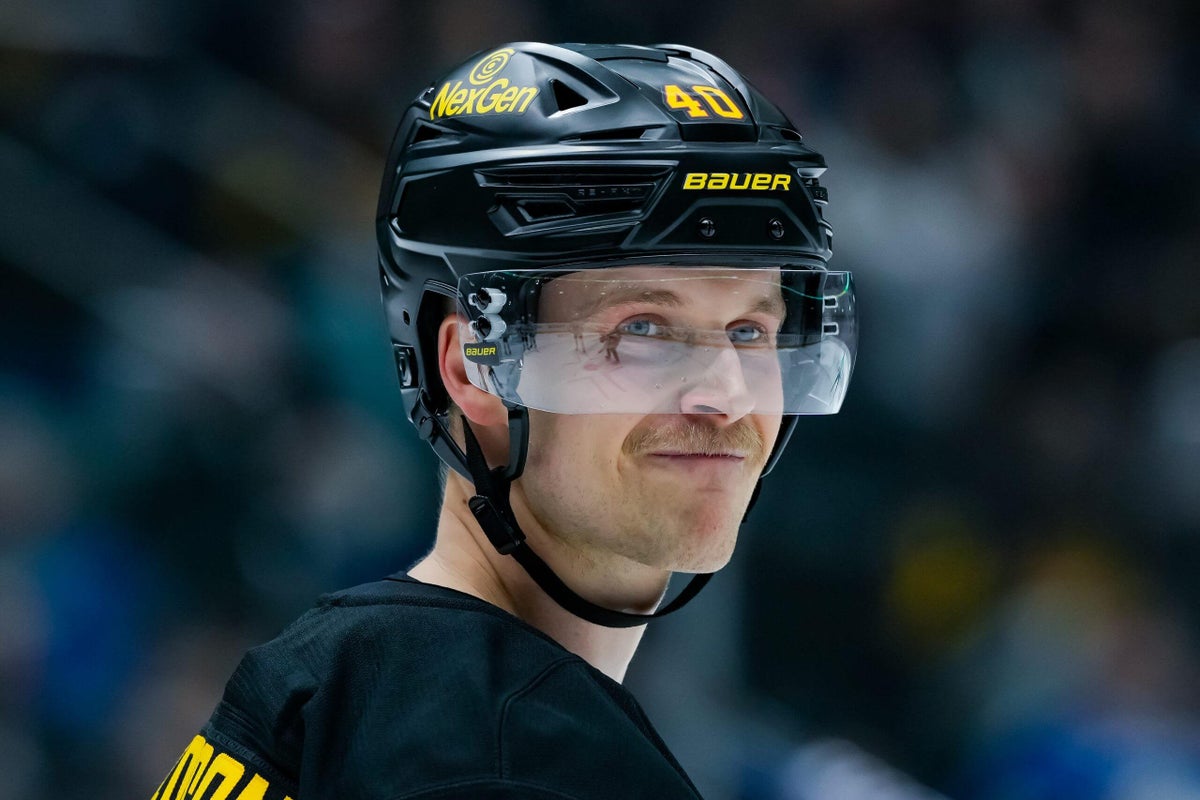
Managing Elias Pettersson’s future is one of the most consequential tasks facing the Vancouver Canucks’ new front office this offseason.
This, of course, won’t be exclusively their decision to make. Pettersson has a full no-movement clause on a contract that has six years remaining at an $11.6 million cap hit. He has the final say, so any plan about his future will need to be a collaborative process between him and the incoming management regime.
To say Pettersson’s relationship with the fanbase and organization is complicated would be an understatement.
After a dominant 102-point campaign in 2022-23 and another superstar-calibre first half of the season in 2023-24, the Canucks re-signed Pettersson to his infamous eight-year extension. Since then, Pettersson hasn’t just declined; his performance has fallen off in a near-unprecedented way for a player in their mid- to late-20s.
The now 27-year-old Swede was a shadow of himself in the 2024 Stanley Cup playoffs, where he scored only one goal in 13 games. He slumped to just 45 points in 64 games in 2024-25, and this season, he failed to make progress, scoring 51 points in 74 games.
It’s not just that his production has dried up; it’s how fundamentally different he looks by the eye test. Pettersson was an incredibly dynamic rush attacker at his peak, but over the last two years, his skating stride and puck-carrying ability through the neutral zone have looked compromised. He’s unable to separate from checkers and create space to shoot from dangerous areas and make elite plays at a high volume.
It’s as if he’s slowly morphing into an Elias Lindholm-type centre — he’s hardworking, attentive defensively and is smart enough to still score at a second-line level, but there’s very little dynamic play-creating, and he can’t drive a line offensively on his own anymore.
All of that leads us to a few burning questions: Should the Canucks explore trading him? Is he even tradeable, and if so, what’s his value? How does the rising cap climate and the NHL’s general shortage of top-six centres impact the organization’s incentives and considerations?
Here’s a look at a few factors the Canucks should be thinking about on the Pettersson file, after conversations with two NHL executives who were granted anonymity so they could speak freely.
One of the first points people bring up when discussing Pettersson’s disappointing performance is that he’s been saddled with middling linemates and subpar support. There’s absolutely some truth to this, but it’s a nuanced topic. Pettersson played at least 150 five-on-five minutes this season with six different wingers: Jake DeBrusk, Evander Kane, Conor Garland, Drew O’Connor, Brock Boeser and Linus Karlsson.
None of those are first-line calibre wingers. There’s zero doubt that this is holding him back to some degree. However, it’s also true that the peak version of Pettersson from three years ago was so dynamic and dominant that he could drive a first line on his own.
In 2022-23, when Pettersson scored 102 points, his most common five-on-five linemates, according to Natural Stat Trick, were Andrei Kuzmenko, Ilya Mikheyev and Anthony Beauvillier.
That’s hardly any better than the crop of linemates he’s had over the past two years. Kuzmenko was a one-hit wonder who mostly rode Pettersson’s coattails — he’s failed to hit 50 points in a single season across three different organizations since leaving Vancouver. Mikheyev and Beauvillier, meanwhile, are speedy, hardworking bottom-six forwards with limited scoring touch.
So yes, mediocre linemates have accelerated Pettersson’s fall-off, but that alone cannot explain his perplexing decline.
“The biggest problem with the Elias Pettersson story is that both sides failed each other,” said a front office source from another NHL team. “If you think about it, the best (winger) that ever probably played on his line, that fit the way he wanted to play, was Tyler Toffoli, and that’s a pretty damning place to be as an organization that gave a player that big of a commitment without a surefire way to support that player.”
That linemates factor is also why there’s likely to still be interest in Pettersson’s services this summer. There will likely be at least a few rival teams with a need down the middle who will believe they can unlock more from Pettersson by insulating him with more talented wingers, a better team environment, and the psychological benefit of a fresh start. Any potential interest in Pettersson will certainly also be fuelled by what’s arguably the worst free-agent class in NHL history — 39-year-old Evgeni Malkin is the only centre that cracked Chris Johnston’s top-20 free-agents list.
Another NHL front-office executive The Athletic spoke with was confident that Pettersson’s contract is movable. The huge caveat, though, is that he predicted the offers wouldn’t include any premium draft picks or prospects and might still require Vancouver to take back another team’s inefficient contract.
“Would someone take his whole contract? Yeah, I think someone would take his whole contract, but what are you gonna get for him?” the executive asked. “Are they gonna make you take back one of their (bad contracts)?”
As a hypothetical example, if the L.A. Kings, who could be in the market for a top-six centre because of Anze Kopitar’s retirement, kick tires on Pettersson, they could ask the Canucks to take back a player like Brian Dumoulin (two years remaining at a $4 million cap hit) or Cody Ceci (three years remaining at a $4.5 million cap hit). And even then, the Canucks are unlikely to net meaningful assets in return.
“This year and last year are the lowest (his trade value) have been in his career,” the executive said. “Four years ago, you could have gotten multiple first-round picks. For me, it doesn’t make sense to trade him just to move him out.”
This raises an important question: Is it worth trading Pettersson simply to get his giant contract off the books?
On paper, the answer is no. The value of offloading Pettersson’s contract would be high if Vancouver were a contending win-now team that needed cap flexibility, but the Canucks are at the start of what’s going to be a long, painful rebuild. Even if the Canucks gained $11.6 million in cap space, it would hardly change the team’s trajectory because nearly every organization has ample cap flexibility.
“The opportunity cost for a team that is 32nd is zero in terms of the benefit of getting off of the (Pettersson) contract commitment,” said the first front office source. “Because if they were to get off the commitment, it’s not like they’re going to spend the $11.6 million on difference-making, contending moves in the offseason.”
Trading Pettersson would also create a hole at centre — Marco Rossi would be an adequate 1C stopgap, but who would be the team’s 2C? Filip Chytil is unreliable because of his injuries, and Teddy Blueger is a pending UFA.
Even if Pettersson doesn’t bounce back — this is a reality the Canucks need to prepare for since they don’t have a winger who can spark him next season — the risk of his trade value declining beyond its already-distressed point is low.
Why? Well, provided that he can maintain his current performance as a second-line calibre centre, his contract should gradually become less onerous as the cap continues skyrocketing. The NHL’s official projection is that the salary cap ceiling will reach $113.5 million in 2027-28, representing a $25.5 million increase since the 2024-25 season. Agent Allen Walsh also said he’s heard that the league is internally projecting the upper limit to reach $123 million by 2028-29.
Pettersson’s $11.6 million cap hit was equivalent to 12.1 percent of the $95.5 million upper limit this past season. If the NHL reaches a $123 million ceiling in three years, Pettersson’s $11.6 million cap hit will be equivalent to a $9 million AAV today. That’s still a bit inflated, but it’s certainly more palatable, especially if a team believes it can unlock a bit more production out of him by surrounding him with better wingers. It especially doesn’t seem so egregious, considering a centre like 34-year-old Charlie Coyle just signed a six-year extension at a $6 million AAV.
If we assume the league’s aggressive cap growth continues beyond the next three years, then Pettersson’s AAV will continue to shrink as a percentage of the cap. By 2031-32, the final year of Pettersson’s contract, CapWages projects that Pettersson’s cap hit will be only 7.9 percent of the cap ceiling, equivalent to about a $7.5 million AAV today.
How Cap Growth Could Affect EP40’s Deal
SeasonEP40 Projected Cap Hit %2025-26 Cap Hit Equivalent
2025-26
12.1%
$11.6M
2026-27
11.2%
$10.7M
2027-28
10.2%
$9.8M
2028-29
9.4%
$9M
2029-30
8.8%
$8.4M
2030-31
8.3%
$7.9M
2031-32
7.9%
$7.4M
Projections courtesy CapWages
Furthermore, as colleague Thomas Drance pointed out, the front-loaded structure of Pettersson’s contract means that his deal could be even more appealing for teams to acquire in a few years.
Pettersson is owed $37.95 million in total salary over the next three years. However, once his signing bonus is paid out on July 1, 2029, he will have only $21.1 million in salary owed, which is just over $7 million per year. In other words, the actual cash that a prospective team will have to pay Pettersson in his final three years will be significantly lower than his actual cap hit, which makes it an easier contract for teams to absorb.
Pettersson will be 30 in the summer of 2029, so it’s not as if he’ll be an ancient, over-the-hill player at that point in his career.
There isn’t a strong hockey reason to trade Pettersson this summer, but that’s not the only factor that this decision will boil down to; culture and leadership are a massive part of the equation.
One of the front office sources we spoke to cited Jonathan Huberdeau as an example. Huberdeau has massively underperformed his $10.5 million cap hit in on-ice production, but his work ethic, leadership and mentorship have been exemplary, so there are no issues with keeping him around.
“From all accounts, it seems like he (Huberdeau) is an outstanding citizen, he is putting in the work to the point where their coaches and his GM … have all said the production isn’t there, but he is a steward in that room and he’s helping do a lot of little things that will help the development of the younger players that are coming in,” the source said.
This is where management and Pettersson will need to sit down and have some tough, honest conversations.
“Preparation” and offseason training were once again major themes when this new management discussed Pettersson. Notably, this comes after Rick Tocchet criticized Pettersson’s practice habits at the end of last season, and after Jim Rutherford said that “I don’t believe he’s put enough preparation in” just last month.
It’s a bad look on Pettersson that he’s eight years into his NHL career, and yet there are still questions about his offseason work habits and drive to improve. Is that the example that this new front office — which spoke passionately about reshaping the culture of this team — wants its highest-paid player to set?
It’s also hard not to read into the fact that former head coach Adam Foote rarely name-checked Pettersson when discussing the veteran leaders who made a positive cultural impact — players like Filip Hronek, Brock Boeser, Marcus Pettersson and Teddy Blueger were routinely mentioned — at various stages in the second half of the season.
“The benefit (of possibly trading Pettersson) is whether or not you want that player and what he does to symbolize the culture you’re trying to build with this next wave of young players with (Zeev) Buium, (Tom) Willander, (Braeden) Cootes, and the first-round pick from 2026,” the NHL front office source said.
“Do you want him (Pettersson) around, taking up and collecting more money than all those guys are gonna make in their first two years together? To set the cultural example of what it takes to get to the next level, it’s just not going to be a good visual necessarily for those players.”
If Pettersson earnestly buys into those work ethic and leadership responsibilities, then yes, the Canucks should hold on to him for now because it’s unlikely he’ll have meaningful trade value this summer.
However, if the Sedins and Johnson have major concerns about Pettersson’s preparation habits and buy-in that can’t be remedied, then it could make sense to consider a trade to reset the vibes and culture around the team, even if the low return would be a very tough pill to swallow.