
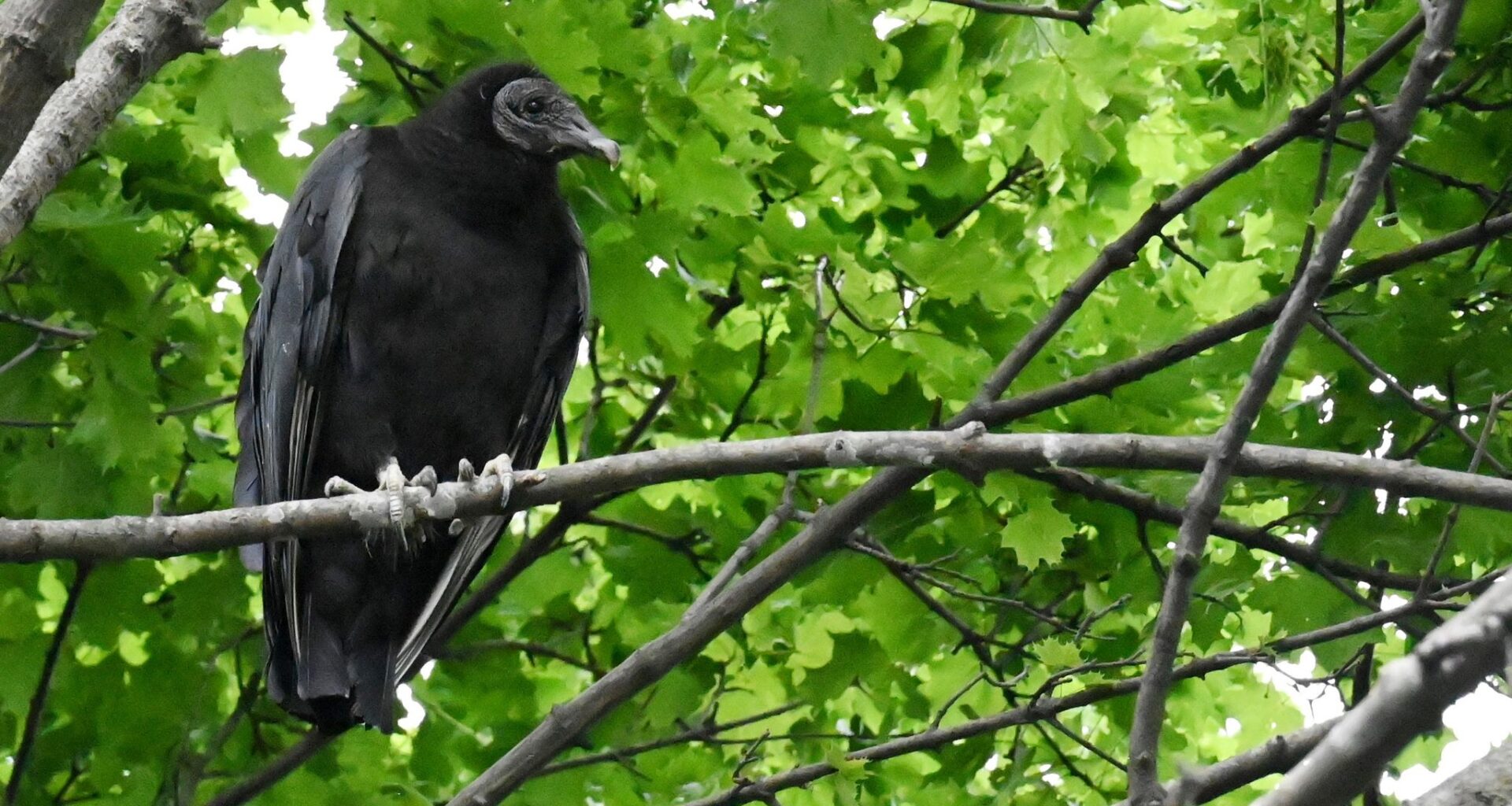
A black vulture roosts in a tree at the Columbia County Solid Waste transfer station on Thursday in Hudson. Black vultures have appeared in the northern Hudson Valley in recent years from their traditional range down south.
Will Waldron/Times Union
GREENPORT — Nancy Jane Kern said she has seen black vultures in Columbia County “hundreds of times.”

A member of the Alan Devoe Bird Club who describes herself as “80 years old and an avid lifetime birder,” Kern said the birds are most commonly seen around the Greenport Transfer Station. At dusk, dozens of black and turkey vultures fly in from all directions to roost in an adjacent cemetery, settling into separate groups in the evergreens like gargoyles.
Article continues below this ad
But the black vultures’ presence is a recent phenomenon, Kern said. Growing up on dairy farms in Columbia County, Kern often saw turkey vultures feeding on animal carcasses, “but no black vultures until the last 20 years.” Now, she said, they are “commonly seen.”
Historically, the black vulture’s range stopped around the Mason-Dixon Line. But today, the birds can be found as far north as Canada. The expansion has been rapid, and scientists have yet to agree on exactly why it is happening.
A northward push
The black vulture is a stocky scavenger with a wingspan of about 4½ feet. It can often be seen circling high overhead, feeding on roadkill or perched in trees. It closely resembles the turkey vulture — a species that has lived in New York for millennia — but differs in a few key ways. Black vultures have black heads rather than red ones, and their underwings feature silvery tips instead of the broad silvery rear halves seen on turkey vultures.
Article continues below this ad
Make the Times Union a Preferred Source on Google to see more of our journalism when you search.
Add Preferred Source
The first recorded black vulture nest in New York was documented at Mohonk Preserve in Ulster County in 1997, according to an article by Mohonk Preserve research associate Joe Bridges in The Kingbird, though the species had been observed in the state before then.
In Columbia County, members of the Alan Devoe Bird Club recorded just four sightings between 1964 and 2003. After that, sightings became annual, and by 2011, black vultures were being observed daily, according to club member William Cook.
The expansion has occurred not only in New York but throughout the Northeast and Midwest, said John Garrett, project coordinator for Cornell University’s birding database, eBird. The spread has also been uneven. In some cases, the species has established populations in more northern areas before filling in territory farther south. Cornell data show black vultures are now common along the Northeast coast and in lower-elevation inland regions, including the Hudson and Mohawk valleys. Higher elevations, such as the Catskills and Adirondacks, appear to be less attractive to the birds.
Article continues below this ad
Individual black vultures are also highly mobile. David Barber, senior research biologist at Hawk Mountain Sanctuary in Pennsylvania, said mature birds typically range across about 100 square miles, while immature birds can roam across as much as 1,000 square miles.
Although black vultures are traditionally considered nonmigratory, Barber said there is “some anecdotal evidence” that birds living at the northern edge of the species’ range may migrate seasonally, while those in the core of the range remain year-round residents.
A black vulture flies over the Columbia County Solid Waste transfer station on Thursday in Hudson. The birds are found near the coasts of the northeastern states and in low-lying areas, including the Hudson and Mohawk valleys in New York, according to data from Cornell University.
Will Waldron/Times Union
So why are the birds moving north so quickly? There are two leading theories.
Article continues below this ad
The first is climate change. Milder winters may allow black vultures to survive in places that were once too cold. Barber said Hawk Mountain’s records show that decades ago black vultures would arrive during the warmer months and head south when winter arrived. Today, many remain throughout the year.
The second explanation involves more direct human impacts on the landscape. In short: more roadkill.
Barber said Pennsylvania has not seen significant road expansion during the same period that black vulture populations have surged. Instead, he points to dramatic increases in white-tailed deer populations. A similar trend can be seen in New York. Road construction has been relatively limited over the past 30 years, but deer populations have grown substantially, in part because of declining hunting pressure, particularly in suburban areas.
Vulture vs. vulture
Black vultures rely in part on turkey vultures to locate food. The relationship is less similar to one person relying on the aid of another to achieve a common goal and more like when a bully relies on another student for lunch.
Article continues below this ad
Tait Johansson, naturalist-in-residence for the Bedford Audubon Society in Westchester County, said turkey vultures possess an advanced sense of smell. They can detect ethyl mercaptan, a chemical released during the early stages of decomposition. The compound is so pungent that utility companies add it to otherwise odorless natural gas to help people detect leaks. But turkey vultures are so adept at finding the scent that utility workers have learned they can sometimes identify gas leaks “by looking for groups of turkey vultures hanging out looking disappointed next to the pipeline,” Johansson said.
Black vultures lack the same olfactory abilities. Instead, they often follow turkey vultures to carcasses and then drive them away from the food source — “especially if there is more than one of them,” Johansson said. Black vultures are also stockier and heavier, giving them the upper hand.
Despite competing for food, the two species have long coexisted throughout much of the southern United States. Data from eBird show turkey vulture populations in the Northeast have remained stable or increased even as black vultures expanded into the region, suggesting there is plenty of carrion to support both species.
Black vultures and humans
A plastic vulture decoy is hung from a railing outside the Columbia County Solid Waste transfer station office, where the black vultures like to gather, on Thursday in Hudson.
Will Waldron/Times Union
Whether because of their intimidating appearance or their association with death, black vultures have not always been welcomed by people.
Article continues below this ad
In Guilderland in 2014, neighbors repeatedly complained to town officials and police after a resident began feeding the birds raw meat during the winter. The practice attracted dozens of vultures, which perched around her home, defecated on cars and unnerved neighborhood children.
The birds also have some unpleasant habits. Young black vultures defend themselves by vomiting on predators. And even when they are not throwing up, they have a reputation for smelling terrible.
They are also blamed for the deaths of young livestock, particularly calves. The most recent available USDA report on the issue, using data from 2015, found vultures were responsible for about 10% of cattle deaths attributed to predators. The report did not distinguish between black and turkey vultures, though turkey vultures are not known to kill livestock. By comparison, dogs accounted for 6.6% of predation-related cattle deaths, while coyotes were responsible for roughly 53%.
Although black vultures are neither endangered nor threatened, they are protected under the Migratory Bird Treaty Act of 1918. Anyone seeking permission to kill one must obtain a permit from the U.S. Fish and Wildlife Service. The agency did not respond to requests for information about how many permits it has issued.
Article continues below this ad
Bird flu and cannibalism
Black vultures also play a notable role in the spread of bird flu. One reason, according to University of Georgia wildlife disease expert Nicole Marie Nemeth, is that they sometimes eat members of their own species.
Nemeth led a study examining 115 black vultures found dead or killed in seven states across the Southeast and Midwest. About 84% tested positive for highly pathogenic avian influenza, or H5N1. The birds were not merely carrying the virus, she said, but had died from it. She also noted the sample wasn’t random — many of the birds were sent in by different state environmental groups because they questioned why the birds had died.
Since 2023, 11 black vultures have tested positive for H5N1 in New York, all in 2025, according to the DEC. But that captures only a fraction of cases, since the agency only examines dead birds that are submitted and it only tests two or three birds if there is a die-off of 10 birds or more. The 11 positive black vultures comprised 4% of all of the species tested since 2024; by comparison, 5% of turkey vultures tested positive in that time range.
Article continues below this ad
A pair of black vultures flies over the Columbia County Solid Waste transfer station on Thursday in Hudson.
Will Waldron/Times Union
Their scavenging lifestyle contributes to the problem. When vultures feed on infected carcasses — a group feeding together is known as a “wake” — they can contract the virus, which remains viable until a carcass fully decomposes.
Black vultures are also “uniquely susceptible” because they gather in large groups to feed and roost, Nemeth said. A roosting group is called a “committee.”
“(Black vultures) in the same groups die (of bird flu), they’re on the ground in the morning, the ones that wake up go — ‘Hey, easy meal, I’m going to go down and eat them’ — and then they get sick, they die, and their buddies in the same group eat them,” Nemeth said.
Article continues below this ad
That cycle can accelerate transmission through an entire flock.
The broader concern surrounding bird flu is that the virus could eventually mutate and gain the ability to spread from person to person. Since 2024, the disease has infected 71 people in the United States and killed two, according to the Centers for Disease Control and Prevention. No cases of human-to-human transmission have been recorded.
Nemeth said black vultures are less likely than waterfowl to serve as the source of such a mutation. Waterfowl can acquire multiple virus strains from contaminated water, allowing different variants to exchange genetic material and potentially create new forms of the disease.
Article continues below this ad
Today, black vultures are common across much of the Hudson Valley and Capital Region. Whether you spot them in a wake, a committee or a “kettle” — the term for a group of vultures soaring together — they are worth a closer look.