
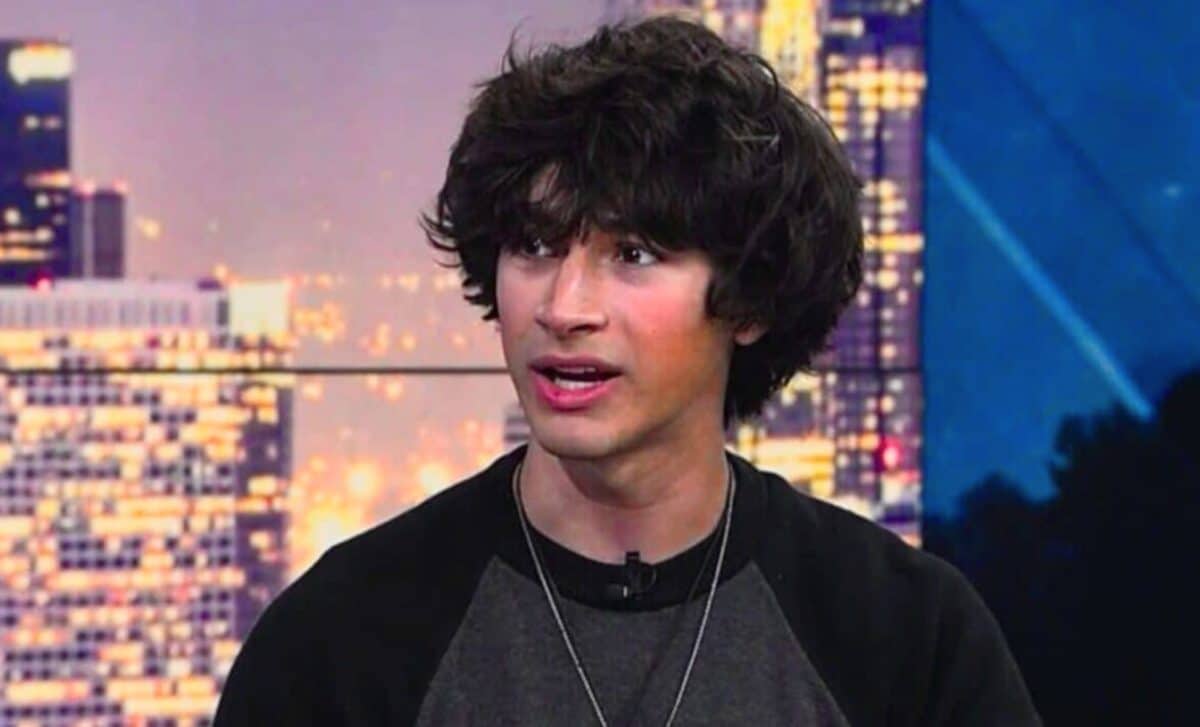
The archive held 10.5 years of silence. NASA’s NEOWISE space telescope had scanned the entire sky repeatedly, hunting for asteroids and logging every point of infrared light that crossed its sensors. The result was a database of nearly 200 billion individual brightness readings, a record too large for astronomers to search by hand. For more than a decade, the information sat inside servers at the Infrared Processing and Analysis Center (IPAC) at Caltech, its deeper contents unread.
Astronomer Davy Kirkpatrick, a senior research scientist at IPAC, had spent years looking at that dataset. He had mentored high school students for five summers, but he also wanted a complete catalog of every infrared source whose brightness changed over time. His plan for the summer of 2023 was modest: assign a student a small patch of sky, find some variable stars by hand, and publish the results as proof that the full dataset held hidden value.
Then a 17-year-old from Pasadena High School walked into his laboratory and proposed doing something else entirely.
The Student Who Wanted to Publish a Paper
Matteo Paz had attended Caltech’s public stargazing lectures with his mother since elementary school. By the time he joined Kirkpatrick’s lab through the university’s Summer Research Connection program, he had completed AP Calculus in eighth grade and was already studying undergraduate-level mathematics. An elective course that integrated coding and theoretical computer science had introduced him to machine learning, a branch of artificial intelligence where computers learn patterns from data.
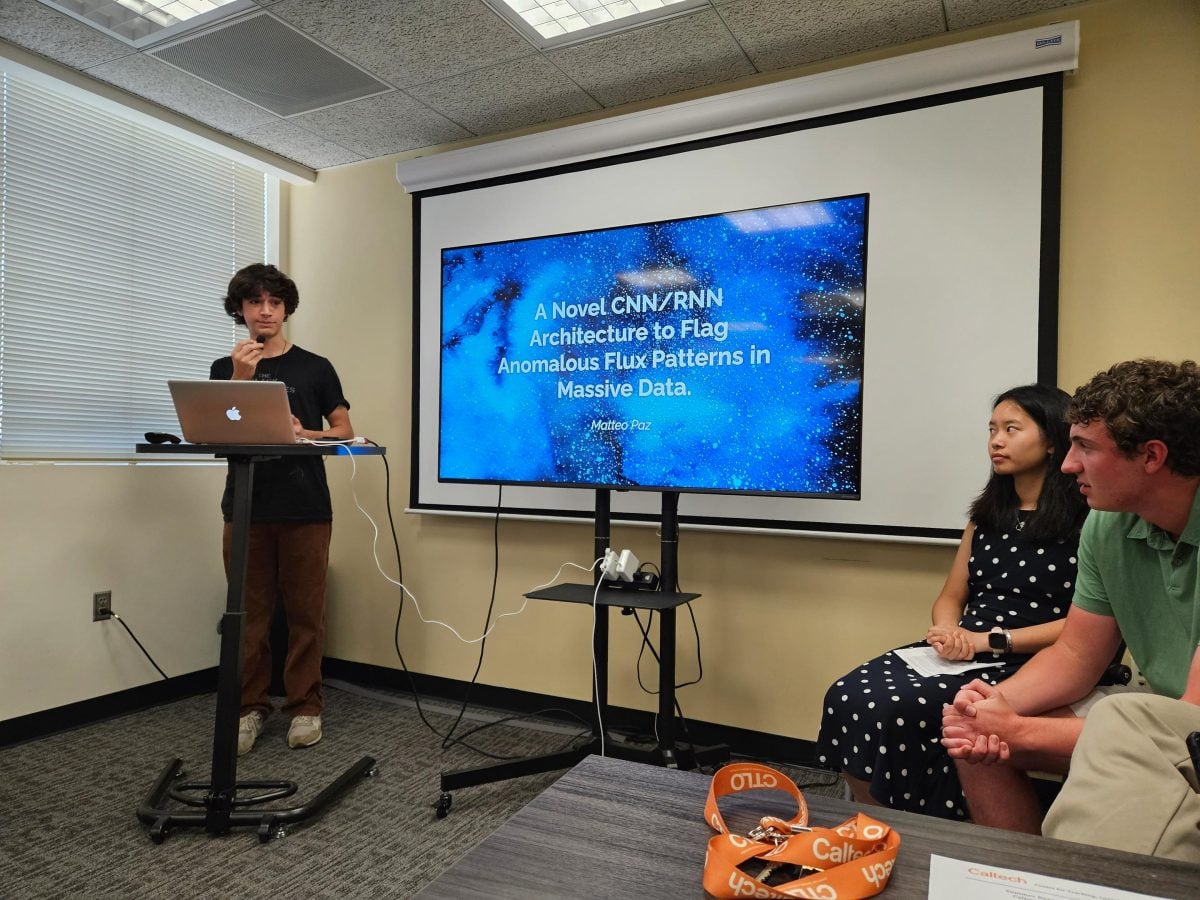 Matteo Paz presents the initial work on his project at a seminar in 2023. Credit: Kitty Cahalan
On their first day together, Paz told Kirkpatrick he wanted to publish a paper. Kirkpatrick did not discourage him.
“He has allowed an unbridled learning experience,” Paz said, according to Caltech. “I think that’s why I’ve grown so much as a scientist.”
Instead of sifting through a single patch of sky by hand, Paz proposed building an AI model that could analyze the entire NEOWISE database. Kirkpatrick connected him with Caltech researchers Shoubaneh Hemmati, Daniel Masters, Ashish Mahabal, and Matthew Graham, who provided guidance on machine learning techniques for astronomy.
 This mosaic is composed of images covering the entire sky, taken by the Wide-field Infrared Survey Explorer (WISE) as part of WISE’s 2012 All-Sky Data Release. Credit: NASA/JPL-Caltech/UCLA
The mentorship philosophy ran deep on both sides. Kirkpatrick grew up in a farming community in Tennessee, where his ninth-grade teacher told him he had scientific potential and outlined the courses he would need for college. She was, Kirkpatrick said, the reason he became an astronomer.
“I wanted to pass on that same sort of mentoring to someone else and hopefully many someone elses,” Kirkpatrick said. “If I see their potential, I want to make sure that they are reaching it.”
The Model That Ran at 53 Microseconds Per Source
Paz built a model named VARnet, which he described in a single-author paper published in The Astronomical Journal in November 2024. The model processes each light curve, a record of how a single object’s brightness changes over time, through three stages.
The first stage uses wavelet decomposition to reduce the impact of false or noisy measurements. The telescope’s observing rhythm created dense clusters of readings separated by six-month gaps, which made traditional methods too slow for a dataset of this size.
The second stage applies a customized Fourier transform that Paz designed to pull out repeating signals from unevenly spaced brightness readings. The telescope’s actual pattern created a lopsided structure: roughly 12 to 16 readings clustered within hours, followed by a six-month gap before the next cluster.
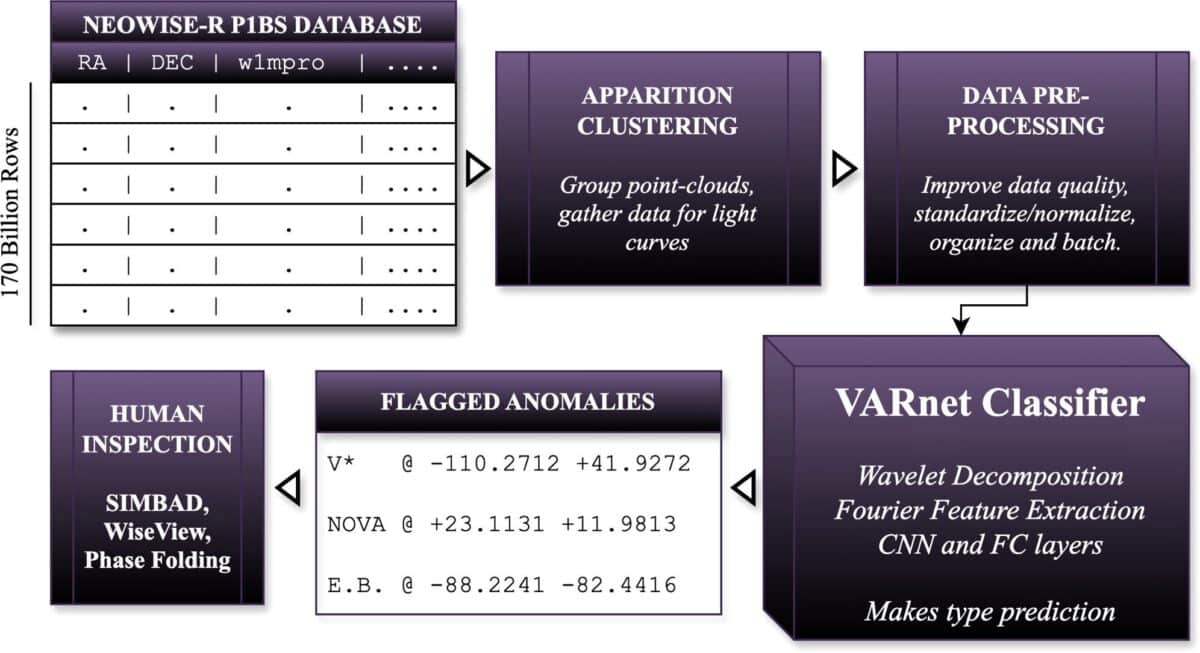 The anomaly extraction pipeline. Credit: The Astronomical Journal.
The third stage feeds the extracted patterns into a convolutional neural network, a type of AI that classifies each object into one of four categories: objects that do not vary, sudden brightening events such as supernovae, objects that pulse regularly, or pairs of stars that dim when one passes in front of the other. Because there were not enough confirmed examples in the NEOWISE data to train the model, Paz wrote a program that generated realistic simulated light curves for each category, giving the model an effectively unlimited training set.
The paper reported a per-source processing time of less than 53 microseconds on a graphics processor with 22 gigabytes of memory. The model reached an F1 score of 0.91, a statistical measure of accuracy, on a validation set of known variable objects.
What the 1.5 Million Candidates Actually Represent
When VARnet finished scanning the NEOWISE archive, it flagged 1.5 million potential variable objects. The figure does not represent 1.5 million confirmed discoveries. Each flagged source is a candidate that needs an astronomer to check and classify it through follow-up observation.
Some candidates will turn out to be objects already known to science, now measured in infrared wavelengths for the first time. Some will be false positives created by noise or instrument artifacts. A certain fraction will be genuinely new detections of quasars, variable stars, and transient events.
 This illustration shows the Wide-field Infrared Survey Explorer (WISE) spacecraft in Earth orbit. Credit: Credit: NASA/JPL-Caltech
The collaboration also uncovered a limit built into the NEOWISE data itself. Because the telescope scanned in great circles centered on the Sun, it could not systematically detect objects that flashed once and faded quickly, or those that changed gradually over years.
The full catalog is scheduled for publication during 2025. When released, it will give astronomers a dataset large enough to support statistical studies of infrared variability across the entire sky.
From Summer Project to National Recognition
For the work, Paz won the $250,000 first-place prize in the 2025 Regeneron Science Talent Search, a national competition run by the Society for Science. Kirkpatrick described the moment as “the highest high I’ve ever had.”
“When you’ve helped someone reach some of their potential and be acknowledged for it, it’s a nice feeling,” Kirkpatrick said.
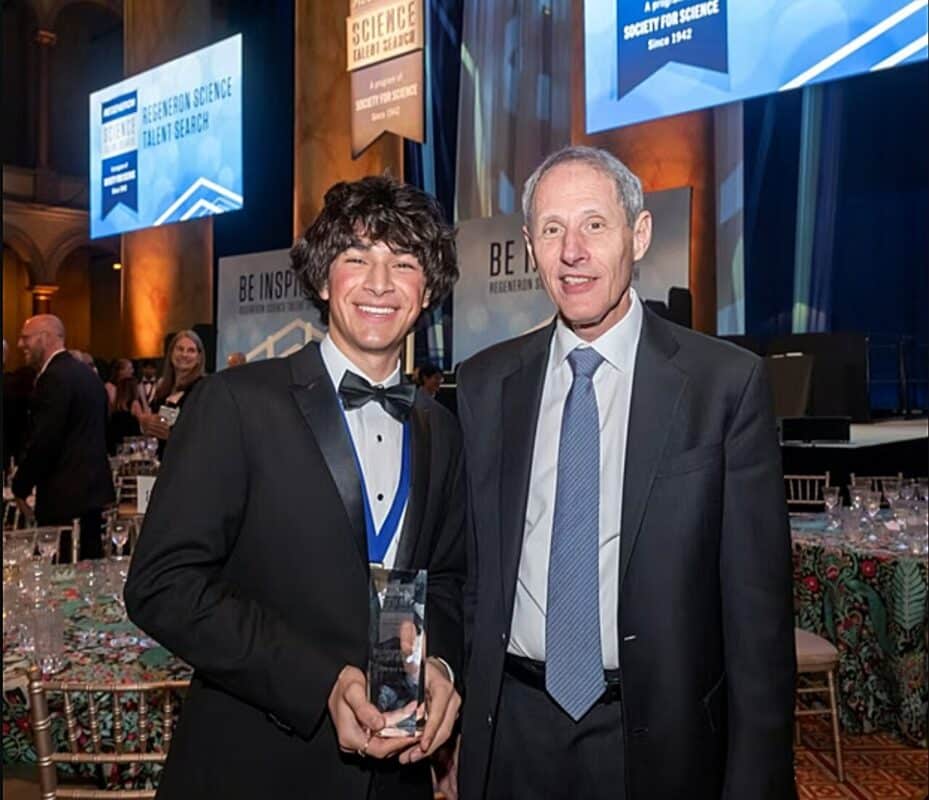 Matteo Paz with Caltech President Thomas F. Rosenbaum at the Regeneron Science Talent Search award ceremony on March 11, 2025. Credit: California Institute of Technology
Paz, now a Caltech employee working at IPAC while finishing high school, said the model has uses beyond astronomy. “The model I implemented can be used for other time domain studies in astronomy, and potentially anything else that comes in a temporal format,” he said. “I could see some relevance to chart analysis, where the information similarly comes in a time series and periodic components can be critical.”
In 2024, Paz returned to mentor other high school students through the same program that placed him in Kirkpatrick’s lab.