
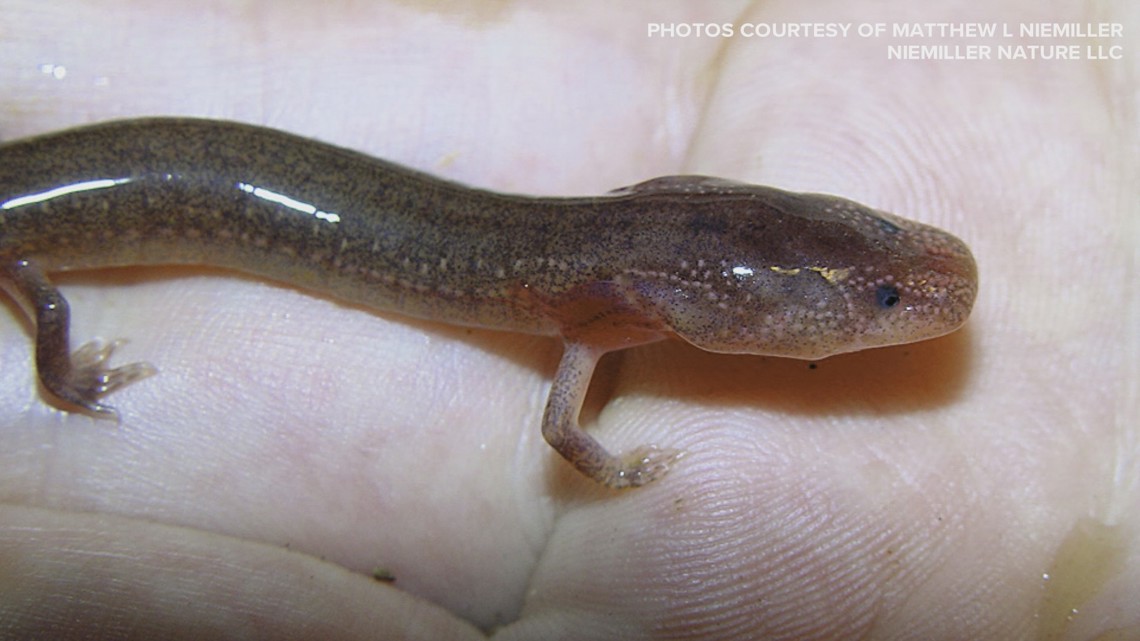
In Knoxville’s caves, the endangered Berry Cave Salamander clings to survival as conservationists work to protect them.
KNOXVILLE, Tenn. — Inside a network of caves below the former Ross Marble quarry at Ijams Nature Center, a rare salamander in the world survives in near total darkness.
The endangered Berry Cave Salamander has only ever been documented at eleven historical locations worldwide. And according to a 2017 survey, researchers were only able to confirm the species at four of those sites — three of them in Knox County.
“That’s a pretty heavy burden of responsibility on the landowner,” Ben Nanny, the conservation director at Ijams Nature Center, said.
One of those protected cave entrances sits behind massive iron gates installed at Mead’s River Cave in 2008. The gates are designed to keep people out while still allowing bats and other wildlife to move freely through the cave system.
Dr. Matthew Niemiller, a biologist and associate professor who has spent years studying cave species in Tennessee, says cave ecosystems often function like isolated islands.
“Once they get there, they don’t really have the opportunity or the ability to disperse or move somewhere else,” Niemiller said. “So they can become isolated right in those little areas.”
That isolation makes species like the Berry Cave salamander especially vulnerable.
Unlike surface animals that can relocate when conditions worsen, cave-dwelling species are often trapped within highly specific environments. Even small changes to water quality, groundwater flow or surrounding land use can have major consequences.
Researchers observed possible population declines at two Berry Cave salamander sites during survey work, raising concerns about habitat degradation and groundwater contamination. The species is currently listed as endangered by the state of Tennessee, but it still lacks federal protection under the Endangered Species Act.
“I think the evidence is there that it should, at the federal level, have a better protected status,” Niemiller said.
One of the biggest threats may come from the surface above the caves themselves. Near Mead’s River Cave sits an area known as the “Lime Bowl,” where waste from historical lime-burning and quarrying operations was dumped for decades. The landscape is still covered in large mounds of leftover material from the marble industry.
“The challenge is that its pH is like 8.8,” Nanny said, “which is a hard medium to grow anything in.”
With little vegetation to absorb rainfall, water moves rapidly across the barren ground and straight into the cave system below. At Ijams, conservation crews are trying to slow that process down. Nanny and his team have spent years restoring native vegetation across the damaged landscape in hopes of rebuilding healthy soil that can better absorb and filter water before it reaches the caves.
“We’re trying to soak up all that water,” Nanny said, “to hold it here, and create an organic layer.”
The restoration work began in 2017, but Nanny says ecological recovery happens on a timeline much longer than a human career.
“I probably won’t see whether it’s completely effective in my lifetime,” he said. “But it’s our responsibility to start the process and try something to mitigate the problem.”
For the people working to protect the Berry Cave salamander, the effort is about more than a single species. It’s about preserving an ecosystem most people never see, hidden beneath Knoxville’s forests.