
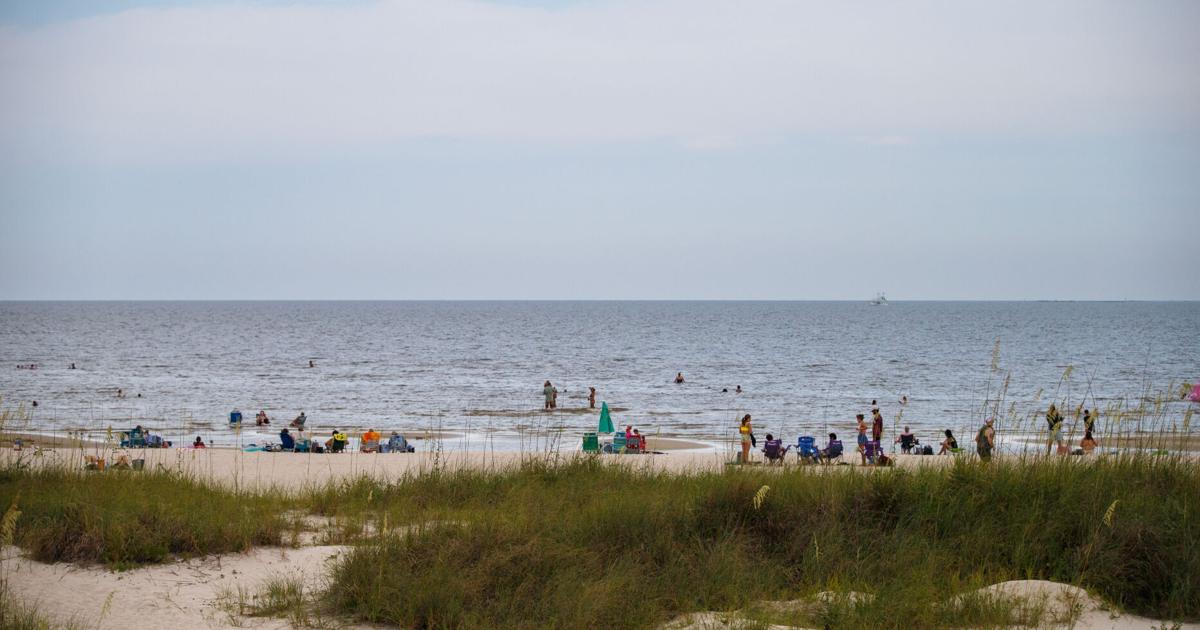
A stubborn problem is plaguing Mississippi’s beaches: Bacteria from sewage leaks keeps turning up in the waves.
The issue, which has long frustrated some locals, drew fresh attention this month when the state issued another round of advisories cautioning visitors against swimming at some beaches just before Memorial Day weekend.
But state leaders are pledging to find solutions to the sewage leaks, and researchers are working furiously to investigate the bacteria’s reach and consequences.
Mississippi’s beaches are still open, and the pollution found there also shows up on shorelines around the country when heavy rains wash contaminants from across coastal landscapes to the water. But on the Gulf Coast — where tourism drives the economy and many locals worship fresh seafood — the stakes of the issue are significant.
Six of Mississippi’s 21 beaches remained under water contact advisories on Friday after routine testing by the Mississippi Department of Environmental Quality showed high bacteria levels near shore. The agency tests for a fecal indicator bacteria that suggests sewer overflows are entering the water.
The latest advisories followed the release of 550,000 gallons of wastewater earlier this month into the nearby Pascagoula River. The state DEQ said the issue there has since been repaired.
Water contact advisories are common on the Mississippi Coast, where barrier islands stop waves and currents from washing pollution farther out into the Gulf. The exact source of high bacteria levels is not always clear, but researchers say leaking septic tanks and aging sewer infrastructure can send pollution through storm drains that lead to the water.
“It is gross,” said Holley Muraco, a Mississippi State University researcher who is studying water quality. “This is coming from some kind of problem with our urban infrastructure.”
Chris Wells, executive director of the Mississippi DEQ, said the agency is spending about $26 million of federal funding on a water quality improvement program to upgrade and repair problematic sewage infrastructure. But he said the pollution can come from many sources and called the issue “very complex.”
“There’s no overnight solution,” Wells said. “It’s just going to take time and a concerted effort.”

Children play at the beach as Jennifer Ahlbrand, an environmental natural resource specialist with the Mississippi Department of Environmental Quality, collects a water sample to test for enterococcus on Wednesday, April 30, 2025. If water from a beach tests positive for enterococcus, the public will be warned not to swim in the water.
Hannah Ruhoff/Sun Herald
Searching for solutions
The source of the beach problems can be challenging to trace. Fecal bacteria can drain toward the shoreline from all over the landscape, and it can also come from bird colonies on the beaches. Researchers also believe the bacteria accumulates in the sand near shore and can resurface in windy conditions.
Solving the issue depends on what causes it. “And figuring out what’s happening can be difficult and expensive,” said Kim Cressman, a water quality coordinator at the Mississippi Sound Estuary Program, which works with local organizations and leaders to conserve Mississippi’s waters.
Like other states around the country, Mississippi has tested beach water quality weekly in accordance with federal law for over two decades. High levels of the same bacteria also sometimes prompt advisories at beaches in Alabama, Florida and other coastal states.
In Mississippi, data from the state DEQ shows the pollution has endured steadily over the last decade. Some Mississippi Coast locals have long opted against swimming at their shallow beaches, instead choosing to travel by boat to barrier islands where the water is clearer.
But researchers say they are also fighting misconceptions about Mississippi’s water, which is naturally brown and cloudy because several rivers empty into it.
“Just because it’s brown doesn’t mean it’s bad,” Cressman said.
Still, swimming at beaches under water contact advisories can increase the risk of illness, including infections, digestive issues, meningitis and hepatitis, according to the MDEQ. Children, seniors and anyone with compromised immune systems or open cuts face the highest risk.
The beach in Ocean Springs, Mississippi on Thursday, March 27, 2025. (Photo by Chris Granger, The Times-Picayune)
Chris Granger
Worries over the high bacteria levels can also curb tourism and exasperate some beach businesses that rent boats and jet skis to visitors. The concerns are leading some state leaders to suggest Mississippi’s legislature should create a formal group of state agencies, lawmakers and scientists to plan infrastructure projects that will improve water quality and track progress.
“This is a way of life for a lot of folks here on the coast,” said state Sen. Mike Thompson, a Republican who represents parts of several Mississippi Coast cities, including Pass Christian and Bay St. Louis. “Making sure that resource is healthy should be a priority.”
Researchers, including Muraco, are still studying how far the bacteria spreads beyond the shoreline and the impact of sewage leaks on seafood and dolphins. The state DEQ is working on about two dozen projects across coastal Mississippi to trace bacteria issues upstream and reduce the frequency of sewer leaks, according to Wells.
The projects include fixing cracked sewer pipes that cross creeks and converting septic systems to sewers. But Wells said it could take years to see progress, especially if bacteria is embedded in sand underwater.
“We’re not ignoring this issue,” he said. “We’re trying to address it.”