
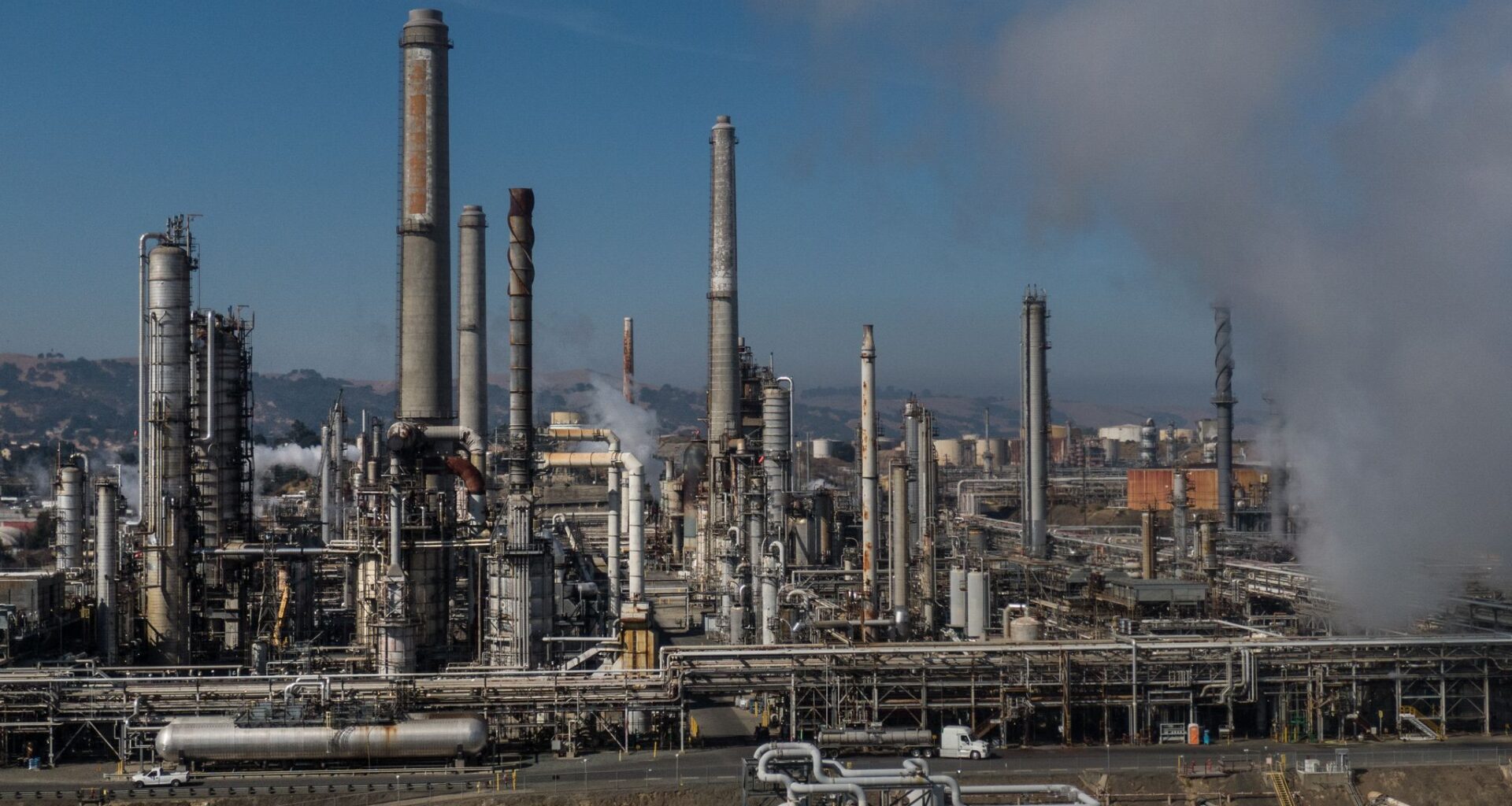
California industrial plants, such as this refinery in Martinez seen in 2019, are expected to face lower costs after the state adjusts its cap-and-trade pollution rules.
Paul Kuroda/For the S.F. Chronicle
California’s signature climate regulation is set for a major overhaul, to better balance the state’s ambitious greenhouse gas reductions with affordability.
Yet, the change comes with tradeoffs that include potentially losing billions of dollars for transit, housing, fire prevention and other popular programs — a highly controversial prospect.
Scores of agencies and advocates, from big-city mayors to housing departments to BART and Muni, are urging the California Air Resources Board to reject the updated “cap and trade” regulation, now called “cap and invest,” for fear of missing out on big money. The air board is scheduled to vote on the overhaul at its meeting next week.
Article continues below this ad
“Our city is finally moving in the right direction and our economy is recovering, but we need a strong, reliable public transit system to continue driving our comeback and enough housing so San Franciscans can afford to stay,” said San Francisco Mayor Daniel Lurie in a statement to the Chronicle, calling the cap-and-invest funding critical to the city’s rebound.
San Francisco Chronicle Logo
Make us a Preferred Source to get more of our news when you search.
Add Preferred Source
The state’s cap-and-invest program, for more than a decade, has aimed to cap — and gradually reduce — greenhouse gas emissions by requiring oil refineries, power plants and other industrial facilities to buy permits to pollute. Such pollution worldwide has driven up temperatures and led to a widening crisis of wildfires, prolonged droughts and rising seas.
The revenue from cap and invest’s pollution permits, in turn, has largely gone into a fund for projects that also help cut emissions. The biggest beneficiary of the Greenhouse Gas Reduction Fund has been the state’s planned high-speed rail line, but hundreds of smaller programs are also supported, through grants. To date, about $35 billion has been doled out.
Article continues below this ad
Last year, Gov. Gavin Newsom and the Legislature struck a deal to extend the cap-and-invest program, which, among other things, changed the formula for how the fund’s money would be spent. Instead of basing allocations on a percentage of the total fund, it locked in $1 billion annually for high-speed rail, to make sure the cash-strapped project continued to get money, and another $1 billion annually for the state budget. Only what was left over would be made available for transit, housing, fire prevention and the other many programs.
The fund’s overall revenue is also expected to take a hit with the coming changes. Air board officials, at the demand of the governor and Legislature, are trying to provide consumers greater price relief by limiting compliance costs that industries pass along. (Some refinery expenses, for example, get added to the price of gas.) To that end, the updated cap-and-invest program gives out more free pollution permits than it generally has, resulting in less revenue for the fund.
While the fund has always been expected to shrink as the regulation’s cap on pollution tightens, the Legislative Analyst’s Office says the planned update will likely mean far less money — and in some years little or none — for the lower-priority projects in areas previously established for funding: mass transit, affordable housing and smart development, wildfire and forest resilience, healthy air and clean drinking water. These programs received nearly $2 billion collectively this year.
Lauren Sanchez, chair of the air board, told the Chronicle this week that the updated cap-and-invest program is the agency’s best attempt to balance competing priorities while extending the vital regulation through 2045.
The air board released a previous update to the program in January but amended it, giving more concessions to industry after hearing from businesses that it was unaffordable. Over the past six months, two California refineries have closed or moved toward closing, and oil prices have soared with the war in Iran. This has increased pressure on regulators to contain industry costs and prevent them from spilling over to consumers and jobs.
Article continues below this ad
“We’re in a moment of global energy disruption,” Sanchez said. “Some near-term relief was really needed to make sure we could support businesses doing business here in California.”
Money that might have otherwise flowed into the Greenhouse Gas Reduction Fund, which is instead helping industry with compliance under the planned changes, will partially help prop up the climate credit on electricity and gas bills, Sanchez noted, which she likened to putting cash back in the hands of Californians. She also expects that easing compliance costs will keep oil companies from further raising prices at the pump.
“We understand those investments (in the Greenhouse Gas Reduction Fund) are critical,” Sanchez said. But, she added, they’re not the “primary goal” of the cap-and-invest program.
Michael Pimentel, executive director of the California Transit Association, who is leading a coalition to protect funding for lower-priority programs, said money for transportation, smart and affordable housing and other initiatives not only drives down emissions but also lowers consumer costs.
“We’re hearing a lot about the need to address affordability: utility rates, fuel prices,” he said. “Lost in that conversation are ways we can address affordability directly.”
Article continues below this ad
Most fundamentally, Pimentel said, the proposed changes to the cap-and-invest regulation will leave many important local and state programs with considerably less to work with.
Since 2015, BART has received more than $1.1 billion from the Greenhouse Gas Reduction Fund, according to agency officials. It’s helped with development of more than 3,000 affordable housing units in transit-friendly locations as well as train station improvements, upgrades to communication systems and new rail cars.
AC Transit, meanwhile, has received more than $90 million from the fund over the past decade, helping expand and electrify bus service in the East Bay. The San Francisco Metropolitan Transportation Agency has been awarded more than $600 million since 2015, supporting such programs as the 38-Rapid Geary bus line and improvements to the N-Judah and K-Ingleside rail lines.
“Losing this funding would be devastating to our efforts to maintain safe and reliable Muni service, which is crucial to San Francisco’s ongoing economic recovery,” said Julie Kirschbaum, director of transportation at SFMTA.
On the housing front, San Francisco has received more than $450 million from the fund over the past decade, which has helped build thousands of affordable homes near transit, according to the Mayor’s Office of Housing and Community Development. By constructing homes near public transportation, as well as near jobs and services, people drive less, and emit fewer greenhouse gases.
Article continues below this ad
Rural water agencies, local air districts and county-level resource conservation districts have also benefited significantly from the Greenhouse Gas Reduction Fund.
Some groups, though, continue to push for greater industry relief in the cap-and-invest update, with negligible concern about funding local programs.
“Cap and invest at its core is not a revenue program,” wrote members of the Legislature’s bipartisan California Problem Solvers Caucus in a recent letter to the air board. The group wants the board to further study how the program is affecting household bills as well as industry decisions to operate in California — or not — and make adjustments accordingly.
The California Chamber of Commerce, in another letter to the air board, wrote that “important questions remain” about preserving affordability and economic competitiveness.
The overarching intent of the cap-and-invest program is to help California reach its statutory goal of reducing statewide greenhouse gas emissions to 40% below 1990 levels by 2030 and to 85% below by 2045.
Laurie Wayburn, president and co-founder of the conservation group Pacific Forest Trust, says the air board’s update goes too far to ease industry compliance, specifically by giving away additional pollution permits, which can lower permit prices in the cap-and-invest auctions and ultimately reduce pressure for emissions cuts.
“What we know is that climate change impacts are accelerating,” she said. “This is going to push us back four or five years. We’re not going to make the 2030 targets. We might not make the 2045 targets.”