

On July 29, Burke said the manatee beached itself early in the morning near Mattapoisett, but bystanders were able to help it back into deeper water.
“It’s basically out of its optimal thermal environment now,” said Nadine Lysiak, a research scientist at the Anderson Cabot Center for Ocean Life. “There’s a lot of concern that its health will deteriorate if it stays in these northern waters for a long period of time.”
Stephen Petrucci, 32, of Walpole, saw the animal on July 26 when it emerged from the water “a foot away” from the dock of his summer house in Mashpee.
“I was confused at first because I didn’t know what I was looking at,” he said in a phone interview Thursday. “But after a few seconds I was shocked because I realized it was a manatee.”
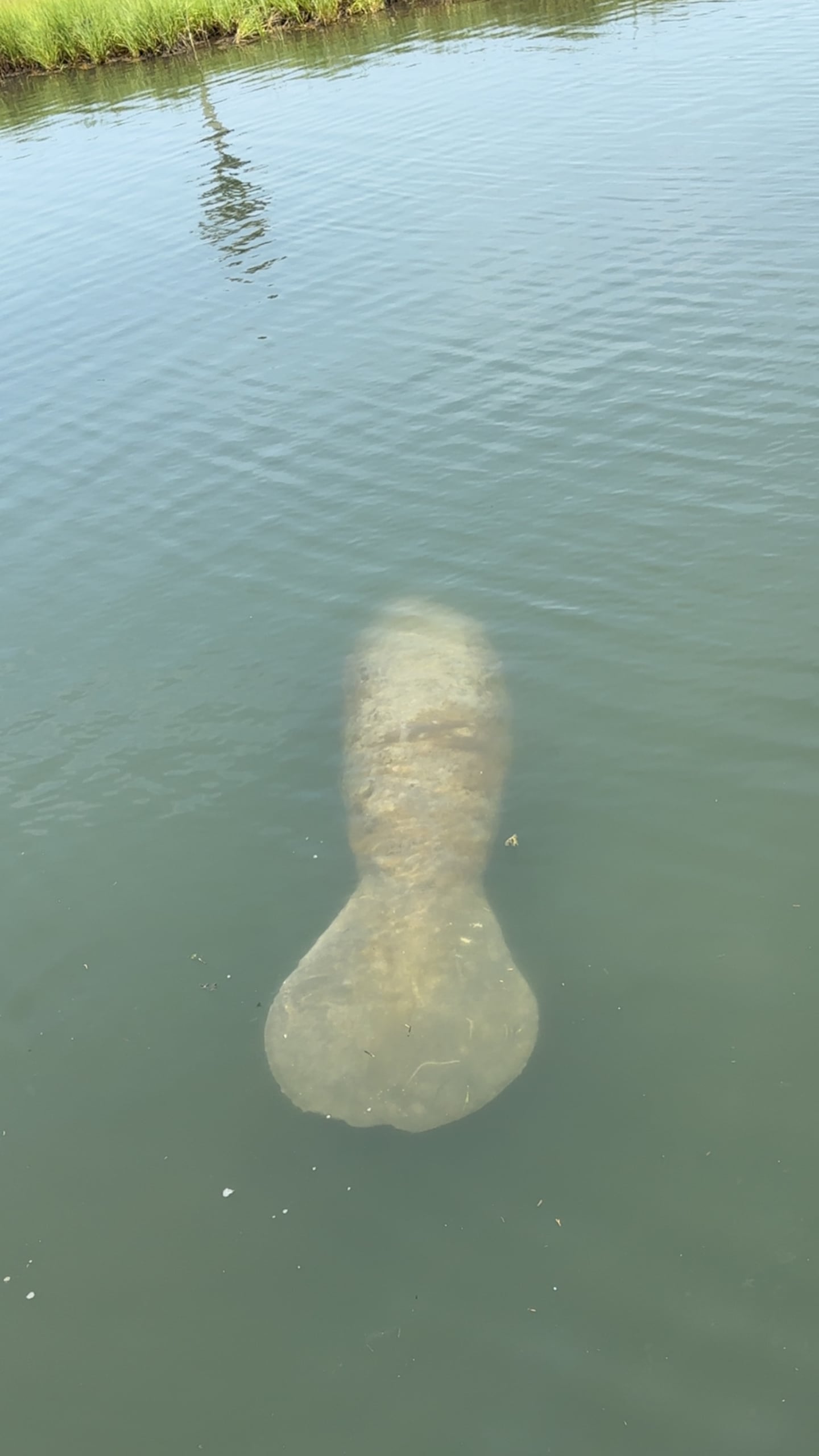 Stephen Petrucci, of Walpole, saw a manatee off the dock of his summer home in Mashpee on July 26. Experts say the manatee will have to be found and taken to Florida.Stephen Petrucci
Manatees are solitary creatures, said Lysiak. Their natural habitat centers around Florida and the Gulf of Mexico, where waters are suitably warm – around 72 degrees.
“But you also may just have individuals who feel like going for a wander and get too far north,” she said, “and then [they] get into a situation where they might become cold-stunned and have some health and physiological challenges where they need some intervention.”
The current whereabouts of the manatee, who does not yet have a name, are unknown, said Burke. She encouraged people to call IFAW, at (508)-743-9548, if they see the animal.
“Our waters are really on the edge of their temperature limits,” she said. “As soon as the water temps drop, they start to not do so well.”
“There isn’t a lot for them to eat around here,” she added.
In 2016, another manatee took itself on tour around the Cape, before being rescued and returned to Florida, Lysiak said.
That manatee was taken by truck to Mystic Aquarium to recuperate, she said. Then it was flown to Florida and released, upon which it promptly swam south to the Bahamas.
“That animal did a little bit of weird movement on both ends of that experience,” Lysiak said. “Some individuals just kind of buck the trend of what we understand the species to normally do.”
In a statement, Stacey Hedman, the senior director of global communications at IFAW, thanked the public for reporting the two sightings.
“Early information is key to ensuring the best possible outcome for any marine mammal,” he said. “We ask that anyone who encounters this manatee or any other marine mammal maintains a safe and respectful distance—at least 150 feet. Do not attempt to feed, touch, or closely approach the animal.”
Truman Dickerson can be reached at truman.dickerson@globe.com.