
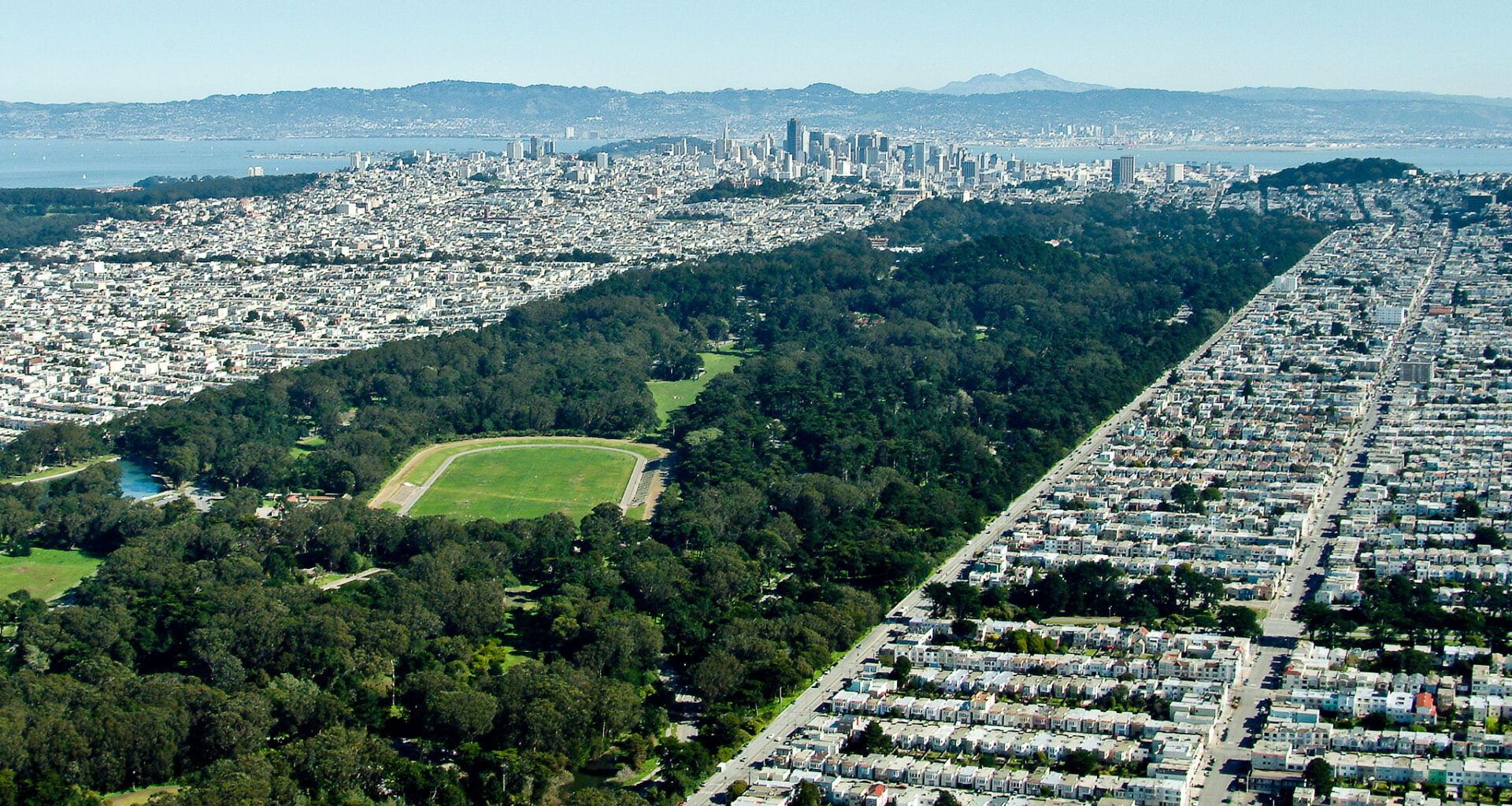
As the fog burned off on a recent April afternoon, Richard Hasegawa made his way along the southern edge of Golden Gate Park, passing the hustle and bustle of joggers and cyclists on MLK Drive before reaching a secluded spot near Mallard Lake. It took the biologist no more than five minutes of sifting through twigs and leaves at the water’s edge before he turned over a piece of wood and knew he had found what he was searching for.

There, wriggling in the sunshine, were two creatures that had never been documented on iNaturalist before: the Golden Gate leech, a predatory worm that only exists in the freshwaters of San Francisco’s largest park.
“I just felt this dopamine rush, this great feeling of ‘eureka!’” said Hasegawa, who lives in Berkeley and works for the environmental consulting firm WRA. “It filled me with a sense of wonderment, that there are things we walk past every day like this without realizing.”
Article continues below this ad
Richard Hasegawa captured the photos using an Olympus Tough TG-6 camera.
Richard Hasegawa
The Golden Gate Leech was photographed on April 26, 2026.
Richard Hasegawa
But he couldn’t dwell on these feelings for long. Hasegawa had other work to get to: namely, “wrangling” the leeches for their close-up. Wielding a small digital camera in one hand and a twig in the other, he gently nudged the pea-sized animals into a jerry-rigged setup with an aquarium box. After providing them with a bit of moisture so they wouldn’t get dehydrated, he snapped away, capturing the distinctive black speckles on the underside of their abdomens and the dark ring on their posterior suckers. The muscular disc at the tail end of their bodies allows them to crawl, “advance on their prey and engulf it whole,” Hasegawa said. “Unfortunately, I didn’t get to witness that, but it’s incredible to see.”
From there, he uploaded the images to iNaturalist and waited. Dozens of replies piled up. A few days later, while he was out doing field work, he learned that his observation of the leech, made during this year’s City Nature challenge, was the first ever recorded on the app.
Article continues below this ad
“I was in total shock,” he said.
View of Mallard Lake in Golden Gate Park in San Francisco.
Screenshot via Google Street View
Founded in 2008, iNaturalist is now a joint initiative between the California Academy of Sciences and the National Geographic Society that allows users to upload and record photos of plants, animals and fungi for other users to help identify. Data from the public platform is used by scientists to track the population and range of various species over time.
Article continues below this ad
A decade ago, Cal Academy launched the City Nature Challenge as a way to encourage people to document the biodiversity in their backyards by using the community science app. What began as a friendly competition between San Francisco and Los Angeles to log the most observations has since become the largest global census of its kind, with millions of observations to date.
Screenshot of Golden Gate Leech at Mallard Lake in Golden Gate Park in San Francisco.
Screenshot via YouTube
Screenshot of Golden Gate Leech.
Screenshot via YouTube
Rebecca Johnson, director of the Center for Biodiversity and Community Science at Cal Academy, told SFGATE that during this year’s challenge, which took place from April 24-27, 106,350 people participated across 754 cities to make over three million observations. In the Bay Area, over 3,000 users recorded nearly 2,000 species, almost 200 of which were threatened or endangered, she said. The leech joins 70 new species documented on iNaturalist for the first time across the world.
Article continues below this ad
“The distribution of plants and animals is critically important for us to know as folks who focus on conservation,” Johnson said. “Scientists can’t be everywhere, so these sightings help us better understand species distributions and how they’re changing. It’s the biggest and most complete picture that we have of biodiversity.”
The species is only found in the ponds of Golden Gate Park.
Richard Hasegawa
Parents carry their young to feed.
Richard Hasegawa
The species was likely introduced to San Francisco in the 1850s.
Richard Hasegawa
Hasegawa told SFGATE he has been casually participating in the City Nature Challenge for the past few years, submitting photos and volunteering to help people learn more about the app. This year, he was encouraged to take part in a bioblitz to find the coastal green hairstreak, a rare butterfly that was thought to be extinct in San Francisco but was rediscovered in the early 2000s, prompting habitat restoration efforts.
Article continues below this ad
Before setting out, Hasegawa decided to see if there were any other unique and overlooked species in the area that he could find. From there, he discovered a paper from the German evolutionary biologist Dr. Ulrich Kutschera, who was the first to describe and identify the Golden Gate leech in what is now Great Blue Heron Lake in 1987. Delving deeper, Hasegawa learned that by 2007, changing conditions in the popular duck pond likely ousted the “small brooding” animals, but that they could still be found in cleaner nearby ponds, including some in the Botanical Gardens and Mallard Lake.
“I thought this would be a convenient way to go look for them,” Hasegawa said.
Scientist Ulrich Kutschera displays his book, *Das Gender-Paradoxon* (The Gender Paradox), in the courtroom. July 5, 2019.
picture alliance/Getty Image
Experts believe the Golden Gate leech arrived in San Francisco Bay sometime in the 1850s by hitching a ride on plants or debris shipped in from South America. While its population size is currently unknown, the species is considered rare because it can only be found in San Francisco, though Hasegawa suspects the leeches are locally abundant based on how quickly he was able to spot them.
Article continues below this ad
The globule of an invertebrate has the capability to protract and elongate its body as it inches along. Particularly noteworthy to Hasegawa is the species’ keen parental care and tendency to brood its offspring. Babies will attach themselves to the bellies of their parents, who carry them to their meals. The leeches primarily feed on flies, bloodworms and snails, using their proboscises like a whip to pierce their prey and suck out their fluids.

Stay informed, and entertained.
By signing up, you agree to our Terms Of Use and acknowledge that your information will be used as described in our Privacy Policy.
“It’s interesting to think such a small, kind of primitive creature takes care of its young like that,” he said.
View of Mallard Lake in Golden Gate Park in San Francisco.
Screenshot via Google Street View
Ultimately, Hasegawa considers his discovery a matter of luck and timing — it’s not uncommon for people on iNaturalist and similar platforms to try to record species that have gone unnoticed. “In this case,” he said, “I happened to be the first person to get to this one.”
Article continues below this ad
Still, he considers it a reminder of how fragile ecosystems can be, and how unique species are in terms of where they can be found. “It’s cool to see they’re still present to this day,” he said.