
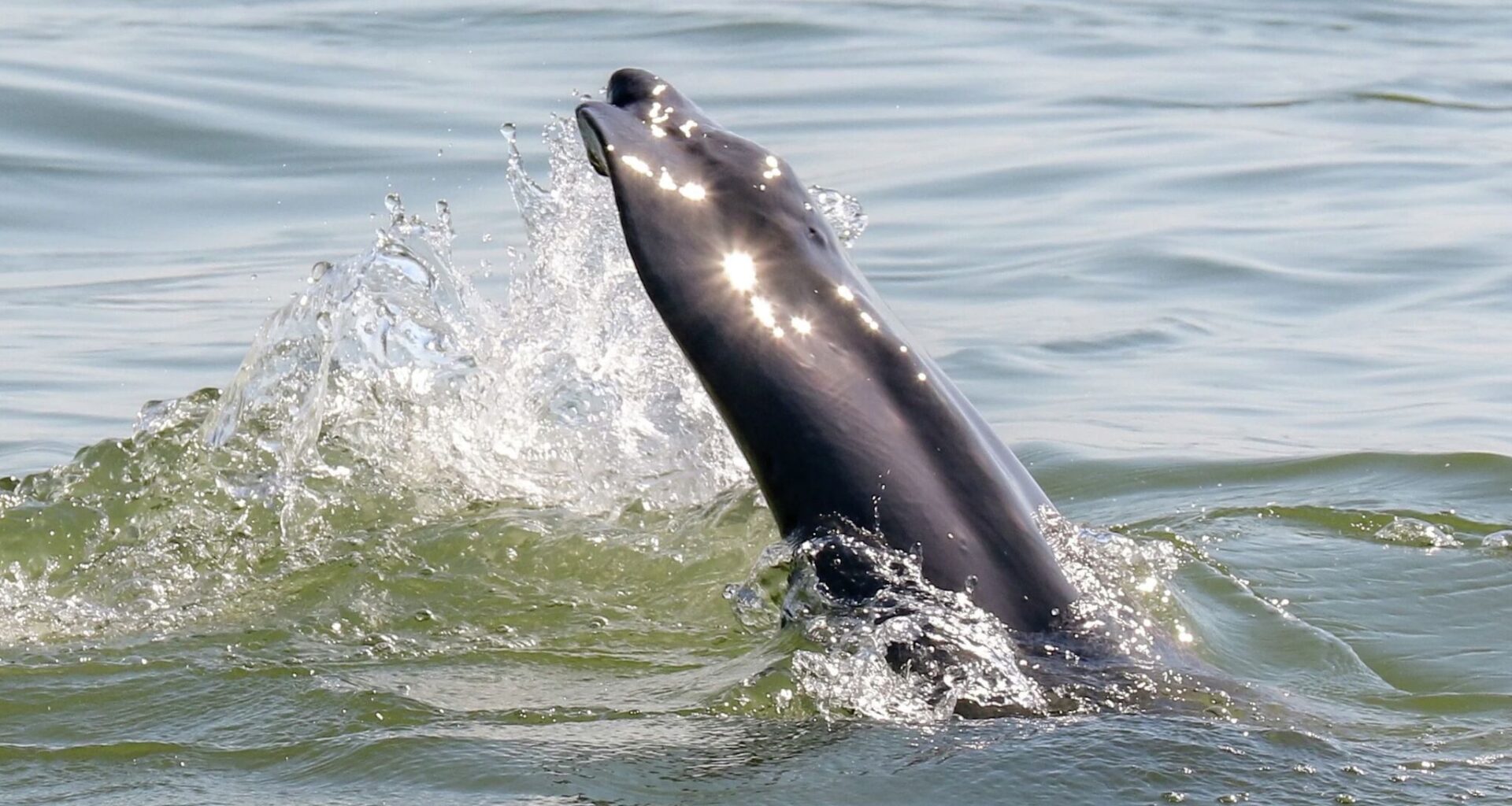
One afternoon in September 2022, researchers from the the Galveston Bay Foundation’s Dolphin Research Program spied a lone bottlenose shadowing a shrimp trawler in the middle of the bay, on the edge of the Houston Ship Channel.

Out on a routine monitoring survey, the team followed the dolphin for about 35 minutes. Eventually, it joined about 25 other dolphins to forage around the trawler’s nets, but did not interact with any of them. Upon closer inspection, the team discovered that this dolphin’s tail was missing its flukes, the horizontal lobes that give the tail its Y-like shape and, more importantly, help propel the dolphin through the water.
And although it moved somewhat unusually, for obvious reasons, the researchers found that the dolphin seemed to be swimming just fine.
Article continues below this ad
“It was by chance that we were out there, and I think it speaks a lot about the importance of doing this kind of research and long-term monitoring,” Galveston Bay Foundation Director of Dolphin Research and Conservation Vanessa Mintzer told Chron. “Just being out on the water and having eyes out there is really important because we do see these remarkable cases.”
Mintzer and the foundation’s other researchers believe Dino was probably a coastal dolphin and was just passing through Galveston Bay when it encountered their team.
Galveston Bay Foundation
Later, Mintzer and her colleagues began sharing photos of the dolphin with other organizations that study marine mammals. The more experts they consulted, the more they realized how rare a find they had on their hands. The dolphin came to be known as Dino, Italian for ‘little sword,’ and is now a prime example of how its species continues adapting to its increasingly anthropogenic—that is, human-altered—environment.
“Dino has changed its swimming strategy; it swims differently than a normal dolphin,” Mintzer said. “Some people describe it as swimming more like a fish than a dolphin. And it does show variation in the muscles: there is muscle atrophy and signs that the body has adapted differently.”
Article continues below this ad
How did Dino lose its flukes?
According to Mintzer, Dino is likely an adult dolphin, though it was on the small side when it was spotted. The prevailing theory for how it lost its flukes is that its tail got entangled in a discarded fishing line, but she said that a shark bite, propeller injury, or congenital condition are also possibilities. However it happened, Dino is now what conservationists call a ‘flagship’ animal—an accidental mascot they can use to (hopefully) educate the public.
“These are animals that are charismatic, that are visible to the public, and that have a remarkable trait,” Mintzer said. “Dino falls into that category, and it really just reminds us of the impact that we’re having on our wildlife. And it can help remind people that we can all take action to decrease those impacts.”
The foundation warns boaters to stay at least 50 yards away from dolphins, and refrain from feeding them.
Galveston Bay Foundation
Some of those actions, she explained, include not feeding or touching dolphins, disposing of fishing line responsibly, and generally giving them their space—boaters should stay at least 50 yards away, for example. Dead, injured, or distressed animals should be reported to the Texas Marine Mammal Stranding Network, Mintzer said, but the foundation is always glad to hear about normal dolphin sightings.
Article continues below this ad
Mintzer said the average lifespan of the dolphins in Galveston Bay is unknown—population estimates range from 800 to 1,200, depending on the season—but bottlenose dolphins can live to age 50 or 60; one in Florida lived to a ripe old 67. The more time that elapses, the more Mintzer is convinced that Dino (“Sorry, I keep calling it a ‘he,'” she laughed) was one of the bay’s many ‘transient’ dolphins, likely passing through on its way back to more familiar coastal waters.
Is Dino still in Galveston Bay?
In 2024, the foundation sent four boats out on the bay at the same time in an all-out effort to find Dino, to no avail. The flukeless dolphin has been elusive ever since. However, as its story made the rounds, Mintzer and her team have also learned about others like Dino in South Carolina, South Korea, Uruguay and the Mediterranean.
“It is pretty remarkable that Dino is alive, or was alive at the time of sighting, and that we’ve learned about other cases of dolphins throughout the world that are similar,” Mintzer said. “So we now know that these dolphins are able to adapt to living without a fluke.”
Article continues below this ad
Since encountering Dino, Galveston Bay Foundation researchers have learned about a handful of other dolphins around the world who have adapted to survive without their tail flukes.
Galveston Bay Foundation
Last week, Mintzer and colleagues from Charted Marine Consulting, the National Marine Mammal Foundation, and the University of Houston-Clear Lake’s Environmental Institute of Houston published Dino’s story in the latest issue of Aquatic Mammals, a bimonthly journal supported by a handful of marine-minded nonprofits. One of the main reasons they waited this long to publish, she said, is that they’ve been hoping Dino will someday return to Galveston Bay. They still do.
“We were hopeful that we would see it again,” Mintzer said. “It just seems like it’s not a Galveston Bay animal, and we’re unlikely to see it [again] for that reason alone. But knowing about these other cases in other parts of the world and knowing that these animals are surviving, I think Dino could be out there.”