
A key problem for NASA to solve in maintaining a presence on the moon, or even Mars, is providing the resources necessary for long-term survival.
The more scientists pack on a spacecraft, the heavier it is and the more fuel it uses. Resupply missions are costly.
But LSU researchers are exploring how to extract materials from the moon itself.
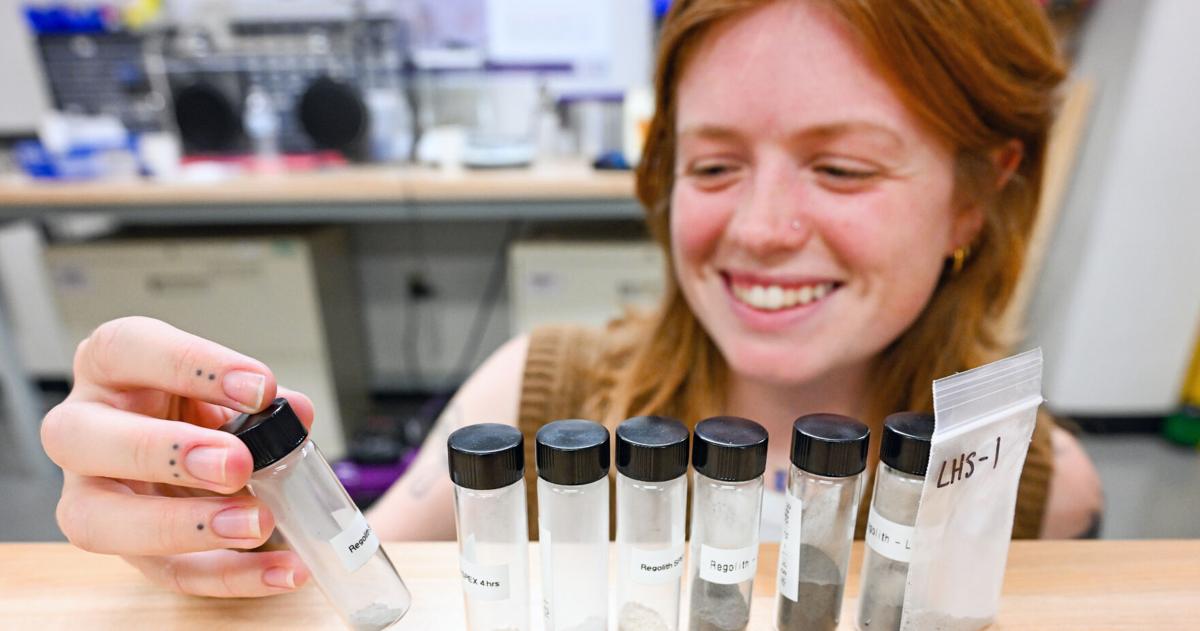
Mechanical engineering Ph.D. student Emma McCarthy is investigating the possibilities of lunar regolith, the dust and debris that make up the lunar surface.
“Getting materials from Earth and resupply from Earth is very expensive,” McCarthy said. “Energy costs are very high for that, so we want to try to use as much as we can from the moon already.”

PhD student Emma McCarthy holds up samples of alloys made from moondust in the powder metallurgy lab on Tuesday, May 19, 2026. Staff photos by Javier Gallegos
Javier Gallegos
Overseen by Christopher Marvel, assistant professor in the Department of Mechanical and Industrial Engineering, McCarthy experiments with using a chemical reaction involving lithium hydride to isolate valuable elements found in moon dust — like aluminum, iron and silicon — from oxygen.
The materials can then be used to build or repair structures on the moon, McCarthy said. Astronauts also could harness the energy from the chemical process, called a thermite reaction.
Her research is funded by NASA to further its “in situ resource utilization” initiatives, which focus on how to use local resources at mission destinations as opposed to relying only on what a spacecraft can carry.
Christopher Marvel, assistant professor in the department of mechanical and industrial engineering, gives a tour of one of his team’s labs at LSU on Tuesday, May 19, 2026. Staff photos by Javier Gallegos
Javier Gallegos
“That’s really big for supporting the Artemis mission right now,” McCarthy said. “This stuff could be applied for a future Mars mission and transferred to the Mars dust.”
For their experiments, the researchers grind simulated lunar regolith into a fine powder using a ball mill. They purchase samples from Space Resource Technologies, which specializes in simulating the properties of the moon, Mars and asteroids.
McCarthy said they chose samples that replicate the lunar south pole, the location being targeted by NASA’s Artemis missions.
Implications for space exploration
McCarthy said her research differs from current approaches to separate metals from their oxides, which are more energy-intensive.
The thermite reaction she employs is already used on Earth — to repair railroads.
“I think we saw an article about NASA’s in situ resource utilization, and we thought, wow, it’s kind of familiar to the reactions that we’re trying to do,” McCarthy said. “Regolith has a ton of oxides in it, so we could use this. We could propose a reaction.”
PhD student Emma McCarthy and Christopher Marvel, assistant professor in the department of mechanical and industrial engineering, pose together with samples of moondust alloys and the equipment used to create them in the powder metallurgy lab at LSU on Tuesday, May 19, 2026. Staff photos by Javier Gallegos
Javier Gallegos
She was one of a handful of students to receive the award from NASA through the Louisiana Space Grant Consortium. It bridged her experiments that used electron microscopy and her lifelong interest in space, she said.
“I have always been super passionate about NASA and NASA initiatives,” McCarthy said.
She said the project has a broader scope than the research team originally anticipated, and it plans to reapply to continue the work after the funding is up.
The method is newer and more energy-efficient than existing practices, and it could play a critical role in advancing humanity’s space exploration, she said.
“It doesn’t cost as much because the aircraft is lighter, you don’t have as much fuel, and there’s room for other stuff that’s more important on the spacecraft as well,” McCarthy said.