
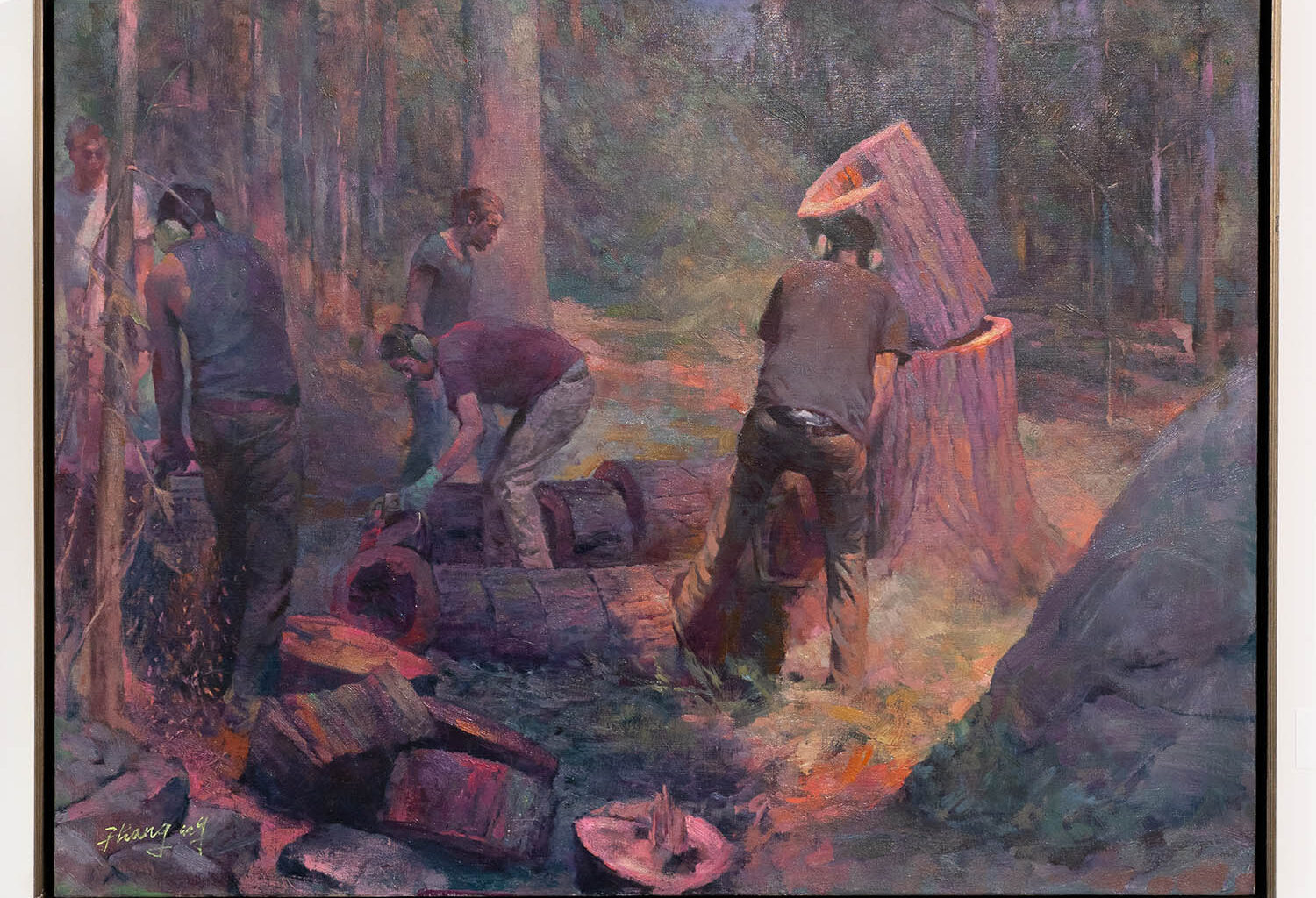
Hongnian Zhang, “Tango in the Woods.” Oil.
William Jaeger/For the Times Union
Ruby Silvious, “Rhythms of Matter,” top, and “Field Construction.” Mulberry paper, water.
William Jaeger/For the Times Union
Toby Barnes, “Corn Candy.” Batik mixed media.
William Jaeger/For the Times Union
Gabrielle Lau, “The American Dream,” top, and “Heading to Chinatown.” Photography.
William Jaeger/For the Times Union
Chong Kang, “Pieces of Hanbok #1.” Graphite, gouache, acrylic on panel.
William Jaeger/For the Times Union
An installation view of “Threads” at the Albany Center Gallery.
William Jaeger/For the Times Union
Ottavia Huang, “Dinosaur, The Highline NYC.” Watercolor and ink.
William Jaeger/For the Times Union
Yeachin Tsai, “Joy of Sea Creatures.” Acrylic on canvas.
William Jaeger/For the Times Union
You might walk into Albany Center Gallery’s big, new whitewalls exhibition space and forget all the years the director, Tony Iadicicco, and the many curators, workers and volunteers, have had to wrestle with awkward, small, irregular spaces with obstacles and ramps and glass partitions. Now we have their new home in downtown Albany for at least the next decade, a bright, expansive, and flexible space at 48 N. Pearl.

You might also walk into the current show, “Threads,” or officially, “threads: weaving an intricate banner,” and not realize the wide variety of work here has a theme, not about fabric art, but art from the area’s “Asian American, Native Hawaiian, and Pacific Island” communities.
Article continues below this ad
“threads: weaving an intricate banner”
When: Through June 13
Where: Albany Center Gallery, 48 N. Pearl St., Albany, NY
Hours: Tuesday-Saturday, noon-5 p.m.
Admission: Free
More info: albanycentergallery.org or 518.462.4775
It’s a big, interesting show that truly validates the new gallery space.
Where to begin in this wide range of work, from utterly abstract pieces to representational painting and photography? One could start with works by Korean-born artist Chong Kang, because here we have seeming abstraction, but with underlying intentions based on the artist’s roots. Within the patterns that form flat, edge-to-edge effects, sometimes in muted tans and browns and sometimes in outrageous yellows, we are told that the artist uses “essential Korean colors,” or that they are based on the Korean alphabet, adding another level to works that are already formally subtle and elegant.
On the other hand, cultural identity is deliberately foregrounded in paintings by Chinese-American Hongnian Zhang. Using a somber, realistic style that feels daringly retro, Zhang depicts a range of ordinary situations: young men cutting big trees, a sleepy family waiting “after a long day,” or a crowd listening to an impromptu guitarist on the steps of a building in New York. In most of these, we can find Asians included among the subjects, and the works are quietly convincing.
Article continues below this ad
Make the Times Union a Preferred Source on Google to see more of our journalism when you search.
Add Preferred Source
The large paintings by Toby Barnes are certainly stunning. Surrealist piles of oddly shaped objects, precisely delineated on repeated batik designs, make for joyous and probably nonsensical fictional settings, sometimes with a kind of tribal face or mask worked into the design. I don’t know how these relate to Barnes’s Thai background — maybe the batik itself, associated with Asian art — but like much of the show, the works function independently of that theme.
There are several essential handmade mulberry paper works by Ruby Silvious, using a Korean technique called Joomchi, which builds up several layers to make a strong and highly textural sheet. Silvious devises holes and further textures throughout the surfaces to reveal the colors given to separate layers, which appear and disappear and create clever visual interplay.
Among the more intriguing works are a series of photographs scattered throughout the gallery. They are small, very tungsten-yellow, and fairly incidental views of domestic interiors, lifted as a group by their apparent inconsequence. The artist, Gabrielle Lau, explains that these are scenes taken during her visits to “Ya-Ya and Ying Ying’s house” in Queens, and they form a love letter to her grandparents there.
Article continues below this ad
There is still much more in this show, like the wild, swooshy abstractions of Yeachin Tsai, the detailed works in deceptive traditional veins by Mengde Shi, some small watercolor and ink works of spontaneous slices of ordinary life by Ottavia Huang, and two photographs by Siwei Song, all wrapped in subjects or styles that fit the curators’ theme, embracing mostly Asian and Asian-American art.
What might the show say about that theme? Are there identifiable strands and effects, influences and histories, that identify with Asia and the Pacific Islands? I think the answer is a qualified yes, in individual cases. The show does well to bring some of these to our attention. Is there an overarching feeling for a movement or trend, or even some common intentions and feelings overall? Probably not.
But maybe that’s not important, that’s not the point. What matters is the disparate individual voices within this broader diaspora, which, to me, is too often neglected in our search for diversity and inclusion — and in our search for good art.
Article continues below this ad