
–The Power for the People Act, which has Democratic support in the House and Senate. It would direct the Federal Energy Regulatory Commission to make sure data centers pay for local transmission upgrades they need.
The bill “balances the need for data center development without pushing those costs onto consumers,” said Rep. Paul Tonko, D-N.Y., its chief House sponsor.
–The Fair Allocation of Interstate Rates Act. Sponsored by Rep. Julie Fedorchak, R-N.D., It would “prevent households from being forced to subsidize transmission projects built to satisfy another state’s green energy goals.”
Currently, regional transmission groups spread costs of big interstate lines to consumers throughout the region.
Latta, the subcommittee chairman, called it “a practical solution to place the burden of renewable portfolio standard costs on the states that choose to adopt those requirements.”
What’s standing in the way?
Politics and, as Hawley put it, “M-o-n–e-y.”
OpenSecrets, a nonpartisan organization that tracks money in politics, found “The electric manufacturing and equipment sector, including firms like Microsoft and Oracle, has poured more than $226 million into lobbying activity in 2025.”
That spending is aimed in part at backing what OpenSecrets called “the rapid growth of data centers and to address the resulting strain on the nation’s power grid.”
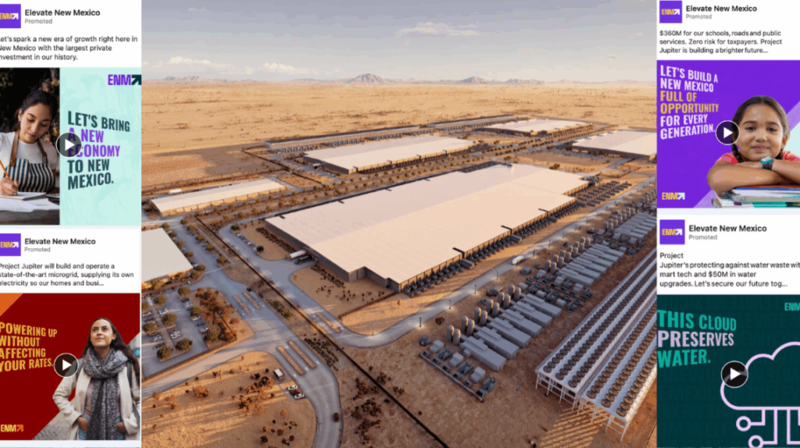 Physical mailers and digital ads urged New Mexicans to support Project Jupiter, a massive Doña Ana County data center complex planned for OpenAI and Oracle. They bear few clues as to who paid for them. (Illustration by Julia Goldberg/Source NM, Project Jupiter rendering courtesy of STACK Infrastructure)
Physical mailers and digital ads urged New Mexicans to support Project Jupiter, a massive Doña Ana County data center complex planned for OpenAI and Oracle. They bear few clues as to who paid for them. (Illustration by Julia Goldberg/Source NM, Project Jupiter rendering courtesy of STACK Infrastructure)
The Data Center Coalition’s McNeill said the industry “is committed to working with communities, local officials, and state and federal leaders to ensure the continued responsible development of this critical industry while protecting families and businesses.”
The Data Center Coalition, he said, “will continue to provide education on the data center industry and look forward to continued engagement with the administration, Congress, and other key stakeholders.”
Also, the data center issue has become bound with other incendiary matters.
Discussing the moratorium idea, Rep. August Pfluger, R-Texas, said in an interview, “Of course they (Democrats) are pushing for that. They’re anti-building, they’re anti-American, they’re anti-everything. They’d rather see Iranian oil be sold in the United States.”
Democrats charge that Republicans are resisting meaningful regulation.
At one of the House hearings, Rep. Jenn McClellan, D-Va., tied the problems to the war in Iran.
“Not until the Trump administration carelessly ensnared the United States in a reckless and costly war of choice with Iran pushing energy prices up even higher,” she said, “that we focused a hearing specifically addressing the alarming impact that data centers could have on energy affordability going forward.”
Virginia Mercury is part of States Newsroom, a nonprofit news network supported by grants and a coalition of donors as a 501c(3) public charity. Virginia Mercury maintains editorial independence. Contact Editor Samantha Willis for questions: info@virginiamercury.com.