
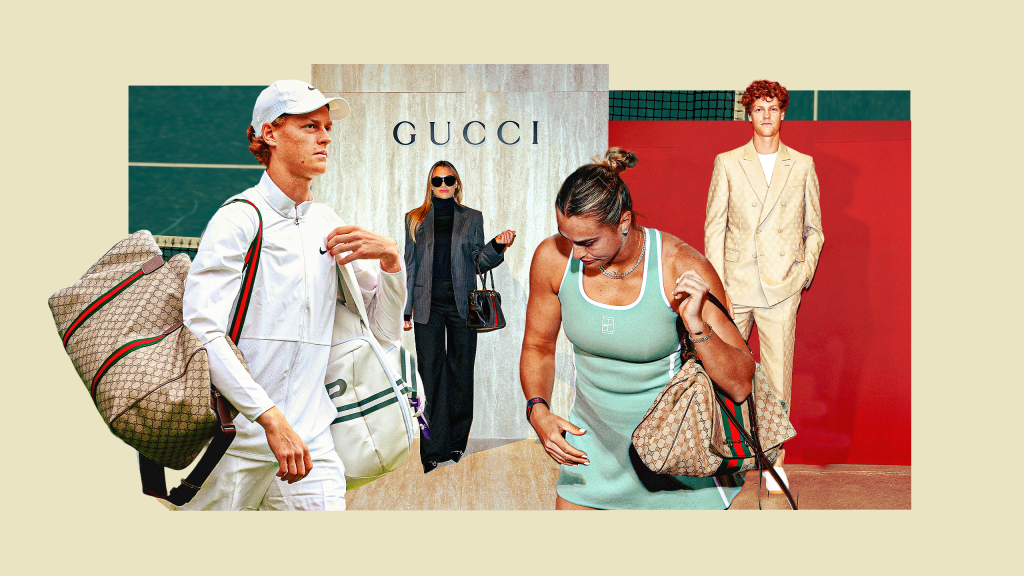
Elite tennis players have become prominent endorsers of designer fashion brands in recent years, including Carlos Alcaraz for Louis Vuitton and Coco Gauff for Miu Miu. But in recent years, tournament organizers have begun cracking down on overt attempts to turn the tennis court into a luxury showroom.
Earlier this month, Aryna Sabalenka walked out onto the court at the Rome Open carrying a $3,600 handbag from Gucci’s spring/summer 2026 collection. The current women’s world No. 1 inked an endorsement deal with the Italian fashion house in January, attending their runway shows and wearing the brand in her newly released cover shoot for Vogue. But people familiar with the matter told Sportico that the WTA is reviewing Sabalenka’s use of the Gucci handbag at the Rome tournament as a potential violation of the tour’s marketing rules for player gear.
A spokeswoman for Sabalenka’s agency, Evolve, said Sabalenka had “written approval from WTA” to carry the bag at the Rome Open. Representatives for Gucci did not have an immediate comment. A spokeswoman for the WTA declined to comment on the Sabalenka case but said in response to questions about tour rules that “players are permitted to carry tennis equipment bags featuring standard manufacturer identifications and limited commercial branding. The rules do not permit branded manufactured bags that are not considered tennis equipment.”
Tennis agents and tournament authorities told Sportico there have been subtle marketing rule changes in recent years, largely in response to another marketing ace by Gucci. In 2023, Jannik Sinner carried a custom Gucci duffel out on court at Wimbledon, becoming the first tennis player to carry any luxury bag on Centre Court. The Italian brand told WWD at the time it secured permissions from the International Tennis Federation, the ATP Tour and Wimbledon for Sinner to carry the bag.
“Jannik Sinner, what he did with Gucci? Full credit to them. They created a moment,” said Tom Chapman, head of commercial at WME Sports, which represents a host of other A-list tennis stars, including Carlos Alcaraz, Naomi Osaka and Venus Williams. Each of those three have worked with luxury brands in various capacities.
Still, Sinner’s Wimbledon coup spooked Grand Slam organizers into amending their rulebook. In 2024, the Slams added language to specify that players can only wear or carry branded equipment from manufacturers that derive a “substantial” portion of their revenues from sports or tennis gear. The rules also specify that the Slam tournaments maintain “reasonable discretion” to determine what is and isn’t proper tennis equipment.
The crackdown on on-court branding for elite tennis players comes as other sports and events have embraced luxury more broadly. Formula 1 began a 10-year partnership with luxury conglomerate LVMH last year. The French fashion and designer goods behemoth also partnered with the 2024 Paris Olympics, with prominent Louis Vuitton leather goods and Chaumet-produced medals throughout the Games.
To be sure, virtually all professional sports have long established rules about what branding can appear on players and on the court, in part to protect commercial relationships with stadium signage rights holders or league outfitters. Other leagues—such as the NFL, NBA and WNBA—have embraced the “tunnel fit” moment, creating spaces for athletes to show off their style en route to the game but outside the field of play.
Chapman of WME Sports said that the evolving marketing rules in tennis are “short-sighted.”
Designer fashion companies are turning to sports as marketing platforms in part to seek new customers. In recent years, global luxury sales have been sluggish, weighed down by the effects of inflation, U.S. tariffs and changing consumer tastes.
These trends are particularly pronounced at Gucci, where revenues fell 22% to €6 billion ($7 billion) in 2025. In April, executives at Gucci’s parent company Kering—a rival to LVMH—detailed extensive plans to make Gucci desirable again, including through cultural touchpoints like sports. (Other plans include maximizing what the company calls Guccisimo, or “the highest expression of Gucci craftmanship.”)
One effort to hedge against evolving tennis marketing rules is the emergence of collaborations between designer brands and athletic gear-makers, such as New Balance and Miu Miu, or On and Loewe. Gucci has also collaborated with the racket-maker Head, which provides Sinner’s equipment.
Another tennis agent, who spoke on the condition of anonymity, said there is a rush among designer brands to get into tennis these days, in part because fans are increasingly dressing up to attend major tournaments.
Chapman echoed that sentiment: “Letting luxury brands into these big moments is good for the sport.”