
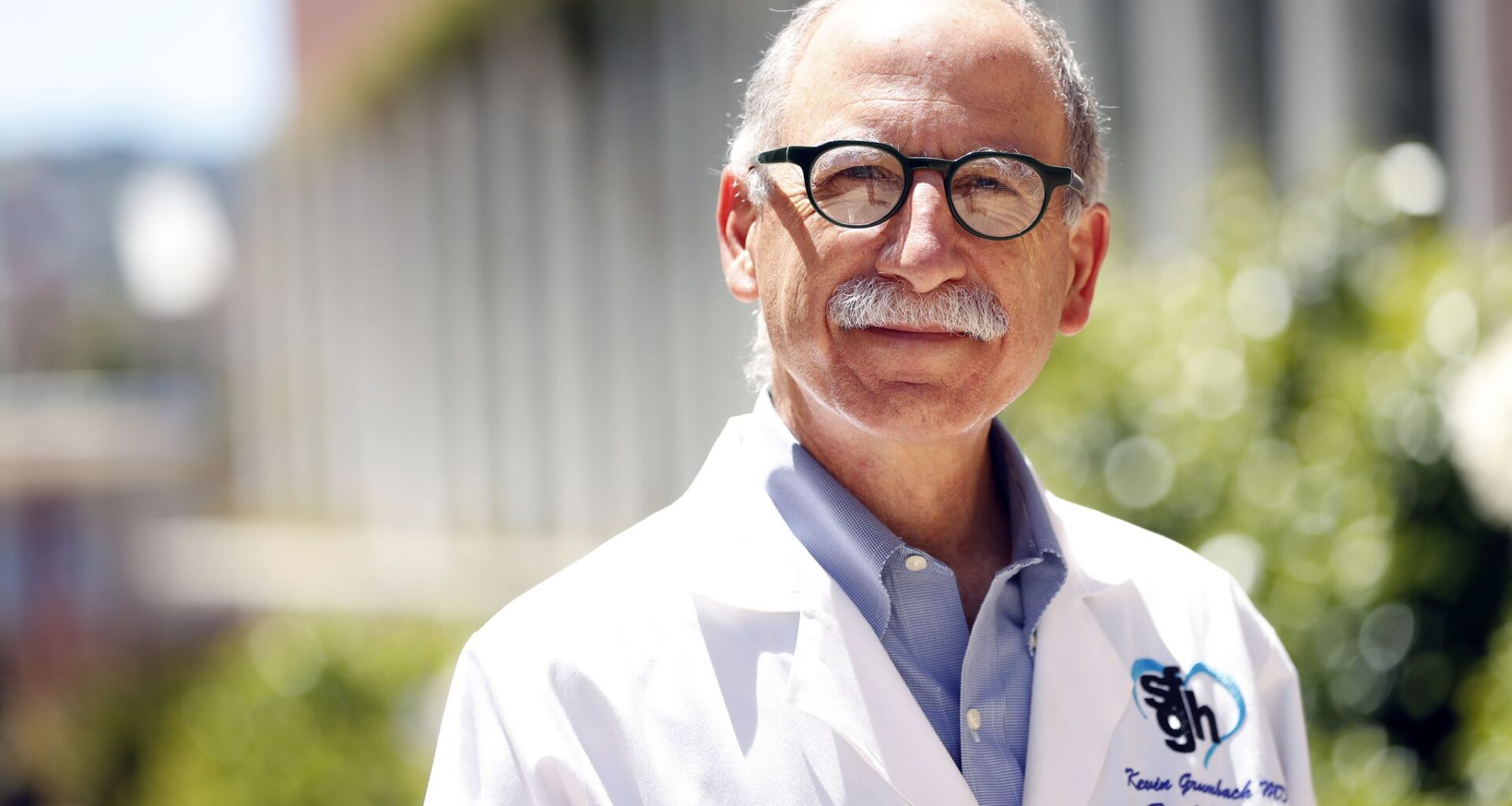
Dr. Kevin Grumbach, a family physician and professor of family community medicine at UCSF, outlines in a new paper how California could implement universal health care at the primary care level.
Scott Strazzante/S.F. Chronicle
Leading Democratic candidates for California governor say they support universal healthcare, but have offered few concrete plans on how to make it happen.
An article published in the Journal of the American Medical Association last week, co-authored by a UCSF physician, proposes one way the state could move toward a single-payer system: Make primary care a public utility, like electricity or clean water, and create a “common fund” financed by public and private sources that would directly pay primary care doctors to treat patients.
Such a model would be a step toward universal healthcare in California by making primary care — a critical component of healthcare — universal, the authors say. The model could be applied in any state, but California is uniquely suited to adopt it because it has already made substantial commitments to boost primary care spending as a portion of overall healthcare spending, they say.
Article continues below this ad
It would mean all Californians, regardless of their health plan, would be able to see a primary care doctor and have it paid for by this fund. Their primary care doctor would not be tied to their insurance or their employer, as it often is now.
“We are calling for, essentially, single-payer for primary care,” said the paper’s senior author Dr. Kevin Grumbach, a family physician and a professor of family community medicine at UCSF. “This provides a road map, how you could get started with a concrete proposal that would build the first floor for moving toward a broader Medicare For All system.”
San Francisco Chronicle Logo
Make us a Preferred Source to get more of our news when you search.
Add Preferred Source
The model would largely leave intact the current way healthcare is paid for and not require a new funding source. Rather, it would pool money that payers — insurance companies, employers, and the federal and state government — are already paying toward all healthcare services. It would carve out a certain percentage of that money from those payers, and put it into a fund that would pay primary care providers directly. The fund would be administered by a public or quasi-public entity.
The percentage that would get carved out and go into the fund would depend on how much each state has determined is their goal for spending on primary care. In California, for instance, the Office of Health Care Affordability has set a goal of increasing health plan spending in primary care from 7% in 2024 to 15% by 2034.
Article continues below this ad
The paper does not explicitly address whether patients, under this model, would have to pay out-of-pocket costs for primary care services. Grumbach said that this is because the authors did not agree unanimously on this point, but that he personally would advocate for no out-of-pocket payments.
For providers, the model would simplify billing by creating one single source to submit claims to, rather than the current web of payers like private insurance, Medicaid and Medicare.
“It works for both the person getting care and the person delivering care,” Grumbach said.
Legislators in Massachusetts and Vermont have proposed bills that would create a similar type of funding system for primary care.
This type of approach to primary care would be difficult for California or any state to do because it’d require waivers from the federal government to redirect spending for primary care by large employers, Medicare, Medi-Cal and Covered California, said Larry Levitt, executive vice president of health policy for KFF, a nonprofit that researches health policy.
Article continues below this ad
“This approach wouldn’t magically increase primary care capacity and accessibility, but it would create an organized system for planning and paying for primary care,” said Levitt, noting that primary care is the type of care people most frequently need and for which many patients struggle to get timely appointments.
California leaders have flirted with the idea of universal healthcare for years. Many consider the issue a nonstarter because of the enormous price tag: one 2019 analysis by UC Berkeley public health researchers found it would cost $17 billion a year. Proposals for universal healthcare generally call for new taxes or other revenue sources.
In 2019, Gov. Gavin Newsom created a commission, Healthy California for All, to look into ways to expand health coverage, including a single-payer model. The commission issued a report in 2022 that endorsed overhauling California’s healthcare system to create a “unified financing” system. This would require the state to negotiate with the federal government to secure a waiver to allow California to take over healthcare spending.
In 2023, the state Legislature passed Senate Bill 770, introduced by state Sen. Scott Wiener, which imposed deadlines for the state to negotiate with the federal government for such a waiver. Those efforts were paused after Trump was elected. But under SB770, the state did commission a report by UCLA to outline a path to a unified financing system, which was released in April.
Article continues below this ad