
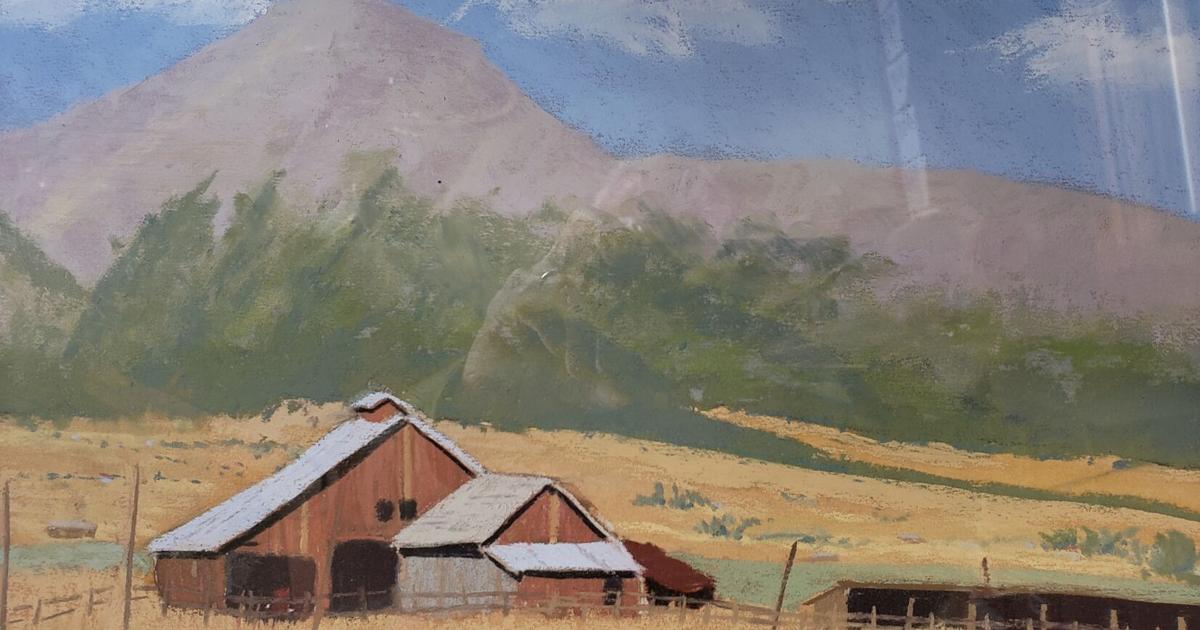

Doug Graybeal’s painting “Home Sweet Home” draws inspiration from Hunter Creek. The piece is featured in the art show “Old’s Cool,” which opens at the Aspen Chapel Gallery on June 3.
Courtesy image
The Aspen Chapel Gallery’s next exhibition, “Old’s Cool,” opens on June 3. It’s planned as a community celebration honoring the history, landscapes and enduring spirit of the Hunter Creek Valley.
Presented in partnership with the Hunter Creek Historical Foundation, the mixed-media exhibition brings together 15 regional artists whose work reflects themes of preservation, memory and the evolving relationship between Aspen’s past and present. The opening reception will be held June 3 from 4-7 p.m. The show marks the gallery’s 267th exhibition of its 40-year history.
Curated by Sam Louras, the show features work by Art Burrows, Judith Fox-Perry, Doug Graybeal, Gregg Hollomon, Suzanne Jackson, Corina Minniti, Jayne Mosher, Leif Mosher, Steve Mundinger, Glenn Rappaport, Fran Reither, Marty Schlein, Robin Sturgeon and Larry Yaw.
The stated mission of the foundation is to stabilize and preserve historic resources in the Hunter Creek Valley to enhance the public’s awareness, enjoyment and stewardship of the valley for future generations. In recent years, the foundation has focused on the preservation of W.E. Koch’s 1893 original homestead and Adelaide Ranch near the entrance to the Hunter Creek Valley floor.
“It never gets old to hike Hunter Creek and observe the restorations of old Aspen,” Aspen Chapel Gallery co-curator Louras said. “Many thanks to the Hunter Creek Historical Foundation for the preservation of this special place in time. Old is cool.”
Co-curator Graeme Means added, “Throughout the ages, the arts have not only documented history but also have served to inspire and profoundly inform and influence our future. A goal of this show is to learn how history has affected these individual artists and their work.”
“Layered Through Time” is a painting by Suzanne Jackson, part of the art show “Old’s Cool,” which opens at the Aspen Chapel Gallery on June 3.
Courtesy image
For many participating artists, Hunter Creek represents both a physical refuge and an emotional connection to Aspen’s history.
Jackson worked as a landscape architect at Design Workshop in Aspen for 25 years. During that time, she regularly spent time running up lower Hunter Creek into the upper valley. She later moved to Basalt and got disconnected from Hunter Creek, but this show allowed her to reconnect with her old stomping grounds,
“It was a treat to be invited to be part of ‘Old’s Cool’ and become reacquainted with this special place,” she said. “I even camped out on a chilly April night so I could paint the historic buildings at dawn and dusk. I especially appreciated the early spring colors-the greys and buffs of Aspen trees in bud, and the warm oranges and yellows of stands of willow.”
Jackson’s watercolor paintings combine local historic structures with impressions gathered while backpacking through Arizona, where she sketched towering saguaro cacti, which she learned could be nearly 200 years old.
“I hope people attending the show come away with a smile as they consider the various artistic interpretations of the theme,” she said. “Perhaps they will reflect on how saved remnants from the past enrich our lives today.”
Graybeal said the show’s themes immediately connected with his longtime fascination with historic Western ranch structures. His paintings focus on ranch buildings in the Wet Mountain Valley near Westcliffe, places he sees as sharing similar pioneer histories with Hunter Creek.
“As an old-time valley artist, it’s wonderful to participate in the ‘Old’s Cool’ show,” Graybeal said.
Mosher has enjoyed hiking up the Hunter Creek Valley for years, visiting the old buildings that William C. Koch built.
She pointed out that Hunter Creek provided electricity to power Aspen in the 19th century. She hopes the show illuminates some of that history.
“I hope people realize how important Hunter Creek is to the history of Aspen and how the foundation has worked to preserve what is left of the town,” Mosher said.