



Dr. Raj Mitra, dean of the Boonshoft School of Medicine and chief academic officer at Premier Health, talks to medical student Francesca Savona from the Wright State University Boonshoft School of Medicine after Savona learned her residency placement for her postgraduate training on March 20. Premier Health and Boonshoft share an ongoing affiliation agreement, which includes recruiting faculty and physician leaders like Mitra. COURTESY OF WRIGHT STATE UNIVERSITY
COURTESY OF WRIGHT STATE UNIVERSITY
Two local health systems are making big investments into medical education and research at two Ohio universities.
Kettering Health gave Ohio University $53.8 million last year as part of an affiliation agreement, and Premier Health also paid nearly $56 million in combined support and clinical performance payments to Wright State University’s Boonshoft School of Medicine for their ongoing partnership, a Dayton Daily News examination of 2025 financial statements shows.
“It supports real-world training, advances medical education and research, and strengthens our region’s healthcare system by developing a highly skilled workforce and improving patient care,” a previous statement from Wright State reads.
Both health systems said the affiliation agreements are intended to increase the healthcare workforce by expanding training opportunities to meet the growing demand for physicians and other medical professionals, while also supporting research and clinical innovation, according to the hospital systems.
They also make both hospitals and universities eligible for a broader range of federal grants aimed at addressing community health needs and creating other training opportunities.
Nationally, the U.S. is projected to have a shortage of more than 140,000 full-time physicians by 2038, according to the Bureau of Health Workforce, a federal agency under the Health Resources and Services Administration.
Premier Health and WSU’s Boonshoft School of Medicine
As part of the ongoing affiliation agreement between Premier Health and Wright State University’s Boonshoft School of Medicine, Premier Health paid the college a combined $56 million, according to its 2025 financial statement filed through the Municipal Securities Rulemaking Board.
“The affiliation between Premier and Wright State is unique in that we are both Dayton-based service organizations who are collectively partnering to deepen alignment around advancing academic medicine, improving community health, strengthening the regional workforce and economy, and positioning our organizations as a destination for future health professionals through leading academic and experiential learning environments,” a statement from Premier Health reads.

A Dayton Daily News file photo of Wright State University’s Boonshoft School of Medicine holding its 2025 Match Day ceremony in the Student Union, where new doctors from the school learned where their medical residencies were going to be. As part of an enhanced affiliation agreement with Boonshoft, Premier Health paid $56 million toward investments into medical education and research in 2025, according to Premier Health’s 2025 financial statement. BRYANT BILLING / STAFF
The affiliation agreement between Premier Health and Wright State stipulates Premier Health will provide annual support payments, including base payments of $10 million for calendar year 2024 and $15 million annually for calendar years 2025 through the remainder of the initial 30-year term.
The agreement between the two also stated Premier Health could make additional payments to Wright State, and according to Premier Health’s 2025 financial statement, its support payment to Wright State increased from the $15 million base payment stated in the contract to $25 million.
On top of the support payment, Premier Health may make clinical performance improvement payments to Wright State, according to the contract between the hospital system and college. For 2025, that payment was $31 million.
“It should be understood these are not simply payments. Rather, they are investments to support shared priorities across the affiliation, strengthening our collective impact on education, research, clinical excellence, and community health,” Premier Health said in a statement. Additionally, some of the work this partnership does is supported by state and federal funding that helps academic medical centers care for large Medicaid populations, according to Premier Health.
“These programs are essential to sustaining the services, training, and infrastructure needed to provide high-quality care and expand access across our community,” the hospital system’s statement reads.
As part of that affiliation agreement, the entities combined physician networks by the end of last year and this year announced obtaining a federal grant that was the first of its kind received in Ohio.
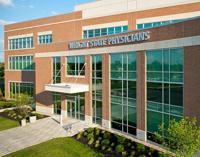
Last year, Wright State Physicians merged with the Premier Health Physicians group as part of the May 1, 2024, enhanced affiliation agreement between the university and the large health system. STAFF FILE
The two entities recently received a $2.5 million federal grant to expand Dayton Street Medicine, a program delivering primary care directly to people experiencing homelessness.
The affiliation expands graduate medical education opportunities at the Boonshoft School of Medicine, as well as training and programs to grow the nursing workforce. Premier Health and Wright State saw progress in this last year by strengthening nursing programs, recruiting nationally-known clinical faculty and physician leaders, and enhancing both academic programs and clinical services, according to Premier Health.
“We are also working to further develop Miami Valley Hospital as a leading academic medical center, bringing together education, research, and patient care to better serve our community and train future healthcare providers,” Premier Health’s statement reads.
The hospital has integrated more research and fostered clinical innovation, including expanded clinical trials and created more opportunities for learning in real care settings, according to Premier Health.
Premier Health employs more than 10,000 people and is one of the region’s largest health systems with five hospital sites, including the region’s only level I trauma center, Miami Valley Hospital. In addition, Premier Health provides care at seven emergency departments, eight urgent care locations and more than 130 outpatient locations.
Kettering Health partnered with Ohio University
Kettering Health’s agreement, announced in November, established an affiliation with Ohio University Heritage College of Osteopathic Medicine (HCOM), which trains more physicians than any other school in the state, according to Kettering Health.
As part of this agreement, the health system will supply research and medical education resources, doing so in 2025 with a $53.8 million investment to HCOM, according to Kettering Health’s 2025 financial statement through the MSRB.
“Kettering Health has many physicians who are graduates from HCOM, so this partnership is a natural extension of that affiliation ,” a statement from Kettering Health reads.
Targeting workforce expansion is one of the hospital’s priorities for this partnership. Many of the physicians who train at HCOM remain in the state to practice medicine and fill gaps in Ohio’s healthcare workforce gap, according to Kettering Health.
As part of that effort to train more doctors, Kettering Health and Ohio University recently announced a new partnership scholarship program that provided $40,000 scholarships to 13 first-year medical students from communities within Kettering Health’s market share starting their first year at HCOM, as well as to 10 fourth-year medical students who have matched into Kettering Health residencies.
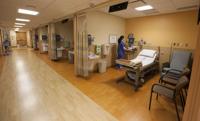
A Dayton Daily News file photo of the pre- and post-operative center at Kettering Health Dayton. As part of an affiliation agreement with Ohio University, Kettering Health plans to grow its residency opportunities. STAFF FILE
The affiliation between Kettering Health and HCOM “will seek to expand residency and fellowship training opportunities with the ultimate goal of training and retaining more physicians in Ohio to fill critical healthcare gaps,” Kettering Health’s statement reads.
The two organizations plan on combining their expertise and resources “to advance models for education, clinical training and translational research to improve community care and health outcomes across the state, especially in southwest Ohio.”
The agreement will also give Kettering Health new opportunities for federal funding to support patient services.
This does not make any of Kettering Health’s hospitals into a research or academic hospital, but this is “a long-term collaboration with plans to continue investing in the education of HCOM students and enhancing HCOM’s medical training capabilities,” according to Kettering Health.
New initiatives and projects of the partnership will be announced as they are developed.
Kettering Health employs about 14,000 people in the region. It is made up of 14 medical centers and more than 120 outpatient locations throughout western Ohio, as well as Kettering Health Medical Group — with more than 700 board-certified providers. Kettering College, a division of Kettering Health Main Campus, is a fully accredited college that specializes in health science education.