
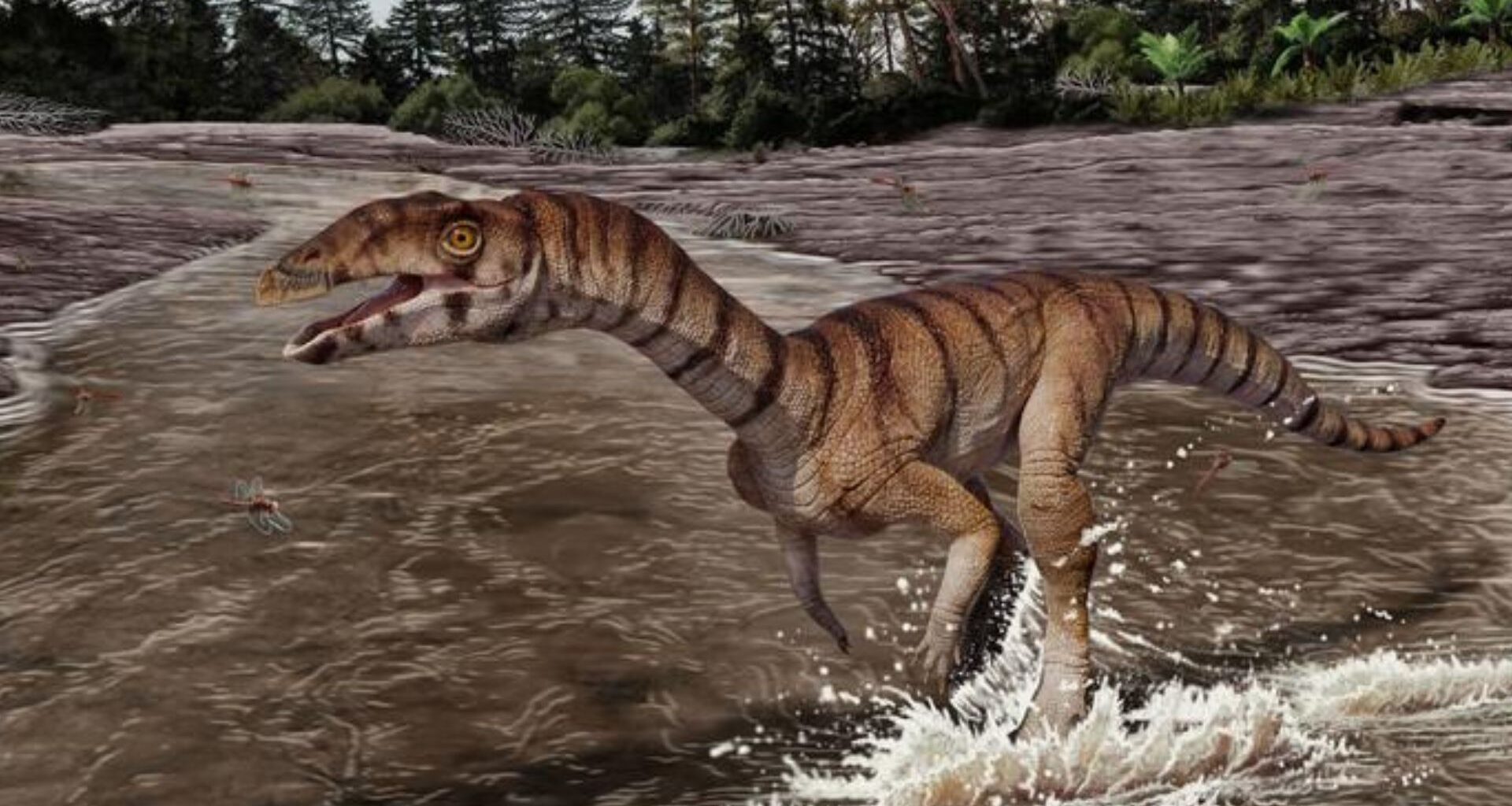
Fossilized remains of a bizarre crocodile ancestor were unearthed from Ghost Ranch, New Mexico. Meet Labrujasuchus expectatus, a bizarre, newly discovered reptile from the Triassic. But it didn’t look like a crocodile at all. This creature navigated a wild, primordial world on two legs, brandishing tiny arms and a toothless, beaked mouth. It is, for all intents and purposes, a crocodile masquerading as an ostrich.
“We see a lot of the successful strategies for modern animals and non-avian dinosaurs first arise in the Triassic, and shuvosaurs are a great example of that convergent evolution,” said Dr. Alan Turner, lead author on the paper.
“Bipedalism is certainly a unique path for crocodile relatives to take, but it’s a path well-trod by dinosaurs and later birds. It obviously worked for these animals,” Turner added.
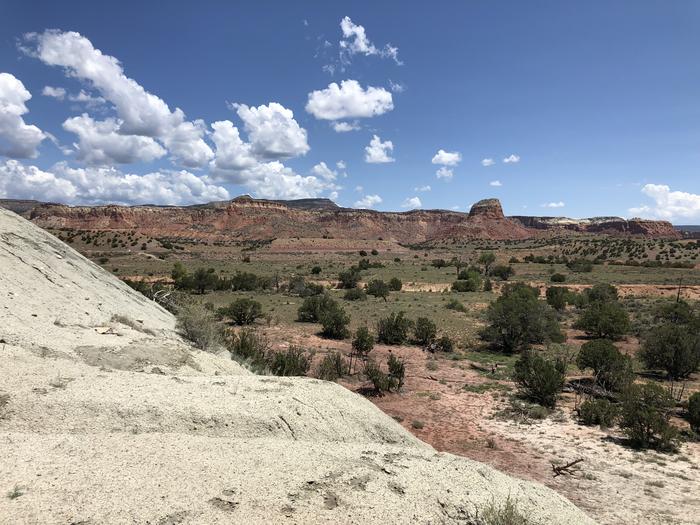 View across Ghost Ranch lands and Late Triassic rocks from the Hayden Quarries site. Photo by Nate Smith
The naming story
The fossil was unearthed at Ghost Ranch, a legendary landscape that has spent decades expanding our view of ancient history. Its name carries a colorful history. Labrujasuchus translates to “Witch Crocodile,” a direct nod to Ranchos de los Brujos (Ranch of the Witches), an old Spanish moniker for Ghost Ranch. According to local lore, 19th-century rancheros used the spooky name to frighten people away from their cattle-rustling operations.
The species name, expectatus, points to how the fossil record works. Paleontologists had already found a shuvosaurid — the group of crocodile relatives Labrujasuchus belongs to — from earlier in the Triassic, and another from later. They knew a missing link had to be waiting in the middle. The discovery was, quite literally, the expected unexpected.
“We also wanted to highlight how the fossil record works—finding one shuvosaur from earlier in the Triassic and one from later meant that we paleontologists knew there were probably more from in-between waiting to be discovered and described,” said Dr. Nate Smith, co-author and Gretchen Augustyn Director & Curator of the NHMLAC Dinosaur Institute.
Bizzare body plan
To understand Labrujasuchus, you have to understand the Triassic. It was an epoch of frantic, magnificent evolutionary experimentation.
The planet was a veritable Star Wars cantina of bizarre body plans. Labrujasuchus shared its ecosystem with creatures like Drepanosaurus, a tree-dweller with a sloth-like claw and a prehensile tail, and Vancleavea, an armored, aquatic mini-tank. It was an era where nature was throwing everything at the wall to see what stuck.
This is what scientists call convergent evolution — when completely unrelated animals evolve identical survival strategies. Despite being an ancient relative of modern, four-legged, toothy crocodiles, the newly discovered Triassic archosaur Labrujasuchus looked surprisingly like a Cretaceous ostrich-mimic dinosaur. The
The Shuvosauridae family is a group of ancient crocodiles that evolved body plans similar to bipedal, small-armed theropod dinosaurs. This bizarre creature completely defied typical crocodile anatomy by navigating its world on two legs, sporting tiny arms, and utilizing a toothless, beaked mouth.
The ancient world can feel entirely alien. Yet, the body plans of these long-gone oddities still echo in the wildlife we see today. By studying how these creatures diversified, succeeded, and ultimately vanished, scientists hope to gain a clearer lens into how to protect our modern, endangered weirdos. The Triassic past, it seems, is always ready to tell us about our future.
The study was published in the Journal of Vertebrate Paleontology on May 26.