
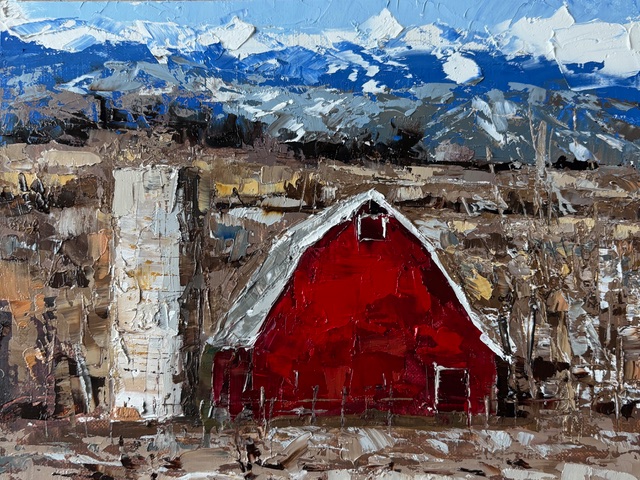
Paint one red barn, and you’ve captured a pretty piece of Midwestern nostalgia. Paint 20, and you’re officially known around the local galleries as “the person who paints a lot of barns.” But setting out to paint a hundred of them, armed with a palette knife and the unforgiving alla prima technique, makes you Sandra Pratt, a self-taught Boulder painter who is currently 20 canvases deep into a 100-work series called “American Pastoral Series.”
Pratt grew up in the Midwest, where barns were part of the everyday scenery, before moving to Colorado at age 12. Now a professional painter represented by galleries in Boulder, Santa Fe, New Mexico, and Park City, Utah, she has returned to barns throughout her work and has found that collectors respond to them with the same slightly mysterious affection she does.
“I feel like other people also like little red barns, and we don’t quite know why,” Pratt said.
That affection has become the foundation for the “American Pastoral Series,” a planned 100-work collection centered entirely on the red barn. The series returns to the same rural image again and again, across seasons, light conditions and moods. In some paintings, the barn is boxed in by bare winter branches, its red walls cutting through a pale sky and a clutter of browns and grays. In others, it appears beside water, its reflection breaking apart in loose blue and green strokes, or sits beneath a mountain backdrop, its roof edged in snow and its red face pressed against a scrubby Colorado field.
 Sandra Pratt is a Boulder-based painter working on “American Pastoral Series,” a planned 100-work series centered on red barns. (Sandra Pratt/Courtesy photo)
Across the series, the barn becomes the closest thing the paintings have to a main character — bright, nostalgic and somehow still charming, even after its 20th appearance.
The red barn carries a weight of national mythology, though its origins are more practical. In the 1800s, farmers needed affordable ways to protect wooden barns from weather, rot and insects. Mixtures using ingredients such as linseed oil and iron oxide helped seal the wood and produced the red color that later became one of the most recognizable sights in the American countryside, according to Washington State’s Department of Archaeology and Historic Preservation.
The barn paintings are small in some cases, larger in others, but they share a physical directness. Pratt works exclusively alla prima, an Italian term for a painting completed in a single sitting, with each layer of wet paint applied directly on top of the last. Traditional oil painters return to a canvas after each layer dries to refine and correct, sometimes waiting days or weeks between sessions. Pratt, rather, finishes her paintings within hours.
Pratt also works with a palette knife instead of a brush — meaning she mixes color on the palette, then applies it in deliberate strokes that hold their shape.
“As a palette knife painter, you really need to understand how to mix color and how to apply it all at once,” Pratt said. “You are mixing on your palette and then applying this beautiful one stroke to signify what you’re seeing.”
The series draws from both real places and imagined ones. Locally, Pratt has found inspiration in barns east of town, including those around 63rd Street near Valmont. She also works from memory and photographs, and is also starting to think about traveling for the project, seeking out landscapes and barns in Illinois, California and possibly Maine.
“I didn’t really think about it when I started,” she said, “but now I’m like, maybe I should go and expand and see what else is out there.”
Until the show opens, Pratt is posting the works publicly on her website at sandrapratt.com, as she completes them. Most of the “American Pastoral” series is expected to be shown at Smith Klein Gallery, 1116 Pearl St, Boulder, this autumn, provided that Pratt keeps painting at a speedy clip.
We spoke with Pratt about the appeal of red barns, finding inspiration in Boulder County and what happens when an artist commits to looking at a single subject 100 times.
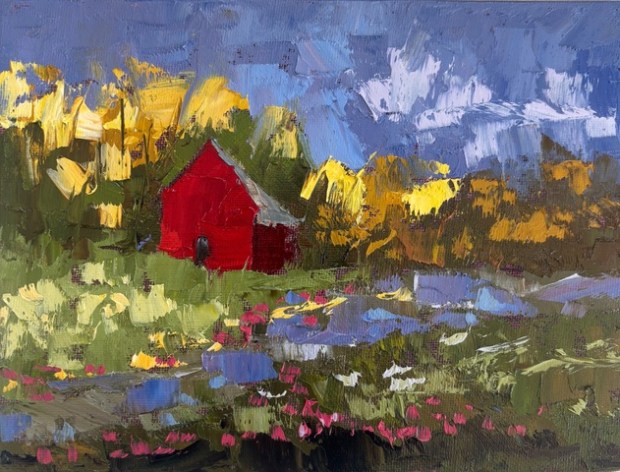 “Where the Light Collects, No. 3,” oil on canvas panel, part of Sandra Pratt’s American Pastoral Series. (Sandra Pratt/Courtesy photo)
Q: How did you first come to painting?
A: I grew up in the Midwest, and barns were just part of the view there. We moved to Colorado when I was about 12 years old, and I just love barns. I think they’re so beautiful.
I’m self-taught. I came into painting through childhood, like so many artists, and just started working with brushes and palette knives. Then I really got into palette-knife painting. It’s so exciting and dynamic. You have to make so many decisions all at once, and it’s all very direct.
Q: What inspired the “American Pastoral Series”?
A: It’s a very ambitious project, for sure. Red barns are just so beautiful to me, and I always feel like there’s a connection I get with my collectors when I put red barns in my scenes.
I was like, I’ll just do 100 red barns and see what the response is. I feel like other people also like little red barns, and we don’t quite know why … I love red as an accent, as well.
Q: What made you want to commit to one subject for that long?
A: I felt like I would grow as a painter by committing to this. In my career, I’ve done a lot of barns. I’m kind of known for that, barns with palette knives, and I feel like the red barn, specifically, is very much an American icon in a way.
I think it’s going to be harder than I thought. I was like, oh, maybe I should have done 20 or 50. But 100 is like, OK, let’s get actually focused on what we’re doing here.
Q: You’re 20 paintings in now. Has your understanding of the barn changed?
A: Yes. I’m looking at different values, and I’m looking at the drawing aspect. Good paintings basically start with the drawing aspect of it.
If you’re going to do a red barn, there’s a value and a color aspect as well that is very intriguing and exciting. There are all the different ways you can do it. How bright red are you going to go? Are you going to have the sun shining on your subject? There are all sorts of fun decisions.
Q: Are these barns based on real places, or are they imagined?
A: Both. Sometimes I will drive by a barn and see it, and sometimes it’s even red, and it’s just like, well, there it is. There’s a painting right there.
Then sometimes I’ll see another kind of painting in a landscape, and I’ll think, oh, that might be cool, and then kind of work it so it’s a really strong painting.
Q: Are there Boulder County barns or landscapes that have inspired the series?
A: There used to be this great barn on Cherryvale Road, but I think they took it down, actually. I do still have pictures. It was a gorgeous barn.
And 63rd Street, there are some nice barns there, kind of east off of Valmont. Over there, there are some good ones.
Q: What does your process look like from start to finish?
A: If I’m doing a plein air painting, which means outside, I will typically set up and first do a pencil drawing, just so I get my drawing absolutely perfect, because if the drawing is bad, the whole painting will be terrible. Then you can’t go back in, right? So you have to nail the drawing.
Then I maybe do a value study, which is just figuring out where your darks and your lights are, and then focusing on the darkest dark first and the lightest light, because that’s the easiest way to put everything within the picture.
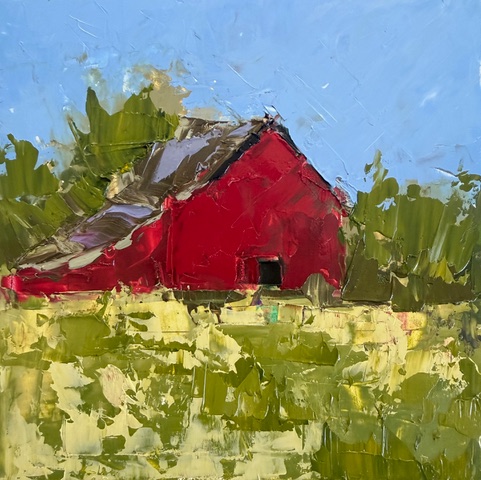 “Crimson Barn, No.1”, oil on linen panel painting. (Sandra Pratt/Courtesy photo)
Then I just start painting. I get my palette knives out, and I think, OK, what’s that color? As a palette-knife painter, you really need to understand how to mix color and how to apply it all at once, so you’re not going back in and making your color muddy. You are mixing on your palette and then applying this beautiful one stroke to signify what you’re seeing.
Then, when you’re done, you’re at the end of the painting, and it’s like, OK, it’s done. Next painting.
Q: How long does each painting take?
A: It depends mostly on the size of my canvas. It can take from like an hour to four hours, start to finish.
I’m planning on doing some larger-scale ones as well, because there’s such a drama in large paintings. Small ones are fun, too. They’re more free-flowing. Larger paintings take more planning. The composition has to be correct. Everything has to be really good, and then you have to do it on the large scale.
Q: What has Boulder offered you as an artist?
A: There’s endless inspiration here. The mountains, the Flatirons, they’re just so beautiful. And there are the barns east of town. There are some really beautiful barns over there.
I think the art scene is improving and getting better, and I have a wonderful gallery. (Smith Klein has) been there for like 50 years, and they’re such wonderful people. I love being with them.
As for Boulder, I feel like it’s super easy to just set up anywhere, no problem, and create art. I feel like it’s a very supportive community.
Q: How has travel shaped your work?
A: It’s incredibly inspiring. Traveling just takes you out of your box that you’re in, the daily box. When you travel, your mind is expanded. Especially if you’re bringing your paints.
I’m going to California in a week to paint on the coast, and that’s going to be nice and different. Something so different takes you out of your daily routine, and then it opens up all these other parts of your creativity.
Q: Do you have plans to show the series when it’s finished?
A: At Smith Klein Gallery. We’re going to do a show in autumn, I think, for most of the paintings. Hopefully, it’s done by then, but it might not be. That’s OK.
Q: Where can people follow the project as it develops?
A: They’re all on my website. It’s called the “American Pastoral Series,” and they’re all there. I try to post as soon as they happen, so you can see them there.