
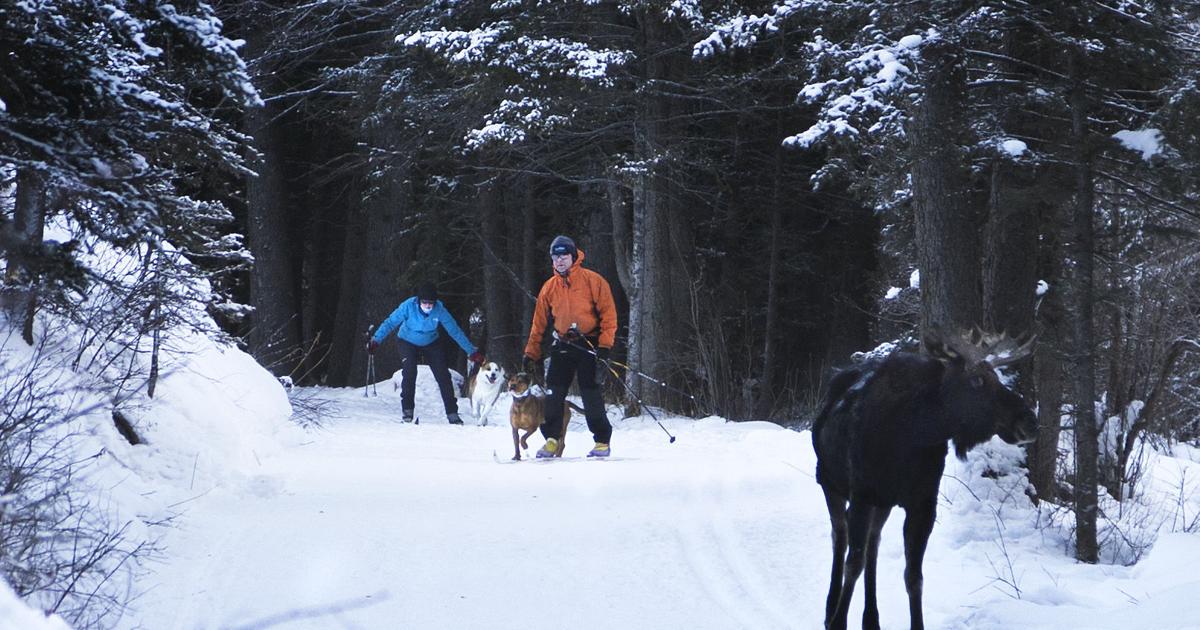
In Teton County, human-wildlife coexistence is a touchy subject.
A study of the impacts of recreation on wildlife in the Cache Creek area has led to chatter and controversy amongst wildlife and land managers.
The paper, called “Neighbors of nature: A case study of recreation-wildlife coexistence in the Greater Yellowstone Ecosystem,” published in Conservation Science and Practice, used trail cameras in the Cache-Game area to study how humans and wildlife use the popular trail system. Researchers found that wildlife still use the area — and with little regard for intensity of human use.
As land and wildlife managers in Jackson and across the West continue to grapple with how to protect wildlife amid increasing recreational pressure, the high-level findings of the study presented a beacon of hope to conservation-minded recreators. Several news outlets covered the study’s findings and a recent op-ed in the News&Guide cited the study in support of a pathway along the Moose-Wilson Road.
But the study has very specific applications, according to its authors. Researchers did not compare wildlife’s present use of the area to a baseline in the area before recreation increased to today’s levels. And though wildlife in the area are evidently already habituated to humans, which allows them to persist in the area, that could have negative consequences. Habituation happens when animals are repeatedly exposed to humans and lose their natural fear.
“What we’re hearing is some people are taking the headline that recreation and wildlife can co-exist and saying anything goes for recreation development,” said Linda Merigliano, a co-author of the paper and recently retired long-time recreation planner on the Bridger-Teton National Forest, which manages the Cache-Game area.“That is not what the study says.”
The study raises questions about what human-wildlife coexistence is and how it can be measured. It comes on the heels of other studies of the impact of human recreation on wildlife on the forest.
A study published in March 2026 found that animals in high-use areas of the Bridger-Teton, including areas near town and the Phillip’s Ridge area, are 22% less likely to flee after hearing human sounds — talking or mountain bikes, for example — than those in low-use areas of the forest. Researchers titled the paper, published in Biological Conservation, “The landscape of no worries? Increased recreation decreases the landscape of human fear in wildlife.”
The title was “tongue in cheek,” said Kathy Zeller, an ecologist at The Wilderness Society and co-author of the paper.
“Recreation still does have an effect upon wildlife there, even though they’re more habituated to it than wildlife in more backcountry areas,” Zeller said. “They’re still showing those negative anti-predator behaviors, they’re still fleeing, although to a lesser degree.”

A biker rides Jackson’s Putt Putt trail in June 2018.
RYAN DORGAN / NEWS&GUIDE FILE
Both studies included researchers from the Bridger-Teton, and both were conducted in anticipation of the ongoing forest plan revision.
The Cache-Game study was a collaboration between the forest, The Nature Conservancy, the Jackson Hole Wildlife Foundation and Friends of Pathways.
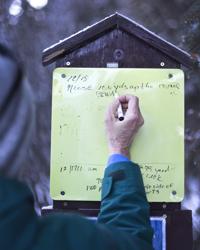
A volunteer ambassador writes “Moose 100 yards up the road, BEWARE” on a dry-erase board at the Cache Creek trailhead.
RUGILE KALADYTE / NEWS&GUIDE FILE
Those researchers used 1.89 million images taken by 27 trail cameras over 2.5 years in a 36 square mile area near Jackson on low, medium and high use trails in the Cache-Game and Snow King areas. Civilian scientists helped identify species identified in the camera traps. Researchers then analyzed how hiking (which included any kind of foot traffic such as running, skiing, cross-country skiing) and cycling impacted different species and how the volume of traffic impacted wildlife.
Researchers did not study encounters between humans and wildlife, but rather how average weekly human use on the trails influenced wildlife use of the same area. They found that human use did not affect habitat use by deer, black bears and mountain lions. Elk were negatively impacted by human use and moose appeared to frequent the same areas as humans — but at times of day where they can avoid human presence, like early morning and late evening.
The study was meant to establish a baseline to help inform future management in the study area, Courtney Larson, a conservation scientist at The Nature Conservancy and the paper’s lead author.
“I don’t think that our findings should be extrapolated across the whole region,” she said. “It’s a good case study of what’s happening within this pocket of high use area, but I don’t think we can talk about applying our findings to the Gros Ventre Wilderness.”
The study will help inform the forest planning process as part of the forest’s monitoring plan, Merigliano said. It could help identify indicators and monitoring metrics that can be used in the area going forward.
The study highlights the importance of recreation management, Merigliano said, in part because the forest does not have a laissez faire approach to recreation management in the Cache area. It’s likely that wildlife still exist in Cache because of winter closures and the area’s connection to other parts of the Bridger-Teton that don’t see as much human use.
“That area is actually embedded within a larger landscape of really wild country,” Merigliano said. “If the Cache-Game area was just this island surrounded by development, we wouldn’t have the critters that we have.”
There are some caveats to the comparison between low and high use areas in the study. Large mammals like moose and deer detected on low-use trails are still likely exposed to lots of people, due to the size of their home ranges. That means wildlife captured on low-use trails could be as used to people as those on high-use trails.
“Maybe they’re not exposed to a ton of use right at that spot, but they’re exposed to a lot of people in other places that they also use,” Larson said.
The study also did not track individual animals, meaning that the same animals that don’t fear humans could be showing up again and again in the animals captured on camera.
“Trail cameras are great tools, but they’re certainly not perfect,” Larson said.
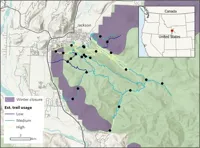
A map of trails and game camera locations made by authors of the ”Neighbors to nature” study.
”Neighbors to nature: A case study of recreation-wildlife co-existence in the Greater Yellowstone Ecosystem”
In the other study, co-authored by Zeller, researchers set up cameras and speakers on game trails at 20 sites on the forest that see different levels of recreation. The team set up motion-triggered trail speakers to play noises that mimic the sound of human recreation and record animals’ responses.
Researchers also purchased anonymized cellphone location data for the forest to see how exposed wildlife in each area were to human and vehicle traffic in the 30 days preceding the sound exposure.
Researchers found that wildlife exposed to heavy human use were 22% less likely to flee than those in areas that humans visit infrequently. Wildlife in high-use areas spent slightly more time being vigilant than those in the lowest use areas.
The study is a follow-up on an earlier study published by the team that found that, in backcountry areas, animals are generally 1.5 times less likely to inhabit places where they have heard sounds of human recreation in the last week.
“There was something about the way these animals arrange their lives when we are not present that changed when we were there,” said Jesse Barber, a sensory ecologist at the American Museum of Natural History and Boise State University.
After analyzing the data, the team built a map, using the cellphone location data, to show how likely animals are to flee on various parts of the forest. They are working on a follow-up paper to study how long it takes for wildlife to habituate to recreating humans.
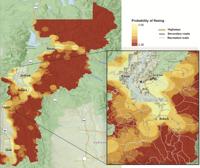
Researchers studying recreation on the Bridger-Teton National Forest found that animals in areas with heavier recreation use are less likely to flee after hearing mock human noises. With their findings, they used anonymized cellphone data to create this map of how likely animals were to flee across the forest, with red being more skittish and yellow being less.
”The landscape of no worries? Increased recreation exposure decreases the landscape of human fear in wildlife”
Many questions about habituation remain unanswered.
Researchers are unsure whether wildlife become used to human presence, or whether less tolerant individuals leave and individuals predisposed to being comfortable around humans remain.
“Are some members of the species leaving, and we’re not noticing that because they are replaced by more tolerant individuals?” said Barber, the sensory ecologist. “That’s been shown in other systems.”
There could be consequences to pushing out more fearful individuals, including removing them from the gene pool, Barber said
The alternate scenario, in which animals with different human tolerances habituate, could also have upsides and downsides.
Habituation, Barber said, is not necessarily “a big negative.” It is “potentially useful,” because it allows animals to access habitat that would otherwise be lost to them, said Mark Ditmer, a quantitative ecologist at the U.S. Forest Service’s Rocky Mountain Research Station and lead author of the sound study. That means habituation may help support a larger population of a given species.
But habituation can lead to conflict, as it does with bears and sometimes elk, Ditmer said. Habituated wildlife could less natural fear and could be more likely to be predated, Barber said.
“In general, the more wild-acting an animal is, the better it’s going to be able to handle real-world threats,” Ditmer said.
Even if wildlife persist in a place, they could still be experiencing a spike in stress hormones in response to seeing humans, Larson said. With hundreds of people going by every day, chronic stress could lead to invisible, negative health impacts.
The potential consequences of habituation beg the question of what “coexistence” is and whether it means something more than “co-occurence.” The Bridger-Teton defines the former term as the ability for wildlife to live and humans to recreate in the same place.
“I think we hemmed and hawed a little bit about putting that word in the title of our paper, because we didn’t want it to be misinterpreted,” Larson said. “I’m not sure if it was a good decision.”
The studies also raise a philosophical question of what it means for wildlife to be “unimpaired,” Barber said.
“An unimpaired ecological system is a place where animals can perform behaviors the way they would in a natural system,” he said. “That doesn’t mean no people. But it probably doesn’t mean a mountain biking system right outside of Jackson.”
Researchers from both studies found that keeping recreation concentrated in dense areas would benefit wildlife.
“I think our study really speaks to the value of having these dense pockets that are designated for recreation, which have a lot of wildlife value, but then also keeping some areas free of recreation that are really meant for wildlife,” Larson said.