
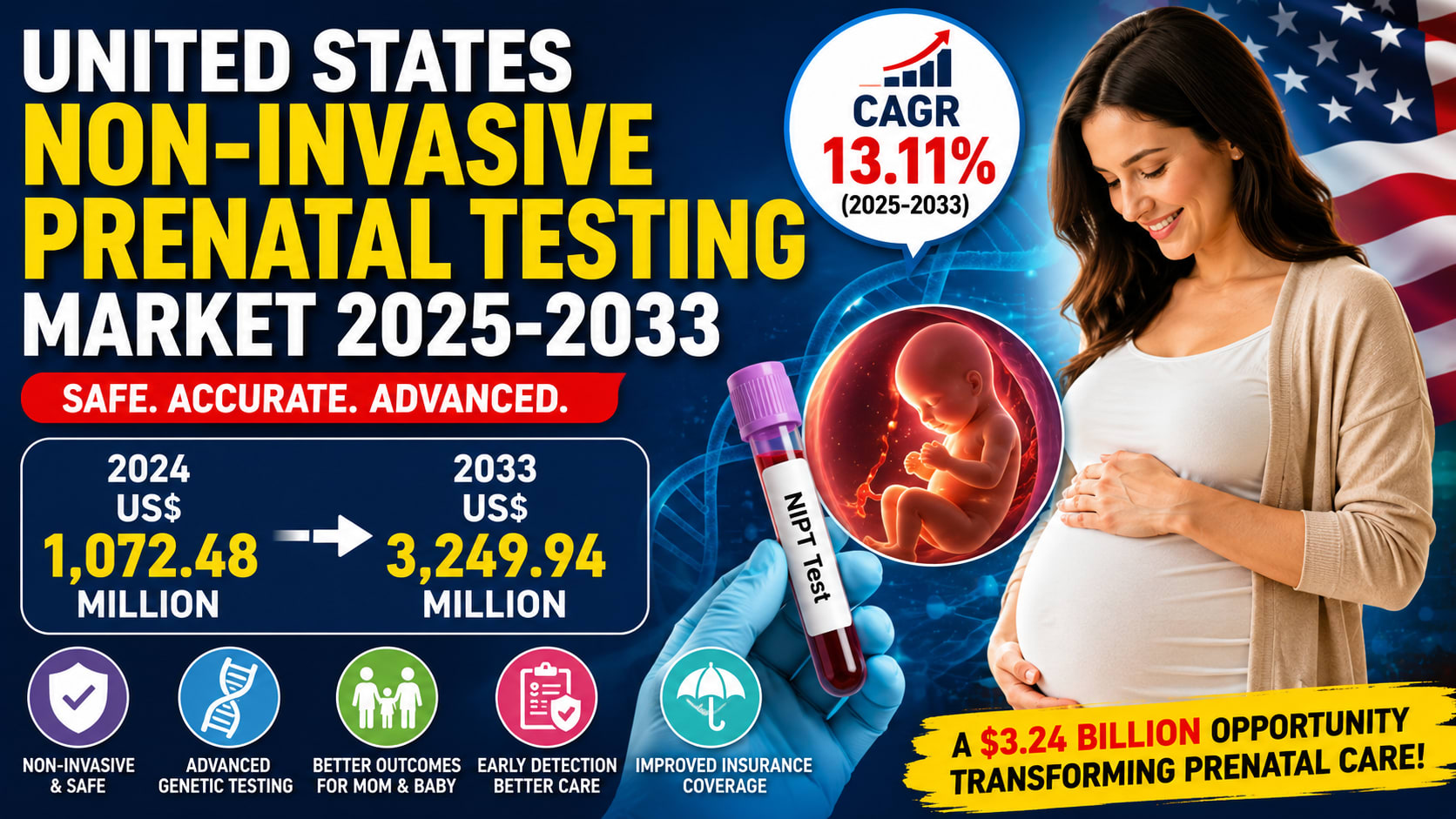
The United States Non-Invasive Prenatal Testing (NIPT) Market is witnessing remarkable growth as healthcare providers and expectant parents increasingly prefer safer and more accurate prenatal screening solutions. According to recent findings from Renub Research, the market is projected to grow from US$ 1,072.48 million in 2024 to an impressive US$ 3,249.94 million by 2033, expanding at a CAGR of 13.11% during the forecast period from 2025 to 2033.
Non-Invasive Prenatal Testing Gains Strong Momentum in Modern Healthcare
Prenatal testing has evolved significantly over the last decade. Traditional diagnostic methods such as amniocentesis and chorionic villus sampling (CVS) have long been used to detect chromosomal disorders in unborn babies. However, these invasive procedures carry a small but notable risk of miscarriage, making many parents hesitant.
Non-invasive prenatal testing has emerged as a safer alternative. By analyzing cell-free fetal DNA circulating in the mother’s bloodstream, NIPT enables healthcare professionals to screen for genetic abnormalities with high accuracy and without risking fetal health.
This technology has transformed prenatal screening practices in the United States. Today, NIPT is widely accepted by both healthcare providers and patients because of its convenience, safety, and early detection capabilities.
Rising Cases of Genetic Disorders Fuel Market Expansion
One of the major drivers supporting market growth is the increasing prevalence of chromosomal abnormalities, particularly Down syndrome.
According to health data highlighted in the report, approximately 6,000 babies are born with Down syndrome in the United States every year, representing nearly 1 in every 700 births. As awareness regarding early diagnosis continues to improve, more expectant parents are opting for prenatal screening tests to better understand potential genetic risks.
NIPT has become especially valuable because it can identify conditions such as:
Down Syndrome (Trisomy 21)
Edwards Syndrome (Trisomy 18)
Patau Syndrome (Trisomy 13)
Turner Syndrome
Other chromosomal abnormalities
The growing demand for early and reliable prenatal screening is expected to continue supporting long-term market expansion.
Technological Innovations Are Revolutionizing Prenatal Screening
The rapid advancement of genetic sequencing technologies has dramatically improved the effectiveness of NIPT procedures.
Modern next-generation sequencing (NGS) technologies allow laboratories to analyze fetal DNA with exceptional precision. This has enhanced the reliability of prenatal screening while expanding the scope of detectable genetic disorders.
Initially, NIPT was mainly used to identify common chromosomal abnormalities. Today, technological innovation enables the detection of:
Microdeletions
Single-gene disorders
Rare genetic syndromes
Expanded chromosomal conditions
These developments are improving diagnostic confidence among healthcare providers and encouraging broader adoption across hospitals and diagnostic laboratories.
Additionally, faster laboratory processing and improved automation are helping reduce turnaround times, making NIPT services more accessible and efficient for patients nationwide.
Improved Insurance Coverage Expands Accessibility
Another important factor driving market growth is the steady expansion of reimbursement policies and insurance coverage.
Historically, NIPT testing was considered expensive and primarily recommended for high-risk pregnancies. However, insurance providers and public healthcare programs are increasingly recognizing the long-term benefits of early prenatal screening.
Today, many commercial insurance providers and Medicaid programs offer partial or complete coverage for NIPT procedures. This has significantly reduced out-of-pocket expenses for patients and expanded accessibility to a broader population.
The growing affordability of testing is expected to encourage higher adoption rates among women across all age groups and pregnancy risk categories.
Professional Medical Recommendations Strengthen Adoption
Professional healthcare organizations are also playing a critical role in boosting the acceptance of NIPT.
The American College of Obstetricians and Gynecologists (ACOG) now recommends non-invasive prenatal testing as a first-line screening option for all pregnant women, regardless of age or risk factors.
This represents a major shift in prenatal healthcare practices. Previously, NIPT was largely reserved for women considered at higher risk due to advanced maternal age or family history of genetic disorders.
As awareness continues to spread among obstetricians, gynecologists, and prenatal care specialists, NIPT is increasingly becoming part of routine prenatal screening programs across the United States.
Hospitals and Diagnostic Laboratories Remain Key End Users
Hospitals and diagnostic laboratories continue to dominate the market landscape as the primary end users of NIPT services.
Hospitals are integrating advanced prenatal screening technologies into maternal healthcare programs to improve patient outcomes and reduce risks associated with invasive testing methods.
Meanwhile, diagnostic laboratories are investing heavily in automation, molecular diagnostics, and genomic testing infrastructure to meet rising demand for high-volume prenatal screening services.
The growing collaboration between hospitals, genetic counselors, and diagnostic service providers is expected to create new opportunities for market growth over the coming years.
Ethical Concerns Continue to Challenge Market Growth
Despite strong market potential, the industry still faces several ethical and regulatory concerns.
One of the most debated issues surrounding NIPT involves the possibility of selective pregnancy termination following the detection of genetic abnormalities. Ethical discussions related to disability rights, eugenics, and reproductive decision-making continue to influence public opinion and policy debates.
In addition, interpreting genetic information can be emotionally challenging for expectant parents. Counseling and emotional support remain critical components of prenatal testing programs.
Healthcare professionals are increasingly emphasizing the importance of genetic counseling to help patients make informed and responsible decisions.
Regulatory Oversight Remains a Major Industry Concern
Another challenge affecting the market is the limited regulatory oversight of laboratory-developed tests.
Many NIPT products currently operate without direct FDA approval because they are classified as laboratory-developed tests. While most NIPT platforms demonstrate high levels of accuracy, concerns regarding false positives and false negatives still exist.
Incorrect results may lead to unnecessary anxiety or inappropriate medical decisions. As the market continues to expand, experts are calling for stronger quality standards and more comprehensive regulatory frameworks to improve consistency and reliability across the industry.
Competitive Landscape Intensifies Among Major Companies
The United States NIPT market is becoming increasingly competitive as leading biotechnology and diagnostics companies focus on innovation, partnerships, and geographic expansion.
Major players operating in the market include:
Eurofins Scientific
F. Hoffmann-La Roche Ltd
Invitae Corporation
Illumina Inc.
Natera Inc.
Centogene NV
Qiagen
These companies are heavily investing in research and development to improve testing accuracy, reduce costs, and expand their genetic testing portfolios.
10 Recent Developments by Leading Companies
1. Natera Introduced Advanced cfDNA-Based Fetal RhD Test
In May 2024, Natera launched a new cfDNA-based fetal RhD blood test to help address shortages of Rho(D) immune globulin treatment in the United States.
2. Illumina Expanded Genomic Sequencing Capabilities
Illumina continued enhancing its next-generation sequencing platforms to support broader prenatal genetic screening applications.
3. Roche Increased Focus on Molecular Diagnostics
Roche strengthened its prenatal diagnostics portfolio through expanded investments in molecular testing technologies.
4. Qiagen Improved Prenatal Testing Workflow Solutions
Qiagen introduced workflow optimization tools designed to improve efficiency in genetic testing laboratories.
5. Eurofins Expanded Prenatal Diagnostic Services
Eurofins Scientific broadened its prenatal screening service offerings across multiple healthcare networks.
6. Invitae Accelerated Digital Genetic Counseling Integration
Invitae expanded virtual genetic counseling support to improve patient accessibility and education.
7. Centogene Enhanced Rare Disease Detection Programs
Centogene invested in rare disease research initiatives connected to prenatal genetic diagnostics.
8. NIPT Providers Increased AI Integration
Several market participants integrated artificial intelligence into data interpretation to improve test accuracy and reporting speed.
9. Diagnostic Laboratories Expanded Automation Infrastructure
Leading laboratories upgraded automated genomic testing systems to handle growing prenatal screening demand.
10. Healthcare Partnerships Continued to Rise
Biotechnology firms and hospital networks formed new partnerships to improve nationwide access to prenatal genetic testing services.
Future Outlook of the United States NIPT Market
The future of the United States Non-Invasive Prenatal Testing market appears highly promising as healthcare systems continue shifting toward preventive and precision-based medicine.
Several long-term trends are expected to shape industry growth:
Rising maternal age across the United States
Growing awareness of prenatal genetic disorders
Expansion of personalized medicine
Technological advancements in sequencing technologies
Increased healthcare spending
Wider insurance reimbursement policies
As testing technologies become more affordable and accurate, NIPT is likely to become a standard component of prenatal care across both high-risk and average-risk pregnancies.
The integration of artificial intelligence, bioinformatics, and precision genomics may further revolutionize prenatal diagnostics in the coming years.
Final Thoughts
The United States Non-Invasive Prenatal Testing Market is entering a transformative growth phase driven by technological innovation, rising awareness, and increasing demand for safer prenatal screening methods.
With the market projected to exceed US$ 3.24 billion by 2033, NIPT is rapidly becoming an essential part of modern maternal healthcare. Improved reimbursement policies, advanced sequencing technologies, and growing clinical acceptance are creating strong momentum for the industry.
Although ethical and regulatory concerns remain important considerations, ongoing innovation and healthcare collaboration are expected to strengthen the market’s long-term outlook.
As prenatal care continues evolving toward more personalized and preventive approaches, non-invasive prenatal testing is poised to play a vital role in shaping the future of maternal and fetal healthcare in the United States.