
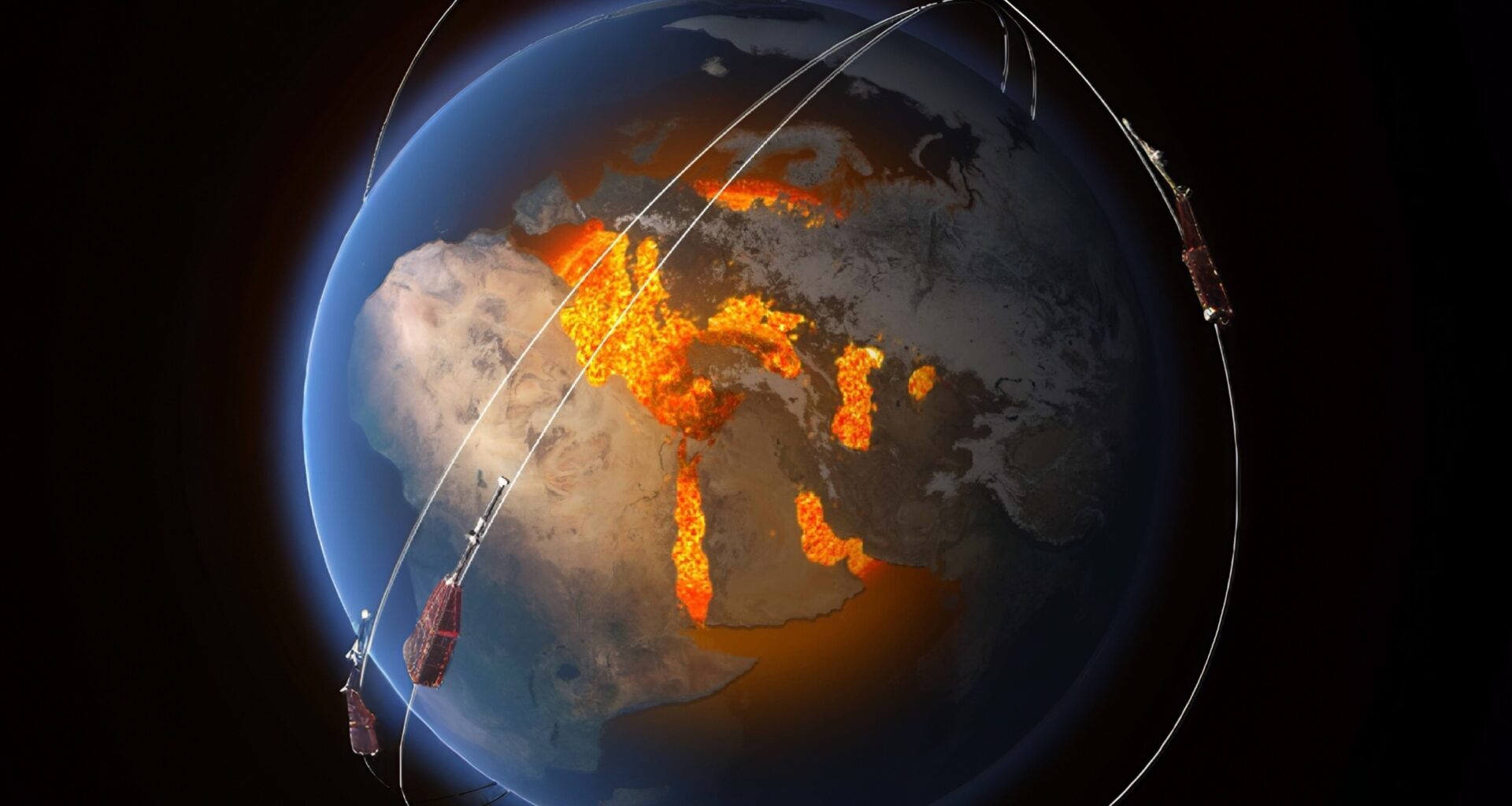
Deep below the Pacific Ocean, something strange happened inside Earth.
A massive flow of liquid iron that had been moving one way for years suddenly reversed direction in 2010. Scientists did not expect it.

Even more surprising, experts only discovered the full scale of the shift thanks to satellites orbiting hundreds of miles above Earth.
The role of Earth’s magnetic field
The finding gives researchers a new look at one of the least understood parts of the planet: the swirling outer core that generates Earth’s magnetic field.
The magnetic field matters more than most people realize. It shields Earth from harmful charged particles coming from the Sun.
Without it, satellites, power systems, spacecraft, and even parts of the atmosphere would face far more damage from solar radiation.
Now, researchers are seeing signs that the deep interior of Earth may be more active and unpredictable than previously thought.
A sudden change beneath the Pacific
The outer core sits roughly 1,370 miles beneath Earth’s surface. It is made mostly of molten iron and nickel. As this superheated metal moves, it creates the geomagnetic field surrounding the planet.
For decades, scientists believed large-scale flows in the outer core drifted steadily westward. Then things changed.
A new study found that a broad region of iron-rich fluid beneath the equatorial Pacific switched from moving weakly westward to strongly eastward in 2010.
Researchers analyzed data collected between 1997 and 2025 from both satellites and ground observations.
The study was led by Frederik Dahl Madsen of the University of Edinburgh’s School of Geosciences.
His team used measurements from the European Space Agency’s Swarm and CryoSat missions, along with data from Germany’s CHAMP mission and Denmark’s Ørsted mission.
Activity in Earth’s deep interior
The shift was dramatic enough to challenge long-standing assumptions about how Earth’s core behaves.
“The large-scale flow reversal beneath the Pacific raises new questions about the behavior of Earth’s deep interior,” said Madsen.
“Scientists now want to understand whether the reversal represents a short-lived fluctuation, part of a repeating oscillation, or a new stable equilibrium for core circulation.”
Madsen noted that continued monitoring will be essential to determine how the flow evolves over the coming years.
Satellites helped uncover the mystery
Earth’s core cannot be observed directly. The temperatures there are believed to rival the surface of the Sun, and the pressure is crushing.
Scientists instead study subtle changes in Earth’s magnetic field to figure out what is happening below. That is where satellites became critical.
The European Space Agency launched the three Swarm satellites in 2013. Each carries extremely sensitive magnetometers that can measure tiny variations in the magnetic field with remarkable precision.
The satellites fly in coordinated formations around Earth, allowing researchers to separate magnetic signals from the core from interference caused by the crust, oceans, atmosphere, and space weather.
Sudden change in the magnetic field
The satellite data revealed rapidly changing flow structures and wave-like accelerations hidden inside older datasets.
Scientists also connected the Pacific reversal with a geomagnetic event known as the 2017 geomagnetic jerk, a sudden change in Earth’s magnetic field behavior.
“Although Swarm was launched after the dramatic reversal event of 2010, it has provided high-precision data that tell us about Earth’s inner core in the period that followed,” said Anja Stromme, the project’s mission manager.
“Importantly, Swarm provides continuous global coverage over many years, allowing scientists to track how core dynamics evolve over time rather than relying only on ground-based magnetic observatories.”
Stromme noted that long-duration satellite magnetic measurements allow researchers to follow changes in the geodynamo in near-realtime and improve models of Earth’s magnetic field evolution.
“Future observations from missions such as Swarm will play a crucial role.”
Deeper changes inside Earth
The reversal may not have happened in isolation.
“The rise of the strong eastward flow in the Pacific is contemporary with a change in behavior in the inner core, as inferred from geodesy and seismology, and we hypothesize that these changes in the deep interior are associated with the changes in flow beneath the Pacific,” explained Madsen.
Scientists still do not know whether the reversal marks a temporary wobble or part of a longer natural cycle.
The latest data suggest the eastward flow has weakened since 2020 after reaching a peak several years earlier.
That raises the possibility that the event may eventually reverse again.
Broader implications of the study
These movements deep underground are not dangerous to people directly. Nobody will feel them. They are not linked to earthquakes or climate change.
But changes in Earth’s magnetic field can affect modern technology.
Airline navigation systems, satellite communications, spacecraft operations, and models used to predict space weather all rely on accurate magnetic field data.
Even small changes matter because the magnetic field is constantly shifting over time.
ESA Swarm Mission Scientist Elisabetta Iorfida said the study shows that regional changes can emerge rapidly within just a decade.
“The findings may also help scientists investigate possible interactions between Earth’s outer core, inner core, lower mantle and, therefore, give more insights into core-mantle boundary, which is a critical region for the deep Earth dynamics.”
The research is published in the Journal of Studies of Earth’s Deep Interior.
Image Credit: ESA/ATG Medialab
—–
Like what you read? Subscribe to our newsletter for engaging articles, exclusive content, and the latest updates.
Check us out on EarthSnap, a free app brought to you by Eric Ralls and Earth.com.
—–